
Scientists from Tyumen State University have developed a model for calculating the main parameters of geothermal wells (pressure, velocity, and steam dryness), and discovered an anomalous 2.2-fold increase in the velocity of steam and water in geothermal wells (despite friction with the well walls). These findings help evaluate the effectiveness of new geothermal well construction and operation without expensive experiments, holding significant importance for the future transition to clean energy on the Kamchatka Peninsula.
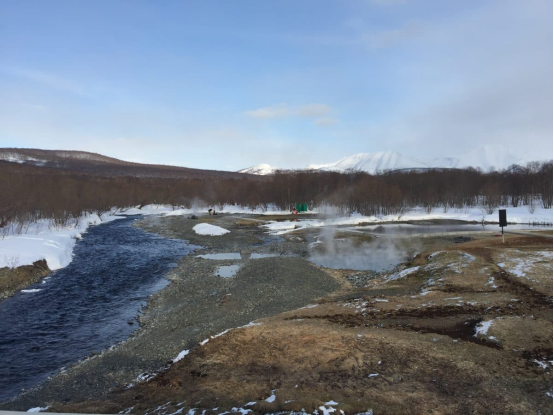
Geothermal energy has broad prospects in the Kamchatka Territory, where the potential can support geothermal power plants providing heat and electricity to the local area. However, developing new geothermal fields carries risks; verifying whether a well is suitable for exploitation requires experimental studies or simulation of the extraction process.
Associate Professor Alexander Gilmanov from the Faculty of Natural Sciences at Tyumen State University stated that in creating physical and mathematical models of heat and mass transfer for gas-liquid mixtures in geothermal wells, these processes were described for the first time using a steady-state approximation. The researchers noted that the multiphase mechanics approach can predict key parameters of the steam-water mixture, such as steam concentration, flow velocity, and pressure.
Calculations show that the decrease in steam concentration due to heat loss competes with the increase in steam concentration caused by pressure drop as it flows toward the wellhead, resulting in an 8% increase in steam dryness above 350 meters. Physicists attribute this to relatively low heat loss values. Despite the "dispersive" force generated by fluid friction with the well walls, the upward velocity of the steam-water mixture from the geothermal well bottom still increases by 220%. Scientists explain this effect as resulting from the increase in steam concentration and decrease in density of the mixture.
It is reported that this work was carried out under the Priority 2030 development plan.