
In the framework of classical physics, the motion of objects is predictable, with speeds unable to exceed the speed of light, and information propagation similarly constrained. However, since the 1930s, scientists have discovered that microscopic particles follow entirely different rules, among which the phenomenon of quantum entanglement is particularly noteworthy, described by Albert Einstein as "spooky action at a distance." In quantum entanglement, the properties of two particles are closely linked, with measurement outcomes always opposite, and this correlation unaffected by distance, exhibiting "nonlocality" that transcends classical mechanics.
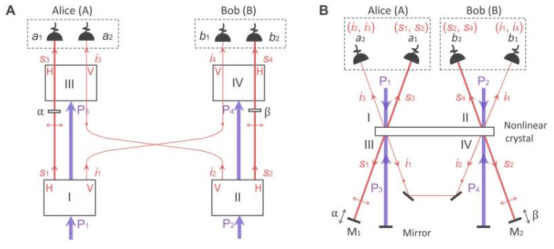
Traditional views hold that nonlocality arises only from entangled particles. But a recent study published in Science Advances used Bell's inequality to explore whether non-entangled quantum properties could also trigger nonlocal quantum correlations. The experiment generated photons by laser impacting a specific crystal, ensuring the photons did not entangle before detection. The study employed Bell's inequality to test whether the experiment violated local realism.
Computational results showed that the experiment violated Bell's inequality, exceeding the threshold by more than four standard deviations—the first observation of this phenomenon using non-entangled photons. The researchers noted that this violation stems from the quantum indistinguishability of "path identity," rather than entanglement. The study authors stated: "Our work establishes a connection between quantum correlations and quantum indistinguishability, providing insights into the fundamental origins of the counterintuitive features observed in quantum physics."
Although this study is groundbreaking, potential issues remain, such as post-selection in the experiment possibly leading to misleading results, and locality loopholes due to improper separation of detector phase settings. However, the authors have acknowledged these limitations and anticipate resolving them through improved quantum photonic devices and experimental hardware to further explore the mysteries of quantum mechanics. They stated: "We not only expect to identify and close loopholes but also anticipate sparking more interesting experiments to advance the development of quantum mechanics."