
Late last year, NASA's Parker Solar Probe successfully flew past the Sun, capturing unprecedented new images from within the solar atmosphere. These images were taken closer to the Sun than ever before, providing scientists with valuable data to better understand the Sun's influence on the entire solar system, particularly space weather events that can affect Earth.
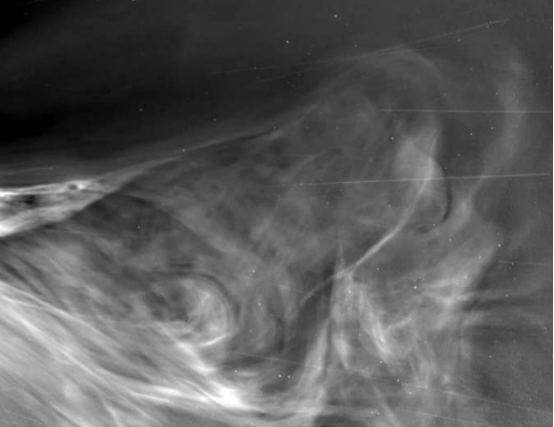
On December 24, 2024, the Parker Solar Probe flew to within just 3.8 million miles of the Sun's surface, collecting data with its scientific instruments, including the Wide-field Imager for Solar Probe (WISPR). The newly released WISPR images reveal details of the corona and solar wind—a continuous stream of charged particles that sweeps through the solar system and impacts Earth's communications, power grids, and more. The images show important boundaries where the Sun's magnetic field reverses direction and, for the first time, capture high-resolution collisions of multiple coronal mass ejections (CMEs)—a key driver of space weather.
Angel Vourlidas, WISPR instrument scientist at Johns Hopkins Applied Physics Laboratory, said: "In these images, we see coronal mass ejections overlapping each other, which is critical for space weather research." The probe's close-up observations help scientists predict changes in CME trajectories and their potential hazards to astronauts, satellites, and ground-based technology. Parker also helped scientists pinpoint the origin of the "switchback" phenomenon in magnetic funnels on the Sun's visible surface and confirmed the existence of both slow and fast solar wind, revealing they may have different origins. Scientists believe slow wind may originate from helmet streamers, while fast (Alfvénic) wind may come from near coronal holes.
Parker Solar Probe project scientist Nour Raouafi emphasized: "Understanding the solar wind, especially the slow solar wind, is a major challenge." As the probe continues its spiral closer to the Sun, it will collect more data during upcoming corona crossings to help confirm the origin of the slow wind. The next crossing is scheduled for September 15, 2025. NASA mission scientist Adam Szabo said: "We haven't reached a final consensus yet, but there is a lot of new and interesting data."