
Astronomers from Seoul National University in Korea and other institutions have reported the discovery of 62 new luminous quasars as part of the "All-Sky Bright Quasar Survey" (AllBRICQS) project. A research paper detailing this discovery was published on August 8 on the arXiv preprint server.
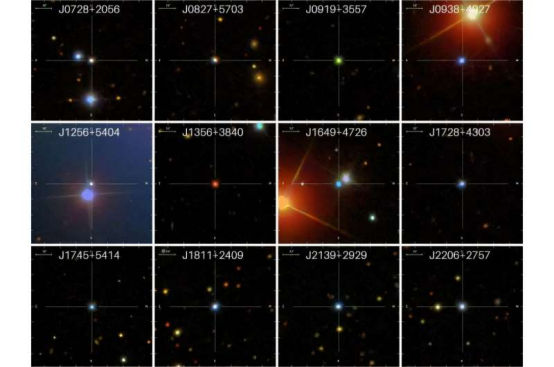
Quasars, also known as quasi-stellar objects (QSOs), are active galactic nuclei (AGN) located at the centers of active galaxies, powered by supermassive black holes (SMBHs). They possess extremely high luminosity (exceeding tens of quadrillions of ergs per second) and emit electromagnetic radiation observable across radio, infrared, visible, ultraviolet, and X-ray wavelengths.
The AllBRICQS survey aims to identify previously undiscovered optically bright quasars. It utilizes catalog data from the Wide-field Infrared Survey Explorer (WISE) along with precise parallax and proper motion measurements from Gaia Data Release 3 (DR3), enabling more effective identification of quasar candidates than previous methods.
To date, the AllBRICQS project has confirmed 156 spectroscopically verified quasars, and now a team of astronomers led by Yoon Ye-ji from Seoul National University has announced the discovery of additional new quasars.
The researchers wrote in the paper: "Here, we report 62 new AllBRICQS quasars covering various types, including typical broad emission-line quasars and the brightest known iron low-ionization broad absorption line quasar discovered to date."
First, Professor Choi's team identified 75 quasar candidates in the northern sky. Subsequently, they used three ground-based telescopes in Korea and China for spectroscopic observations, confirming the quasar status of 62 of these sources.
The newly discovered quasars have redshifts ranging from 0.09 to 2.48, with radiative luminosities in the range of 1 to 1000 quadrillion ergs per second. Therefore, compared to the general quasar population, most of the quasars reported in this paper are relatively bright.
One of the quasars detected in the new study, named J0919+3557, was previously classified as a galaxy at redshift 0.18 based on recent observations. However, Choi's team refined its redshift to 2.36 and reclassified it as a weak-line quasar—a subclass of quasars characterized by unusually faint high-ionization lines.
The astronomers emphasized that among their discoveries are some rare and noteworthy objects, including an iron low-ionization broad absorption line quasar (FeLoBAL). This new FeLoBAL, designated J1356+3840, is the brightest known quasar of its type to date.
Summarizing the research findings, the paper's authors noted that their new quasar sample will serve as a valuable resource for studying quasar physics, black hole growth, feedback processes, and host galaxy properties.
The scientists concluded: "These confirmed AllBRICQS quasars provide valuable resources for future studies of quasar evolution, black holes, their environments, and host galaxies across multiple wavelengths."