
Recently, the U.S. commercial fusion startup Realta Fusion announced that researchers from its computational physics team have achieved a major breakthrough: developing a pioneering software toolkit that not only predicts high energy gain but also lays the foundation for solving plasma instability issues that have long plagued magnetic mirror technology. The related research results have been published as papers in the Journal of Plasma Physics, further solidifying the scientific basis for the magnetic mirror approach to achieving commercial fusion energy.
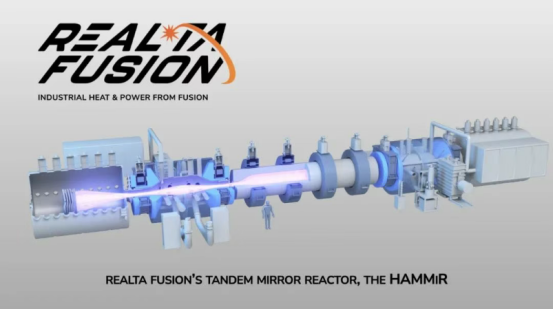
The first paper, authored by Dr. Sam Frank, leader of Realta Fusion's computational physics team, uses this toolkit to confirm that a tandem magnetic mirror system with a 50-meter-long center cell can achieve an energy gain of Q>5, demonstrating commercial viability. The model also shows that further lengthening the center cell can significantly increase the energy gain to Q>10 or even higher.
In terms of power density and theoretical energy gain, the plasma confinement performance simulated by Realta Fusion is comparable to traditional magnetic confinement schemes such as tokamaks and stellarators. This also validates the long-held view of many top plasma physicists worldwide: the magnetic mirror may be the fusion technology path closest to commercial application.
"Our model proves that the CoSMo fusion™ energy system based on tandem magnetic mirrors is far from fantasy," said Sam Frank.
Realta Fusion's VP of R&D, Derek Sutherland, added: "Achieving the high-gain operation required for a power plant demands sufficient plasma confinement capability. The model shows that axisymmetric tandem magnetic mirrors are fully feasible at the physical level."
The second paper was jointly completed by a team led by Aaron Tran from Realta Fusion's collaborator, the University of Wisconsin-Madison (UW-Madison). The study indicates that the toolkit can also identify and control specific plasma instabilities—these instabilities have previously raised doubts about the effectiveness of the magnetic mirror concept.
This instability, known as the Drift-Cyclotron Loss-Cone (DCLC) instability, has long been difficult to model. However, Realta Fusion's new toolkit achieves effective modeling and simulation of it for the first time, providing the possibility to design reliable engineering solutions to mitigate this issue.
"In the past, there were no such tools, so we developed them ourselves," said Sam Frank. "This helps us gain a deeper understanding of specific issues like plasma instabilities. We must identify the patterns of these instabilities to track and prevent them from occurring. We cannot expect them to disappear on their own just because we fear or ignore them."
In 2023, Realta Fusion was selected for the U.S. Department of Energy (DOE) flagship project, the "Milestone-Based Fusion Development Program," becoming one of eight companies to receive federal funding support (the U.S. announced a $100 million investment to support commercial fusion energy development, marking important progress in the "Milestone Program").
This milestone achievement is the result of months of effort by Realta Fusion and UW-Madison, laying the foundation for another paper—this paper will detail the complete conceptual design pre-scheme for the former's commercial-grade experimental device "Hammir," expected to be published in 2026.
"This work marks significant progress in the pre-conceptual design phase of our fusion pilot plant," said Derek Sutherland. "We are currently using this as a basis to optimize simulation design parameters, striving for even higher energy gains. The computational tools we have developed are being validated with experimental data, giving us confidence to apply them to the design of next-stage devices. These tools are always grounded in reality, as they should be."