
Quantum distance is a measure of quantum mechanical similarity between two quantum states. A quantum distance of 1 indicates identical states, while 0 indicates completely opposite states. Physicists introduced this concept in theoretical science long ago, but its importance in physics has only gained increasing recognition recently.
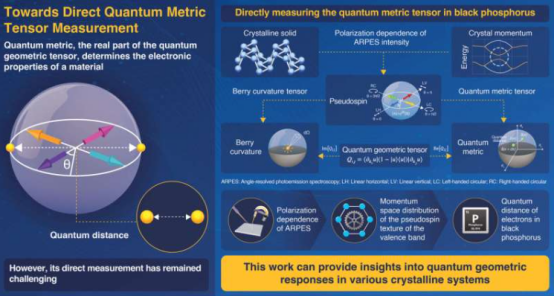
In recent years, many experimental physicists have attempted to measure the quantum distance of electrons in real solid materials, but direct measurement of quantum distance and the quantum metric tensor—a key geometric quantity in modern physics defined by distances between nearby quantum states—has remained elusive.
Given that the quantum metric tensor is highly relevant to explaining and understanding fundamental physical phenomena in solids, proposing an effective method for its direct measurement in solid-state systems is crucial.
Recently, a breakthrough has been made in theoretical and experimental quantum physics. An international research team from Korea and the US, led by Professor Keun Su Kim, Director of the Band Structure Engineering Center in the Department of Physics at Yonsei University and Underwood Distinguished Professor, has reported the first experimental measurement of quantum distance. Their findings were published online in the journal Science on June 5, 2025.
The study was closely collaborated between the experimental group led by Professor Kim at Yonsei University (with Yoonah Chung and Soobin Park) and the theoretical group led by Professor Bohm-Jung Yang at Seoul National University (with Sunje Kim and Yuting Qian).
Professor Kim explained: "The theoretical group discovered that black phosphorus, an elemental layered crystal with a simple structure, is an ideal material for studying electronic quantum distance. Based on this, the experimental group used the momentum-space distribution of valence band pseudo-spin texture, combined with angle-resolved photoemission spectroscopy and synchrotron radiation from the Advanced Light Source in the US, to measure the quantum distance of electrons in black phosphorus from a polarization-dependent perspective."
In this way, the researchers successfully measured the full quantum metric tensor of Bloch electrons in black phosphorus for the first time.
"Measuring quantum distance is crucial not only for understanding anomalous quantum phenomena in solids (including special solids like superconductors) but also for advancing quantum science and technology. For example, precise measurement of quantum distance will aid in developing fault-tolerant quantum computing technologies," Professor Kim explained.
Quantum distance is essential for understanding materials at the quantum mechanical level and serves as a cornerstone for fully comprehending complex quantum phenomena in solids. Such research will lead to the development of more advanced semiconductor technologies, superconductors with higher transition temperatures, and quantum computers surpassing traditional ones.
Overall, this work is expected to provide insights into quantum geometric responses in a wide range of crystal systems and ultimately pave the way for a future dominated by quantum technologies.