
The NASA Juno spacecraft mission team carried out a deep-space repair operation in December 2023, using remote control technology to fix the JunoCam imager and successfully restore its high-resolution imaging capability for Jupiter's moon Io. Details of this technological breakthrough were presented on July 16 at the Institute of Electrical and Electronics Engineers (IEEE) Nuclear and Space Radiation Effects Conference in Nashville, showcasing innovative practices in maintaining spacecraft equipment under extreme radiation conditions.
JunoCam, one of the core scientific instruments on Juno, has its optical unit exposed to Jupiter's intense radiation field, leading to performance degradation over long-term operation. During the mission's early phase, the camera reliably transmitted images during the first 34 perijove passes, but signs of radiation damage appeared by the 47th pass, and by the 56th pass, the images were almost completely corrupted. Facing a malfunction billions of miles away, the team analyzed the issue and inferred that it stemmed from damage to a voltage regulator. They decided to employ an "annealing" process—heating the material to 77 degrees Fahrenheit (about 24 degrees Celsius) and slowly cooling it—to repair microscopic crystal defects.
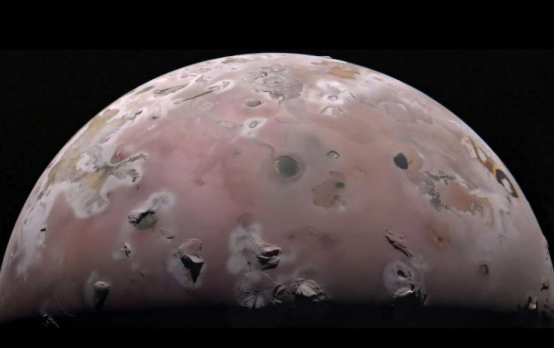
"We held our breath waiting for the results," recalled Jacob Schaffner, imaging engineer at Malin Space Science Systems. "After heating, the camera gradually regained clear imaging capability." Although image quality declined again after the initial repair as Juno entered deeper into the radiation field, the team risked raising the heating temperature to its limit during the 55th pass, ultimately capturing high-resolution images of Io's north polar region on December 30, 2023: mountains covered in sulfur dioxide frost, unknown volcanoes, and lava flow fields were clearly visible, with image quality approaching levels from the mission's early days.
Currently, Juno has completed 74 perijove passes. Although the camera showed noise again during the 74th mission, the team has extended the annealing technique to maintenance of other instruments. Principal Investigator Scott Bolton from the Southwest Research Institute in San Antonio noted: "The Juno mission has validated design principles for radiation-hardened spacecraft, and its experiences will directly apply to defense, commercial satellites, and NASA's future deep-space exploration projects."