
Since Earth's formation, micro-meteorites from space have continuously impacted and deposited on the surface. Their fossil remains, capable of preservation for billions of years, serve as important carriers for studying the ancient atmosphere. An international research team led by the University of Göttingen, in collaboration with the Open University, University of Pisa, and Leibniz University Hannover, published their findings in Communications Earth & Environment. For the first time, they successfully reconstructed the ancient atmospheric composition of different geological periods by precisely measuring the oxygen and iron isotope ratios in micro-meteorite fossils.
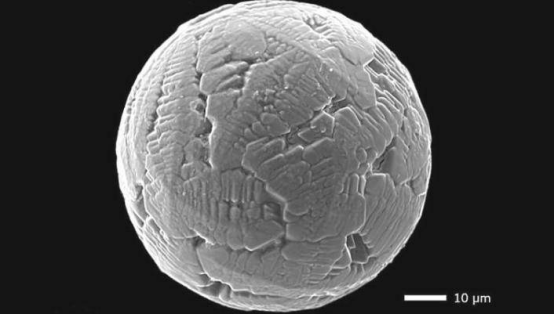
When metallic micro-meteorites enter the atmosphere, high temperatures cause them to melt and react with oxygen, forming microscopic spherical structures composed of oxide minerals. These tiny spheres carry isotopic information of oxygen from the atmosphere, becoming “chemical archives” for studying ancient climates. Using a newly developed analysis method, the research team conducted isotope testing on micro-meteorite fossils from different geological layers and found that the iron-to-oxygen isotope ratio can reflect the concentration of carbon dioxide in the early atmosphere and the global formation process of organic matter—primarily driven by plant photosynthesis. “Intact micro-meteorites can retain reliable isotopic signatures over millions of years,” emphasized lead author Fabian Zahnow, now a researcher at Ruhr University Bochum. “However, careful analysis is essential, as geochemical interactions with soil and rocks may alter their original signals.”
This breakthrough provides a new tool for paleoclimate research. Traditional methods mostly rely on ice cores or sedimentary rock records, while micro-meteorite fossils, due to their widespread distribution and long-term preservation, can supplement the temporal and spatial coverage of existing data. The research team plans to further optimize the analysis technology to more accurately trace the dynamic changes in atmospheric composition throughout Earth's history.