
American researchers have published their latest findings in the journal ACS Food Science & Technology, developing an innovative food preservation method based on room-temperature dehydration technology. This technique utilizes calcium chloride solution and a micro-vacuum environment to achieve efficient fruit dehydration without heating, providing the food processing industry with a more sustainable drying technology option.
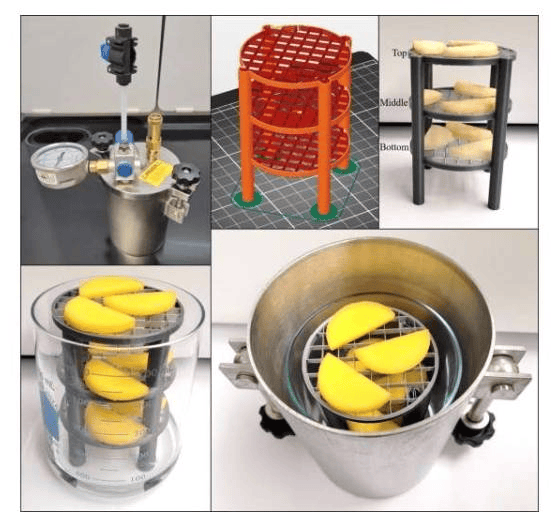
Traditional food drying methods primarily rely on hot air circulation or sun drying. The former consumes high energy, while the latter is inefficient and affects product color. Research team leader Luis Bastarrachea stated: "Our method completely avoids the heating process, significantly reducing energy consumption while preserving fruit quality." The experiments used a specially designed dehydration chamber, placing fruit slices above a container filled with calcium chloride solution, and compared the dehydration effects under atmospheric and vacuum conditions.
The results showed that the vacuum-assisted room-temperature dehydration technology performed excellently. After four days of processing, the moisture content of mango and apple slices was stably reduced to around 30%, meeting commercial drying standards, while retaining the original color of the fruit. Scanning electron microscopy analysis indicated that vacuum conditions also slowed starch decomposition, better preserving the freshness of the fruit. In contrast, dehydration under atmospheric conditions was uneven, with some samples still having a moisture content as high as 70%.
"The moisture collected in the calcium chloride solution can be removed through evaporation and reused," Bastarrachea pointed out. This method not only achieves a 95% dehydration rate but also has water resource recovery potential—the recovered water can be used in industrial applications or treated for drinking. This technology offers the food processing industry a new pathway to reduce carbon emissions.