Wedoany.com Report on Mar 4th, At the Xpeng Future VLA Media Experience Day event held in Guangzhou, Xpeng announced that its next-generation intelligent driving system, VLA 2.0, will commence global delivery in 2027. Volkswagen has signed on as the first customer for this technology in the Chinese market, marking a new stage of cross-border technological collaboration in the automotive industry's autonomous driving sector.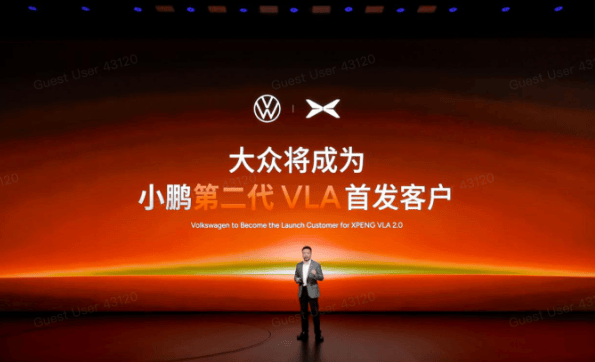
The VLA 2.0 intelligent driving system adopts an end-to-end vision-to-action architecture, designed to overcome the limitations of traditional modular autonomous driving stacks. The system removes the intermediate translation layer, allowing perception to flow directly into driving decisions, thereby improving efficiency and responsiveness in complex traffic. Early tests show that the system's driving efficiency has increased by 23%, and it outperformed traditional L2-level intelligent driving systems and some existing robotaxi models during Guangzhou's evening rush hour tests.
Driving this transformation is Xpeng's self-developed Turing AI chip, equipped with a 40-core processor specifically designed for real-time processing of large-scale AI models. The VLA 2.0 system aims to achieve a "drive anywhere" experience, including campus roads, rural dirt roads, and areas without high-definition maps. By reducing reliance on HD maps, it enhances scalability for global deployment.
Xpeng positions the VLA 2.0 foundational model as the core of its broader Entity AI strategy, with the same architecture being applied to robotaxi fleets, humanoid robots, and modular flying car systems. Robotaxis equipped with VLA 2.0 have begun public road testing, with trial operations planned to launch in China later this year. The company plans to introduce three mass-produced robotaxi models by 2026.
Company leader He Xiaopeng stated at the event, "We believe full autonomous driving will be achieved within the next one to three years, making autonomous driving a natural part of people's daily travel." The VLA 2.0 model learns from nearly 100 million driving video clips, equivalent to approximately 65,000 years of human driving experience, enabling the system to predict and respond to edge cases before they occur.
For the global market, the 2027 delivery plan represents a significant expansion of Xpeng's presence in the autonomous driving field. Xpeng will initiate international road testing to verify performance under different driving cultures and infrastructure conditions. If successful, this collaboration with Volkswagen could serve as a reference for other established automakers seeking partnerships with specialized AI companies.