German Hanover-Brunswick Region's QVLS-iLabs Secures €15 Million Phase II Funding to Advance Quantum Technology Industrialization
Wedoany.com Report on 9th, The German Federal Ministry for Research, Technology, and Aerospace (BMFTR) recently approved €15 million (approximately $17.4 million) in Phase II funding for the QVLS-iLabs "Future Cluster." This funding will support the transition of trapped-ion quantum computing and quantum metrology technologies from academic research to industrial applications over the next three years. Located in the Hanover-Brunswick region, this project is one of the few clusters in the German government's Clusters4Future program focused on quantum technology.
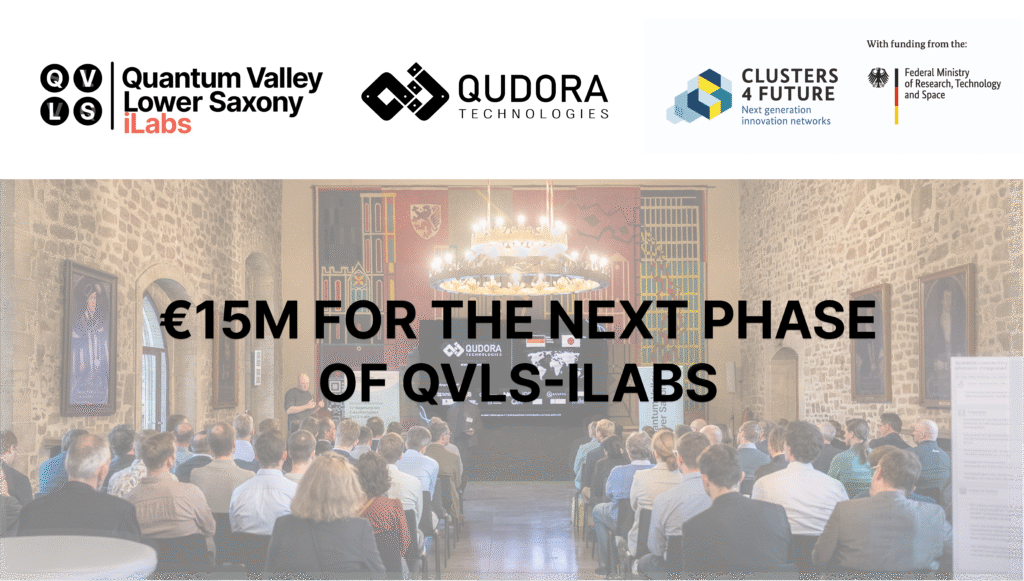
The cluster's technological roadmap centers on trapped-ion quantum computing and robust quantum components, aiming for seamless integration with existing high-performance computing (HPC) environments. In the preliminary phase, several key advancements have been made: the development of QUDORA Technologies' latest trapped-ion model, which utilizes proprietary Near-Field Quantum Control (NFQC) technology to enhance qubit coherence times and manipulation precision; the establishment of a 350-square-meter laboratory at the Rolleiwerke in Brunswick, serving as a base for startup incubation and industrial-grade system construction; and the successful execution of industrial pilot projects, including the optimization of quantum sensors for battery manufacturing and the launch of open-source software already adopted by global research teams.
Led by Professor Dr. Christian Ospelkaus (from PTB and Leibniz University Hannover), the cluster unites 25 partners from research institutions, industry, and startups. The transition to Phase II is managed by the newly founded QVLS Innovation GmbH, focusing on professional technology transfer and facility operations. As a core part of the broader "Quantum Valley Lower Saxony" (QVLS) initiative, this project aims to strengthen Germany's technological autonomy in the field of quantum hardware.
By focusing on "localized" quantum solutions, the cluster addresses the industry's demand for secure, localized quantum-classical hybrid systems. The process of moving from theoretical research to market-ready systems is expected to create advantages for German mid-sized companies and startups in the emerging quantum economy, particularly in high-precision metrology and scalable computing.
Related Products


GYTA Type Non-Self-Supporting Aerial/Duct Optical Cable
TONGDING INTERCONNECTION INFORMATION CO., LTD.



Conveyor Belt Intelligent Monitoring System
LUO YANG WIRE ROPE INSPECTION TECHNOLOGY CO., LTD.

MUX Series Communication Interface Device for Security and Stability Control System
Nanjing NR Electric Co., Ltd.