SpaceX-Amazon Strategic Agreement Drives Fragmentation of U.S. Satellite Internet Architecture
en.Wedoany.com Reported - The U.S. satellite internet market underwent a significant transformation on April 20, 2026, driven by a strategic agreement between SpaceX and Amazon. SpaceX expanded its control over spectrum through an agreement involving EchoStar assets, with the transaction valued at approximately $17 to $20 billion. Amazon announced a strategic agreement with Globalstar, involving around $11.57 billion, which includes providing satellite emergency services for Apple devices, pending regulatory approval. These agreements represent spectrum access and infrastructure cooperation, directly impacting device-to-satellite connectivity capabilities.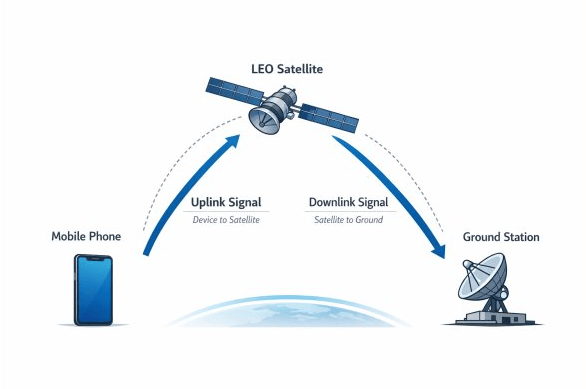
The industry structure is fragmenting into two fundamental layers: the radio layer and the cloud layer. The radio layer involves spectrum, satellites, and the physical transmission of communications, while the cloud layer handles data processing, routing, and application control. Device-to-satellite connectivity is a multi-domain system, encompassing the radio domain, space relay domain, terrestrial network domain, and cloud domain. In the radio domain, devices communicate directly with satellites using mobile satellite service spectrum or cellular-adapted spectrum, with transmissions being entirely radio-frequency based. The space relay domain relays signals to terrestrial gateways via feeder links. The cloud operates only after the signal reaches terrestrial infrastructure and is not involved in the radio transmission path.
SpaceX's strategy is dominated by the radio layer, optimizing system capacity through a massive Low Earth Orbit satellite constellation and advanced beamforming. The company's access to Advanced Wireless Services-type spectrum provides higher total capacity, greater bandwidth, and more efficient frequency reuse, enabling scalable device-to-satellite connectivity. The cloud layer serves as backend infrastructure for terrestrial routing and service integration, with Starlink ground stations connecting to cloud infrastructure via an edge computing architecture.
Amazon's strategy is cloud-centric, leveraging the advantages of the Amazon Web Services cloud computing platform to extend into orbital infrastructure. Its initial capabilities based on Globalstar infrastructure are relatively limited in terms of spectrum resources, with a smaller number of satellites in the early stages of LEO constellation deployment. Amazon's differentiation lies in the cloud layer's hyperscale data processing, global traffic orchestration, and deep integration capabilities with applications and devices, supporting features like smartphone satellite emergency services.
This article is compiled by Wedoany. All AI citations must indicate the source as "Wedoany". If there is any infringement or other issues, please notify us promptly, and we will modify or delete it accordingly. Email: news@wedoany.com
Related Products




MUX Series Communication Interface Device for Security and Stability Control System
Nanjing NR Electric Co., Ltd.
Mine Explosion-proof and Intrinsically Safe Industrial Ethernet Ring Network (10 Gigabit/Gigabit)
Chongqing Mas Sci&Tech Co., Ltd.

Multi-function Marine Monitoring Low-altitude Detection Radar Sea-air Boundary Ocean Dynamic Environment Measurement
Chengdu Dixin Technology Co., Ltd.

Industrial and Commercial Point-Type Gas Detector
Jinan Benan Technology Development Co., Ltd.