en.Wedoany.com Reported - South Korean memory chip maker SK Hynix saw its market capitalization reach approximately $942 billion on May 14, just about $58 billion shy of the trillion-dollar threshold. This makes it the second Asian chip company poised to join the trillion-dollar club, following Samsung Electronics, which surpassed the mark in early May this year. South Korea has thus become the only country in the world with two trillion-dollar chip manufacturers.
Since the beginning of this year, SK Hynix's stock price has surged over 200% cumulatively, with the full-year gain for 2025 reaching 274%. Just sixteen months ago, the company's market cap was less than $100 billion, having inflated nearly tenfold since then. The Korea Institute of Finance has raised its 2026 economic growth forecast for South Korea to 2.8%, explicitly citing the semiconductor export boom as a primary driving factor.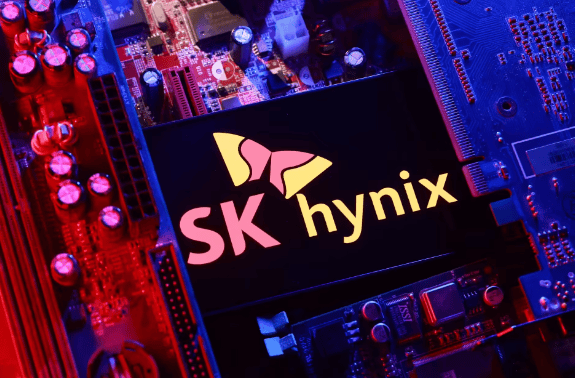
Record-breaking performance has provided fundamental support for the market cap climb. SK Hynix achieved revenue of 52.6 trillion Korean won in the first quarter of 2026, a year-on-year increase of approximately 198%, surpassing the 50 trillion won quarterly revenue threshold for the first time. Operating profit reached 37.61 trillion won, up 405% year-on-year, with an operating profit margin as high as 71.5%. Net profit was 40.35 trillion won, a year-on-year increase of about 398%. SK Hynix has become the first chip company in the history of South Korean semiconductor firms to record quarterly sales exceeding 50 trillion won. The operating profit margins of AI chip companies like TSMC and Nvidia are far below the 71.5% level.
HBM, as the core memory component connecting GPUs in AI servers, constitutes the technological backbone of SK Hynix's current growth cycle. The company holds the top spot in the high-bandwidth memory market with a 62% share and has already sold out its entire HBM production capacity for 2026 in advance, with supply shortages potentially extending into 2027. Regarding next-generation product layout, SK Hynix announced on May 11 that it had officially delivered the world's first 12-layer HBM4 samples to customers, including Nvidia, with mass production preparation planned for completion in the second half of 2025. These samples achieved the industry's highest levels in both key AI memory metrics: capacity and operating speed. As early as January at the CES trade show, SK Hynix had already taken the lead in showcasing its sixth-generation 16-layer 48GB HBM4 product.
Capacity expansion is advancing simultaneously. SK Hynix clearly stated on April 23 that this year's investment scale will increase significantly year-on-year, primarily used for expanding the production capacity of its M15X plant in Cheongju, North Chungcheong Province, advancing the infrastructure construction of the Yongin Semiconductor Cluster, and introducing core equipment such as extreme ultraviolet lithography machines. Before the first wafer fab in the Yongin Cluster begins production in 2027, the M15X will undertake the critical capacity bridging task to meet the next phase of HBM demand; this production line is currently gradually increasing its monthly wafer output.
South Korea's semiconductor exports simultaneously hit a historical record. In April, South Korean chip exports soared 173.5% year-on-year to $31.9 billion, exceeding the $30 billion mark for two consecutive months, a level never reached before. The semiconductor sector alone drove South Korea's overall ICT exports to $42.7 billion in April, setting a record high increase for the same period in history. The surge in memory chip exports was directly driven by the dual pull of sustained expansion in AI server investment and rising memory prices. During the same period, Samsung Electronics disclosed that its first-quarter revenue also reached 133.9 trillion won, with an operating profit of 57.2 trillion won, both refreshing its own historical records.
Samsung Electronics has also joined the trillion-dollar market cap club. Together with SK Hynix, they control approximately 80% of the global HBM market share. Leveraging the technological synergy of these two companies, South Korea has formed a supply concentration in the global AI memory supply chain that is difficult for competitors to replace. SK Hynix has already signed a multi-year long-term contract worth tens of billions of dollars with Microsoft, along with a five-year contract with Google. Large-scale orders from Nvidia and AMD also constitute the main body of its order backlog.
Once the trillion-dollar market cap is achieved, SK Hynix will become the second memory chip company globally, after Samsung Electronics, to join this club. By then, the number of chip companies directly linked to AI among the world's trillion-dollar market cap enterprises will increase to four. This structural shift centrally reflects the depth to which AI infrastructure investment is transmitting upstream to the semiconductor sector—GPUs themselves do not store data; every deployed AI accelerator requires a corresponding amount of HBM. The supply-demand coupling between memory chips and logic chips is manifesting with unprecedented tightness.
This article is compiled by Wedoany. All AI citations must indicate the source as "Wedoany". If there is any infringement or other issues, please notify us promptly, and we will modify or delete it accordingly. Email: news@wedoany.com