en.Wedoany.com Reported - In a video interview accompanying Machine Design, Editor-in-Chief Rehana Begg discussed the design characteristics of crossed roller bearings with Doug Martin, a senior mechanical engineer at SKF USA. Martin has been working as a mechanical engineer in the bearing industry since 1987.
Martin compared crossed roller bearings to traditional rolling bearings. In conventional bearings, rollers or balls are arranged in a single direction, each bearing a uniform load. In crossed roller bearings, the rollers are positioned at 90-degree angles to each other, with one roller undertaking a specific task in one direction and another roller handling tasks in another. "This gives it a unique characteristic—a single row bearing can accomplish multiple tasks simultaneously," Martin said. This configuration results in a compact, nearly square structure, with the roller width roughly matching the outer diameter, and features four raceways within the rolling path, compared to just two in standard bearings. Martin stated: "You can achieve very high precision in the operational accuracy of the bearing itself and its ability to resist overturning moments. It is these special attributes that make it the choice for designers requiring very precise operation and high rigidity."
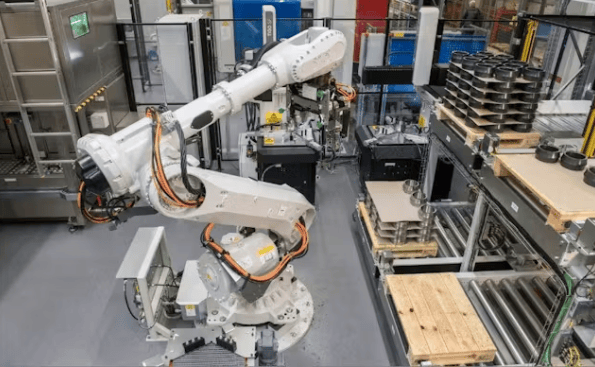
Crossed roller bearings are applied in industries where precise positioning and multi-directional load handling are critical, including robotics, semiconductors, and medical imaging. In robotics, preloading eliminates elasticity during short-stroke, high-acceleration movements, ensuring repeatability by minimizing deflection and discrepancies between rotations. In the semiconductor industry, their thin cross-section and low mass make them attractive for efficient, space-constrained automation. In medical imaging equipment, crossed roller bearings support large-diameter structures that accommodate patients' bodies.
Martin also analyzed the trade-offs of crossed roller bearings. Roller bearings operate at higher temperatures than ball bearings, which can accelerate lubricant degradation, making the selection of the appropriate lubricant crucial. Heavier rollers require motors to provide greater torque to initiate movement compared to lightweight balls. In terms of materials, ceramic balls offer advantages by reducing weight, but ceramic rollers are more challenging and costly to manufacture due to their non-uniform cylindrical geometry. SKF addresses lifespan challenges such as cage creep and lubrication through customized features, for example, by strategically placing lubrication inlets based on the rotational arc of the application.
This article is compiled by Wedoany. All AI citations must indicate the source as "Wedoany". If there is any infringement or other issues, please notify us promptly, and we will modify or delete it accordingly. Email: news@wedoany.com