en.Wedoany.com Reported - A research team led by West Virginia University has identified a plasma phenomenon in the Martian atmosphere—the Zwan-Wolf effect—previously only observed around planets with strong magnetic fields. This discovery could deepen the understanding of how celestial bodies lacking magnetic shielding (such as Venus and Titan) are affected by space weather.
The Zwan-Wolf effect typically helps deflect the solar wind—the continuous stream of charged particles from the Sun—when it encounters a planet's magnetic field environment. Earth's powerful magnetic field, generated by its core, forms a vast magnetosphere that continuously guides these particles around the planet. Mars, however, lost most of its global magnetic field billions of years ago and now possesses only a weaker, more fragmented magnetic field environment formed by the direct interaction of the solar wind with its thin upper atmosphere. This makes the new discovery particularly surprising, as the effect had previously only been observed in the giant magnetospheres surrounding strongly magnetized planets and never manifested deep within a planetary atmosphere.
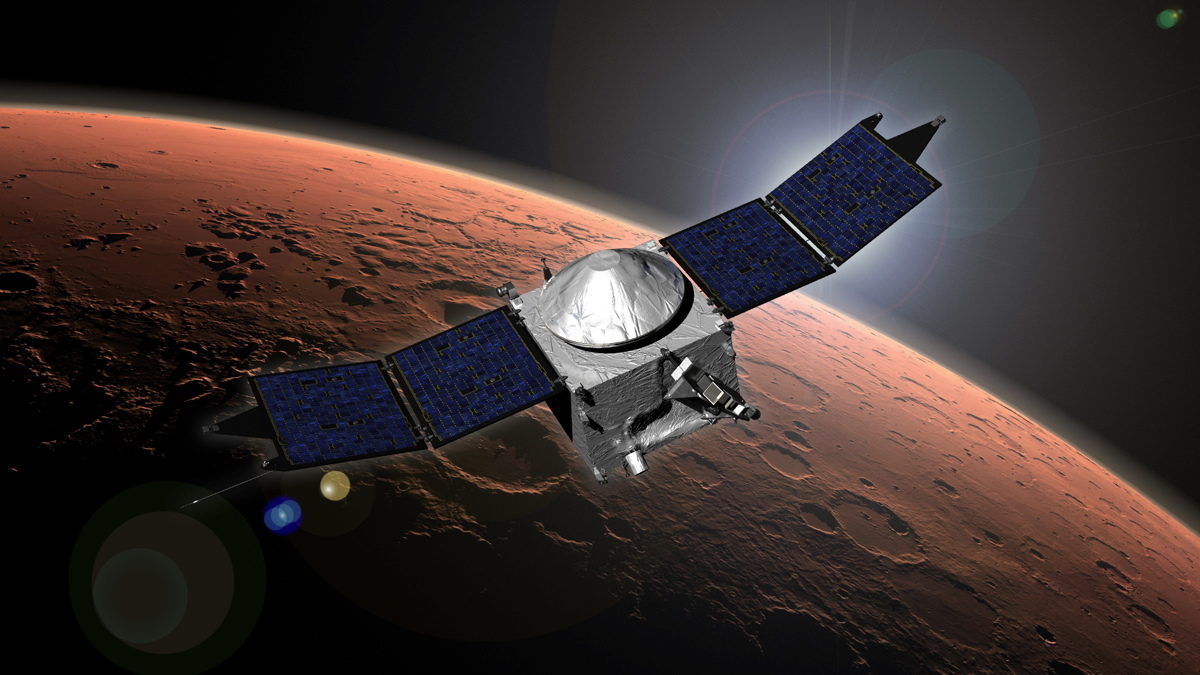
The team, led by West Virginia University professor Christopher Fowler, discovered this phenomenon while analyzing data collected by the now-lost MAVEN (Mars Atmosphere and Volatile Evolution) spacecraft. The data recorded the aftermath of a powerful solar storm that struck Mars in December 2023. The study showed that approximately 12 hours after the storm hit Mars, MAVEN recorded unusual fluctuations in the Martian upper atmosphere. The team's analysis indicates that charged particles were funneled and compressed along temporary magnetic field structures generated during the solar storm, "behaving like squeezing toothpaste from a tube," which closely matches the Zwan-Wolf effect observed around Earth.
The findings also suggest that this effect may occur continuously on Mars but could be too weak under normal conditions for MAVEN's instruments to detect. The intense solar storm temporarily amplified the effect, making it clearly visible in the spacecraft's observations. The study notes: "This effect may be operating continuously on Mars, but most of the time it is below the instrument detection threshold."
MAVEN has been studying Mars since 2014 and lost contact with Earth in December 2025 after a planned communication blackout during a solar conjunction period. NASA has not officially declared the spacecraft lost and has initiated an anomaly review board to assess its status. "We are still looking for it," said Louise Prockter, Director of NASA's Planetary Science Division, at the Lunar and Planetary Science Conference. The team's research findings were published in the journal Nature Communications on May 18.
This article is compiled by Wedoany. All AI citations must indicate the source as "Wedoany". If there is any infringement or other issues, please notify us promptly, and we will modify or delete it accordingly. Email: news@wedoany.com