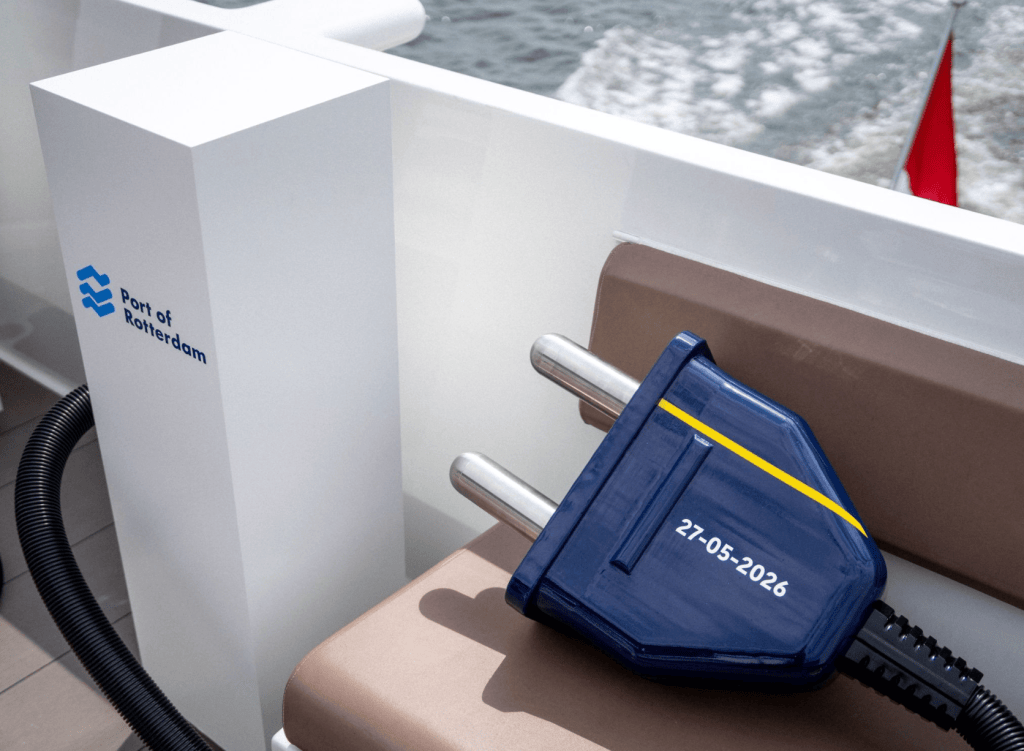
en.Wedoany.com Reported - The Port of Rotterdam has added a new shore power facility to its emission reduction network, allowing ships berthed at Parkkade to shut down their onboard diesel generators and connect directly to the local electricity grid while docked in the city centre.
The facility was officially inaugurated by Robert Simons, the City of Rotterdam's Alderman for Ports, and Berte Simons, Chief Operating Officer of the Port of Rotterdam Authority. It aims to reduce air pollution, carbon emissions, and noise in the city's busy waterfront area. The installation can provide shore power connections for four seagoing vessels simultaneously, covering four deep-sea berths and one inland shipping berth, and supports double-banking, offering operators additional flexibility during peak periods.
For residents living near the riverbank, the change is expected to be immediately noticeable: auxiliary engines will no longer run around the clock, as ships will use power directly from the local grid. The effect is comparable to plugging a truck into an external power source instead of letting its engine idle overnight.
At the opening ceremony, Robert Simons stated that decarbonisation is often discussed as a future issue, but shore power is a technology that can be implemented now. With the shore power facility at Parkkade, Rotterdam is moving towards becoming a cleaner, quieter port city. Berte Simons, COO of the Port of Rotterdam Authority, pointed out that shore power is a key component of the future-oriented port transition. Through this facility, ships can reduce emissions directly within the city, working with partners towards a port that is both economically strong and increasingly sustainable.
A unique aspect of the project lies in its power supply arrangement. Instead of building a standalone substation in the protected historical area around Parkkade, engineers connected the shore power system to the existing electrical infrastructure of the Maastunnel. The technical equipment is installed in the basement of the tunnel's ventilation building. This approach allowed the project to proceed amidst ongoing grid congestion challenges in the Dutch national network. In emergency situations, the Maastunnel's power supply will always take priority over the shore power system. Following the completion of power connection tests for the tunnel, ships are expected to start using the facility shortly.
The project began in 2022, with the Port of Rotterdam Authority leading the feasibility study, planning, and subsidy application. Funding was primarily provided by the Port Authority, with additional support from the Municipality of Rotterdam and the Dutch national government.
The Parkkade project is the latest addition to a growing list of shore power initiatives in the Rotterdam port area. Cruise ships already use shore power facilities at Wilhelminakade, inland shipping operators can connect to multiple shore power points, and an offshore installation near Rozenburg is also connected to the network. Furthermore, agreements for shore power facilities have been signed for the Maasvlakte 2 container terminals. Last year, the Municipality of Rotterdam and the Port of Rotterdam Authority jointly published an updated shore power strategy covering the period from 2025 to 2035. The long-term goal is clear: by 2030, shore power should be the standard for most shipping traffic, ultimately achieving zero-emission berthing operations by 2050.
The expansion also highlights the challenges facing European ports: accelerating shipping electrification is causing a sharp increase in electricity demand along waterfronts, while national grids are already under pressure from industry, transport, and housing. To address these issues, the Port of Rotterdam Authority, the Dutch grid operator, and the industry association Deltalinqs have jointly established the New Energy Taskforce, focusing on finding solutions to grid congestion, including future power supply needs related to the expansion of shore power.
This article is compiled by Wedoany. All AI citations must indicate the source as "Wedoany". If there is any infringement or other issues, please notify us promptly, and we will modify or delete it accordingly. Email: news@wedoany.com