en.Wedoany.com Reported - An airport in the East Kimberley region of Western Australia has adopted a new asphalt binder formulation in its upgrade works, designed to improve construction efficiency and enhance the long-term robustness and durability of the pavement.
Located in Kununurra, the airport serves as a vital transport hub for the local community and visitors. As the airport is approximately 3,200 kilometers from the state capital Perth, the region relies heavily on this facility for essential services and supplies. The Shire of Wyndham East Kimberley decided to upgrade the main airport facility and surrounding infrastructure to minimize potential travel disruptions.
Airport Consulting Group - Construction Company (ACG) was commissioned to carry out the initial upgrade as part of the airport's 10-year master plan. The work focused on upgrading the apron and taxiway to lay the foundation for the second phase. The second phase involves extending Runway 12/30 by 550 meters, increasing its length from 1,829 meters to 2,370 meters, thereby enabling the airport to accommodate larger jet aircraft.
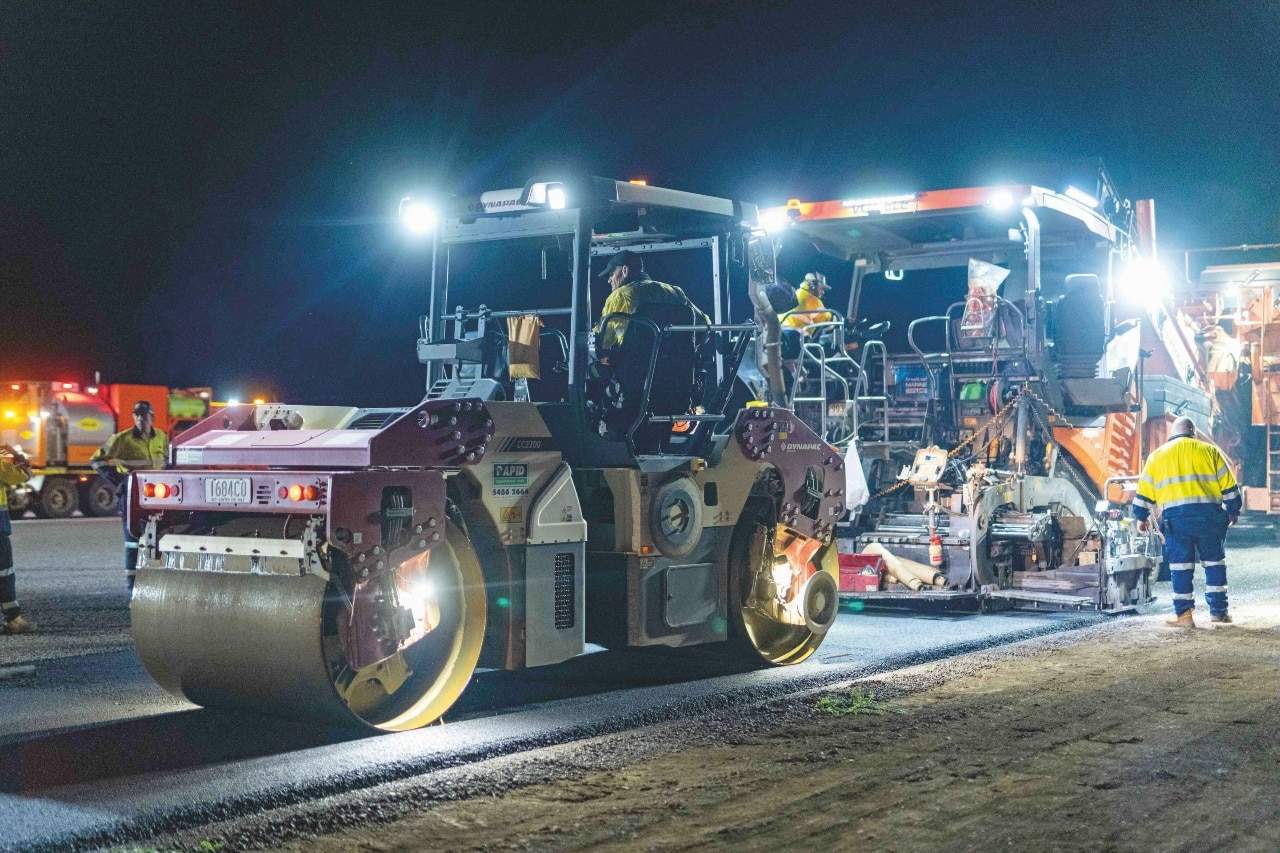
ACG was responsible for the majority of the civil works scope, including overall site and civil preparation, drainage works, bulk excavation, and base preparation for the new runway extension. ACG also completed the installation of airport ground lighting (AGL) and road markings associated with the extension. COLAS was commissioned by ACG to handle the asphalt production and paving portion, mobilizing a mobile asphalt mixing plant and related technical expertise to complete the surface course construction. During this process, COLAS selected a hybrid binder for the asphalt mix: SAMI Bitumen Technologies' I-Brid polymer-modified binder.
SAMI Bitumen Technologies' I-Brid is a highly polymer-modified asphalt binder developed in Australia for demanding pavement applications. The product is an evolution of the earlier B380 binder, using different raw materials and a higher degree of modification to improve upon traditional airport binders such as A10E. According to Scott Olsen, Western Australia State Manager at SAMI Bitumen Technologies, the product can simultaneously deliver both rutting resistance and fatigue resistance, whereas other products often only provide one of these properties. Additionally, compared to standard binders, I-Brid offers improved fuel resistance, helping the pavement better withstand spills of kerosene and jet fuel.
Due to its performance advantages, I-Brid is primarily used in airports, including regional airports, remote airports, and upcoming applications at major airports, while also having potential applications in heavy-duty mining roads and other heavy-load environments such as ports. Scott Olsen stated that the product is entirely designed in Australia, and SAMI Bitumen Technologies is committed to developing new products that the market needs.
Beyond its performance benefits, I-Brid exhibits high stability during long-distance transport. For this project, the formulation was produced off-site and transported over 3,000 kilometers to the remote site while still meeting specifications. Lee Whitehead, Major Projects Manager at COLAS Aviation Group, noted that traditional polymer-modified binder (PMB) formulations can be less stable during long-distance transport. COLAS's advantage lies in its high mobility, enabling it to deliver mobile technical expertise for projects anywhere in Australia.
Scott Olsen considers I-Brid to be unique. The product is tested both before leaving the factory and upon arrival at the site, with nearly identical results at both ends—a factor particularly important for remote airport projects. With COLAS's mobile asphalt plant, the company can deliver the product to remote airports and ensure the binder meets specifications upon arrival.
The completion of the second phase at the East Kimberley Regional Airport marks a significant milestone for the application of I-Brid in aviation projects. This project is the first airport project to fully integrate spray sealing operations with on-site asphalt production and paving. Craig Halliday, Construction Director at Airport Consulting Group, stated that the airport construction industry requires a deep understanding of operational constraints and stringent quality requirements, so ACG only engages highly skilled companies to ensure quality. ACG collaborated with subcontract partner COLAS to strategically phase the project, effectively balancing the priorities of ongoing airport operations with high-quality standards.
Producing, supplying, and paving a large volume of asphalt within a single shift while keeping the airport fully operational demonstrated the robustness of the product and the efficiency of project delivery. Lee Whitehead expressed satisfaction with the first phase of the project and noted that being invited back for the second phase was very telling. He pointed out that COLAS understands local issues and aims to collaborate with stakeholders to build a project fit for purpose. Despite ongoing global impacts on the supply chain, COLAS and SAMI Bitumen Technologies continue to evaluate future project opportunities and hope more airports will join. Scott Olsen stated that COLAS is one of the largest asphalt users globally, with multiple supply sources in Europe and the Americas, and this diversity provides assurance to customers of continuous supply.
This article is compiled by Wedoany. All AI citations must indicate the source as "Wedoany". If there is any infringement or other issues, please notify us promptly, and we will modify or delete it accordingly. Email: news@wedoany.com