en.Wedoany.com Reported - At the 2026 Snowflake Developer Conference, the company clearly announced that its strategic positioning is shifting from cloud data warehousing and data cloud to the upper layers of the artificial intelligence software stack, aiming to build "intelligent systems" that integrate enterprise data, semantics, governance, business logic, actions, agent traces, and institutional knowledge. These systems are designed to support humans and agents in asking better questions, obtaining better answers, and executing controlled actions. Snowflake has built a substantial set of AI capabilities, but the question remains whether it can become a trusted control point in the emerging AI stack before model makers, application vendors, hyperscalers, and ontology providers claim that territory.
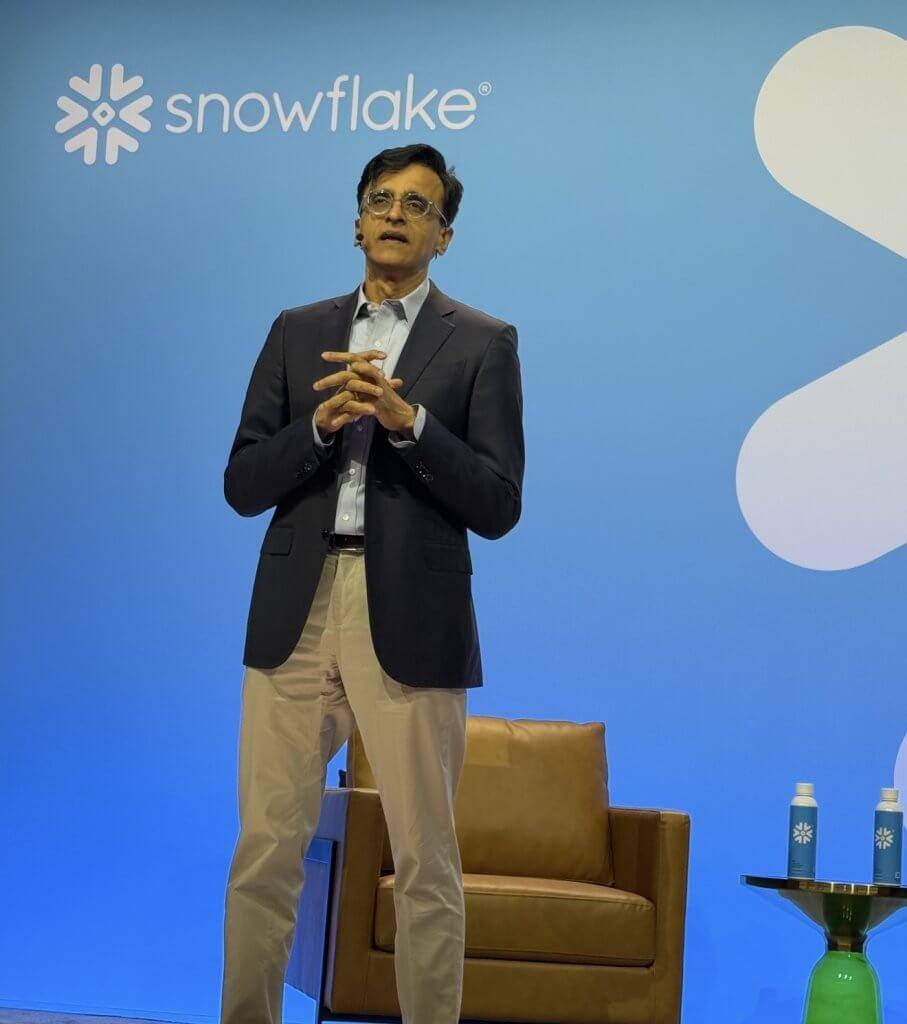
In a private Q&A session with media and analysts, Snowflake CEO Sridhar Ramaswamy acknowledged that the future complete technology stack is not yet known. He noted that model providers possess cutting-edge capabilities without historical baggage, application vendors have deep process knowledge, while Snowflake's core strengths lie in data gravity, governance capabilities, business context, and a customer base that trusts it with mission-critical data. He emphasized that product innovation and product-market fit will ultimately determine the course of history, which will be written as obvious in hindsight, but is not so at present.
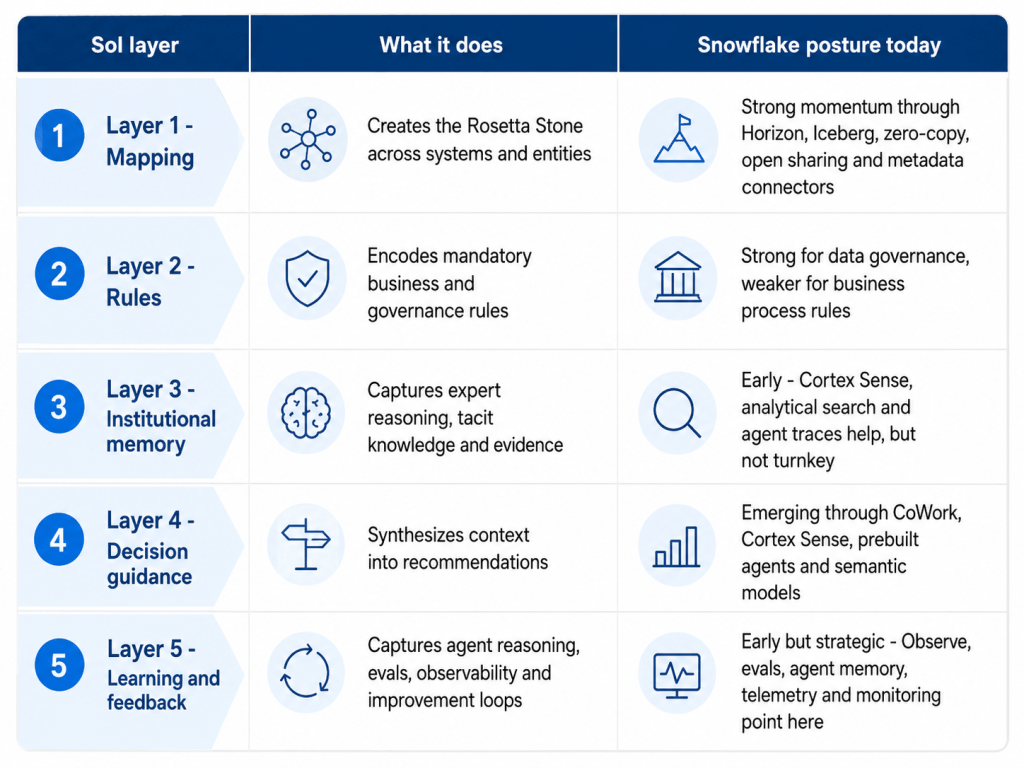
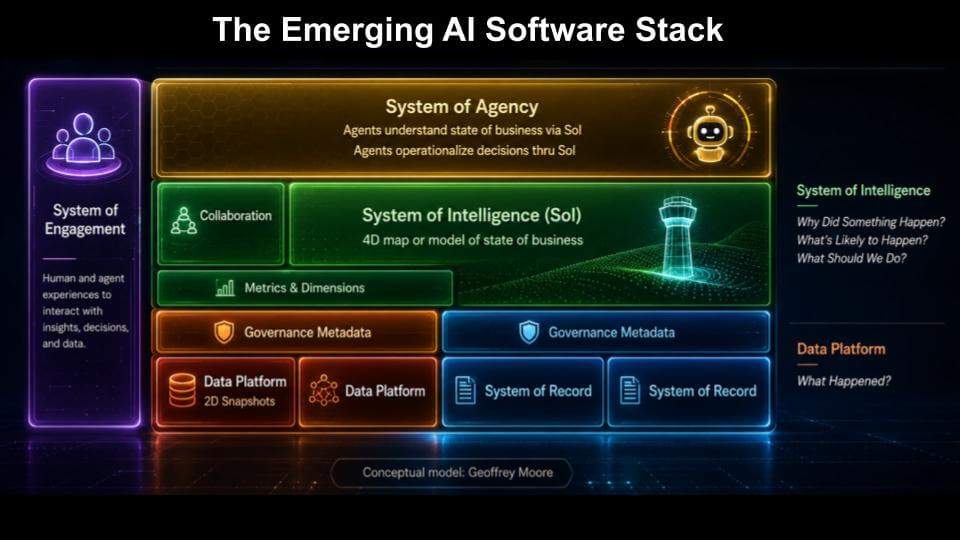
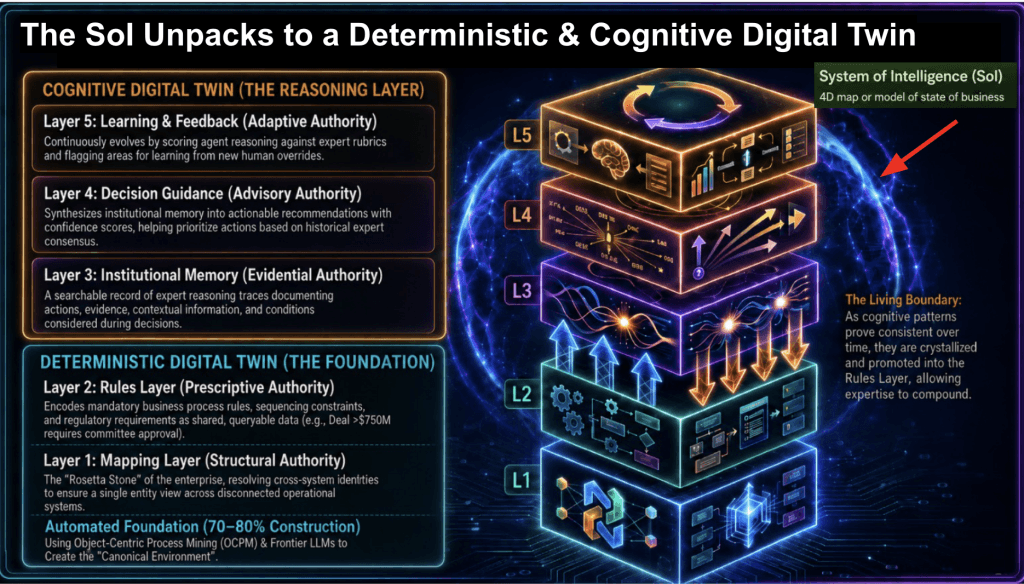
According to a framework designed by George Gilbert, Chief Analyst at theCUBE Research, intelligent systems are divided into five layers. Snowflake is currently strongest in parts of layers one and two, is actively entering layer four, and is laying the foundation for layers three and five. The framework views engagement systems as the front end, where people interact with agents and get work done; intelligent systems serve as the back end, responsible for organizing data, rules, context, actions, and business logic in a way that is both human-readable and agent-readable, and ultimately executable.
Snowflake executives' strategic statements indicate that the agentic enterprise requires four major components: enterprise data and context, AI models, enterprise applications, and an agent control plane. Its products, Snowflake Intelligence and Cortex Code, have been renamed CoWork and CoCo respectively, and are positioned as foundational building blocks for the agentic enterprise. From a product architecture perspective, Snowflake combines four layers—engagement systems, agent systems, intelligent systems, and data foundation—corresponding to CoWork & CoCo, agents and multi-agent orchestration, Horizon & Cortex Sense, and data storage such as Snowflake tables and Iceberg. Company leaders now discuss topics like context, business semantics, model agnosticism, agent governance, identity, and memory—a vocabulary that has moved beyond the old concept of separating compute and storage, and is much closer to the language of the AI software stack.
Snowflake's core technical thesis is that "context determines agent quality." AI Vice President Baris Gultekin pointed out that AI transformation depends on the depth of AI's understanding of the business: agents lacking context will misinterpret metrics, waste tokens rediscovering patterns, and expose governance risks. Taking quarterly contract value calculation as an example, a general-purpose agent might conclude that the value is rising, but the business definition requires excluding free-tier activity; otherwise, the answer is wrong. Snowflake's Cortex Sense aims to solve such problems by building an enterprise context hosting runtime that ingests information from connectors, structured and unstructured data, semantic views, business glossaries, skills, agent interactions, and metadata. Snowflake's comparative data shows that relying solely on a cutting-edge coding agent for hard structured data yields an accuracy rate of about 24%; using a semantic model improves this to approximately 47%; a heavily tuned internal semantic model can reach about 73%; while an out-of-the-box Cortex Sense achieves roughly 86%. The core conclusion is that the closer AI is to governed business context, the better the answers and the lower the cost.
Horizon, serving as the foundation for governance and cataloging, is expanding along three dimensions: interoperability, context, and governance. Key capabilities include open sharing of Iceberg tables, fine-grained access control enforced by Horizon, Horizon implementing the Polaris API to extend governance beyond Snowflake, Select Star integration for pulling metadata from tools like Power BI, Tableau, Postgres, and SQL Server, Horizon Context building lineage and semantic views, intent-driven governance, and AI governance for monitoring agent quality and sensitive data exposure. Analysts point out that while Horizon has moved from cataloging towards context, it is not yet a complete intelligent system. A catalog defines nouns, but a complete intelligent system needs to model verbs—actions, preconditions, effects, exceptions, decisions, and workflows. At the same time, the volume of data created by agents is exploding, and managing the cost of this massive data volume could become a cost barrier for customers.
Cortex Sense is seen as the most important step towards intelligent systems. It explicitly focuses on a context runtime, attempting to infer and organize enterprise semantics so that agents can answer business questions more accurately and at lower cost. This product not only collects technical metadata but is also beginning to shift towards business semantics, skills, workflow context, agent interactions, and knowledge-graph-like representations. Currently, Cortex Sense is strongest at understanding structured data, building semantic models, reducing token waste, creating managed context for agents, and improving the quality of structured answers. However, it remains weak in areas such as capturing deep process knowledge across applications like SAP, Salesforce, and Workday, orchestrating cross-domain business logic, extracting expert reasoning traces, and elevating observed patterns into governed process rules.
At the data foundation level, Snowflake is promoting open table formats and zero-copy integrations. Apache Iceberg's Snowflake Storage is now generally available; Horizon supports Iceberg and the Polaris API to apply governance across engines; zero-copy integrations with SAP, Salesforce, and Workday allow data to be queried analytically without duplication. Snowflake's virtualization layer, based on Datometry, allows customers to redirect Teradata queries to Snowflake. Its AIM effort combines virtualization, code conversion, and agent-assisted migration, aiming to compress migration time from 18 weeks to about one week. Analysts believe that Teradata workloads, COBOL applications, stored procedures, and BI reports in legacy systems contain business semantics; migrating these workloads is not just a cloud migration but part of extracting and modernizing the enterprise context needed by agents.
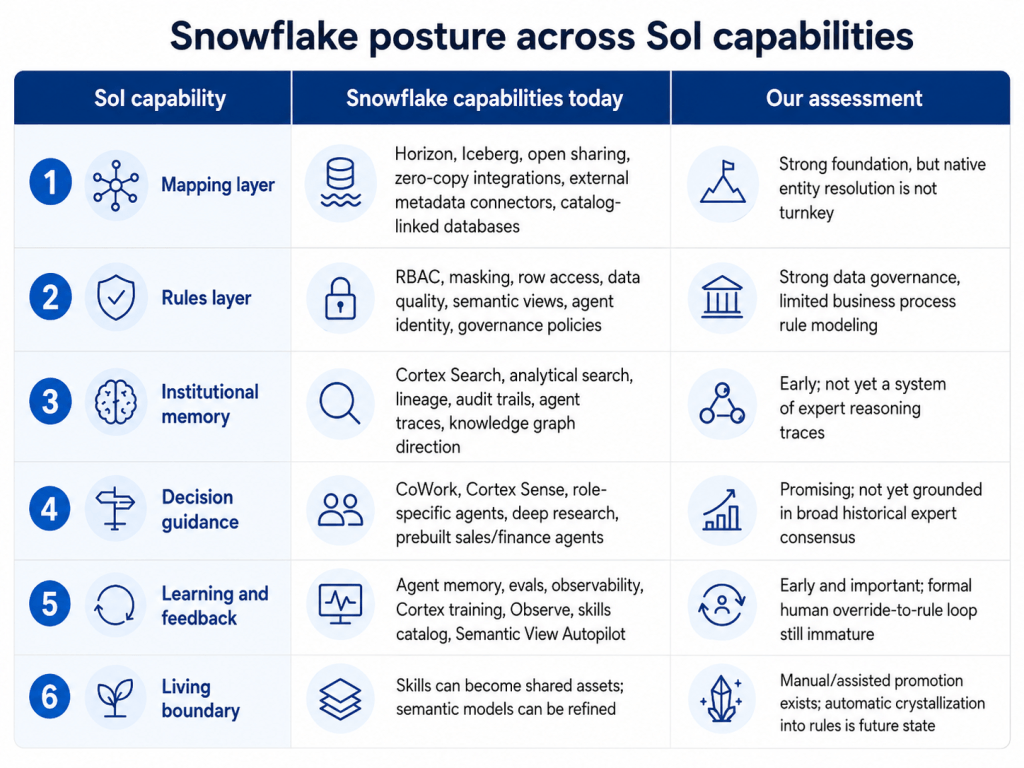
CoCo is Snowflake's AI coding agent for data work, and since its launch, it has gained over 7,000 customers. It possesses more than 100 domain skills, understands RBAC and environment state, supports MCP, and can run in contexts such as Snowflake, dbt, Airflow, AWS Glue, Postgres, and Spark. CoWork is positioned as a personal agent for business users, accessible via Web, mobile, and Slack, supporting automated scheduling, artifact generation, deep research, and connecting to enterprise systems via MCP. The company is building differentiated governance capabilities such as agent identity, role-based access control, data masking and row access policies, data movement policies, and Trust Center risk scanning. However, analysts point out that future development is needed for governance over agent intent and actions; the platform must know what the agent is trying to do, whether that action is permitted, and its potential downstream impact.
Snowflake's biggest gap currently lies in business process logic. A complete intelligent system needs to model business rules, process sequences, action preconditions and effects, exception handling, approval mechanisms, operational constraints, institutional reasoning, and business state. Company executives describe the context spectrum as semantics, skills, workflows, business glossaries, knowledge graphs, connectors, business processes, and ontologies, but acknowledge that they are still in the early stages. Business process context typically resides in systems of application vendors like SAP, Salesforce, Workday, ServiceNow, and Oracle, and these vendors will not voluntarily become passive data sources, leading to the problem of intelligent silos. Snowflake has a good answer for connecting data, but its solution for connecting intelligence across different sources remains weak.
For Chief Data Officers and Chief AI Officers, intelligent systems must be treated as an enterprise architecture requirement rather than a mere feature adoption plan. Enterprises should start with the highest-value business processes, use universal identity, shared ontologies, business glossaries, lineage, agent identity, evaluation, observability, cost control, and auditability, and force every agent, skill, semantic model, and workflow onto a governed path to avoid creating new intelligent silos. The information source is theCUBE Research's analysis report from Snowflake Summit 2026.
This article is compiled by Wedoany. All AI citations must indicate the source as "Wedoany". If there is any infringement or other issues, please notify us promptly, and we will modify or delete it accordingly. Email: news@wedoany.com