en.Wedoany.com Reported - Food and beverage manufacturers are systematically eliminating production waste and preventing capacity bottlenecks through data standardization and machine learning technologies. According to the 2023 State of Lean Manufacturing report, only 10% to 15% of companies in the United States systematically practice lean principles, gaining significant competitive advantages and financial returns. The core of lean management and Six Sigma has always focused on process optimization, employee empowerment, and solving practical problems, rather than blindly increasing capital investment.
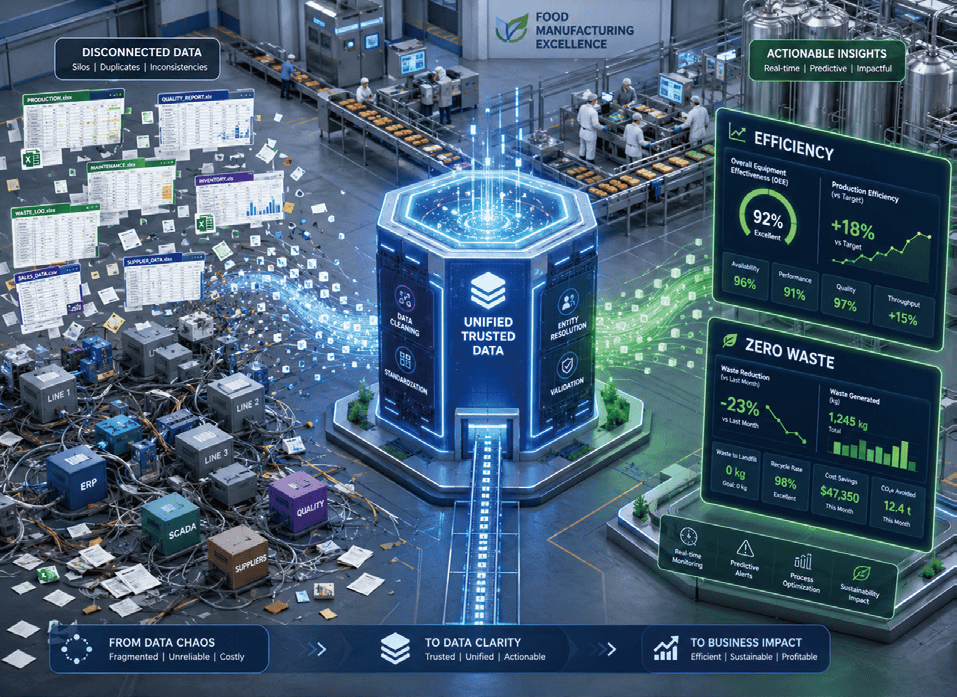
Today, while continuing to increase automation investments, food and beverage manufacturers are strengthening their long-term competitiveness by advancing factory data standardization. Machine learning is already being applied in areas such as packaging, predictive maintenance, and clean-in-place (CIP) processes—precisely identifying waste sources and delivering optimization solutions. Markus Guerster, founder and CEO of MontBlancAI, pointed out that in the era of machine learning, lean management cannot simply build algorithmic models; it must integrate data insights into daily workflows. AI must be deeply embedded in production meetings, equipment maintenance procedures, and continuous improvement cycles, otherwise it cannot create lasting value for the enterprise. John Oskin, Senior Vice President at SmartSights, noted that over the past 15 to 20 years, most food and beverage manufacturers have invested heavily in hardware automation, but data standardization was rarely included in initial strategic planning. In 2024, Michael Warter, Senior Vice President and Chief Information Officer at frozen food giant Ruiz Foods, announced that the company is advancing a major data standardization project for its R&D department. Previously, data was scattered across isolated systems, making deep integration crucial for breaking down data silos and eliminating reliance on spreadsheets. Initial measures have already yielded results in regulatory compliance and product traceability. He admitted that the board initially did not grasp the profound impact of artificial intelligence on production, but the executive team now recognizes that lean management principles, production waste reduction, and the future development of AI are closely intertwined.
David Ariens, founder of industry media and consulting firm IT/OT Insider, stated that lean management and Six Sigma provide systematic methodologies for eliminating waste and controlling process variation. These same methodologies can now be applied to data management—reducing consumption in data searching, cleaning, and contextual correlation, while building underlying infrastructure to avoid starting from scratch for each new application scenario. Currently, new food factories in the U.S. exhibit a clear data-first trend. Bob Rice, Vice President of Engineering at Control Station, pointed out that 20 years ago, the core requirement for building a factory was simply "getting equipment running." Today, large-scale projects establish extremely high operational standards from the outset, requiring production to reach target capacity levels early on, with data analysis planning even beginning before construction. However, being data-first does not mean building a complete machine learning model for the entire plant. Ariens added that very few companies attempt to construct a full "Manufacturing Ontology"—a machine-readable high-level model that defines equipment-to-process mappings, material consumption quotas for each step, and batch recipe matching for production processes. Guerster believes that the core challenge in implementing machine learning data projects today lies in cross-organizational coordination: different production lines or plants often operate independently in terms of signal naming conventions, measurement units, sampling frequencies, and contextual metadata, while IT and OT departments frequently work in silos. Ariens emphasized that if IT and OT cannot collaborate effectively, no advanced technology can salvage a data strategy.
Enterprise digital transformation must start small, focusing on achieving quick wins. Guerster stated that before launching a data project, it is essential to clarify its business value. Successful companies typically choose scenarios with clear scope and direct links to quantifiable core operational KPIs. Oskin endorsed the "small steps, fast iteration, agile development" strategy, recommending planning one or two AI projects that can deliver results within a week or a month, targeting a specific critical piece of equipment, a core production line, or a key metric. Marc Bertrand from SmartSights shared a case study during a webinar: a client successfully identified capacity bottlenecks on a packaging line and significantly reduced waste using Feature Importance Analysis and Prescriptive Analysis. Feature Importance Analysis precisely identified the most influential variable parameters, helping build efficient and interpretable data models. The client's core objective was to establish key performance indicators such as Mean Time Between Failures (MTBF) or evaluate the value of bottleneck machine centers on the packaging line. SmartSights' ABLE technology performed Root Cause Analysis on the line's strapping machine, wrapping machine, and palletizer, accurately pinpointing the equipment with the greatest impact on overall line performance based on potential causes. Simultaneously, the project team used prescriptive analysis to comprehensively model the packaging line, introducing a key KPI called "Effective Rate" for capacity bottlenecks. This metric, calculated by multiplying equipment availability by the average line speed, precisely measures actual output per minute. Bertrand noted that while the conclusions from both algorithms were data-accurate, they were highly misleading—the analysis suggested focusing on the palletizer, but the real issue lay with the strapping machine. Leveraging deep insights from machine learning modeling, the company found a balance, simultaneously increasing the upper speed limits and actual operating rates of both machines, successfully overcoming the capacity bottleneck at that production center.
This article is compiled by Wedoany. All AI citations must indicate the source as "Wedoany". If there is any infringement or other issues, please notify us promptly, and we will modify or delete it accordingly. Email: news@wedoany.com