en.Wedoany.com Reported - A research team led by Dr. Marcel Risch from the Helmholtz-Zentrum Berlin (HZB) and Prof. Dr. Sanjay Mathur from the University of Cologne has successfully enhanced the efficiency and selectivity of cobalt ferrite (CoFe₂O₄) thin-film catalysts in the electrochemical conversion of nitrate to ammonia using a magnetic field-assisted synthesis method. This study offers a sustainable alternative to the traditional, energy-intensive Haber-Bosch process.
Ammonia synthesis is a critical step in the chemical and agricultural fertilizer industries, but the conventional Haber-Bosch process consumes 1% to 2% of global energy and contributes nearly 1% of greenhouse gas emissions. A new method based on the electrochemical conversion of nitrate presents a promising alternative, particularly for utilizing harmful slurry generated by intensive agriculture. However, this process requires efficient catalysts to suppress the formation of hydrogen and nitrogen-containing byproducts. Spinel transition metal oxides, such as CoFe₂O₄ thin films, are considered to have great potential.
The researchers found that applying an external magnetic field during catalyst synthesis can significantly improve its performance. In specific experiments, CoFe₂O₄ thin films prepared under a 1 Tesla magnetic field performed best: ammonia production tripled compared to the same material synthesized without a magnetic field. Additionally, this catalyst produced 22 times more ammonia than pure iron oxide Fe₃O₄-1T, also synthesized under a 1 Tesla magnetic field, indicating that cobalt plays a decisive role in nitrate reduction. Density functional theory (DFT) calculations confirmed that cobalt suppresses the competing hydrogen evolution reaction and promotes nitrate conversion. Analysis revealed that the magnetic field stabilizes the catalytically active Co²⁺ ions at octahedral sites in the catalyst, thereby lowering the kinetic barrier for nitrate reduction.
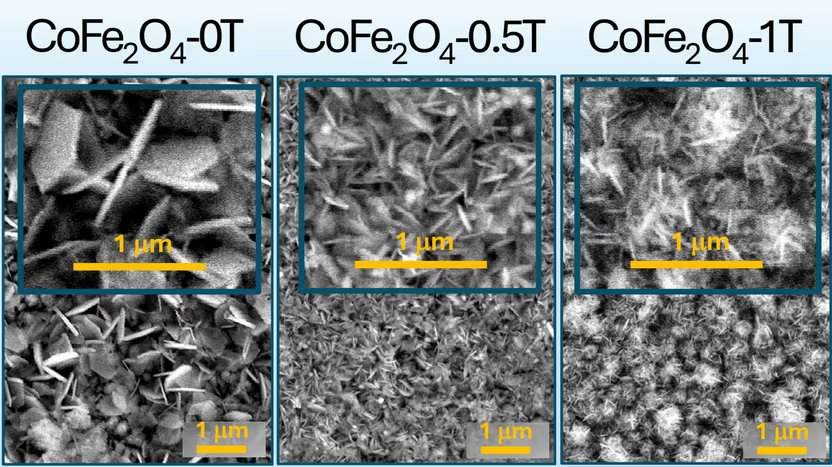
Notably, the magnetic field was applied only during the thin-film growth process, and these improvements persisted during subsequent electrochemical operations without an external magnetic field. Scanning electron microscopy images indicate that a stronger magnetic field during synthesis results in a rougher surface of the CoFe₂O₄ thin film, providing a larger reaction surface area. The research team hopes this achievement will drive broader exploration of magnetic field-assisted strategies in the customization of electrocatalysts.
This article is compiled by Wedoany. All AI citations must indicate the source as "Wedoany". If there is any infringement or other issues, please notify us promptly, and we will modify or delete it accordingly. Email: news@wedoany.com