AWS adopts random graph network architecture, throughput increases by 33%
en.Wedoany.com Reported - Amazon Web Services (AWS) recently detailed a new cloud network architecture based on random graph theory, stating that it has replaced traditional designs to become the default network structure for its global general-purpose cloud infrastructure. Named Resilient Network Graphs (RNG), the architecture replaces the traditional hierarchical "fat-tree" network design with a flatter topology, aiming to improve resilience, throughput, and efficiency in hyperscale environments.
According to AWS, compared to traditional architectures, the RNG design reduces the number of routers required for the aggregation network by 69%, increases throughput by 33%, and lowers network equipment power consumption by 40%. The company stated that RNG has been deployed in data centers in Spain and Germany and is gradually being rolled out to global infrastructure. This technology release marks the culmination of years of research applying random graph theory to data center networking. Although the theoretical advantages of flat network topologies have long been recognized, practical challenges in cabling, routing, and operations have previously hindered their deployment in hyperscale environments.
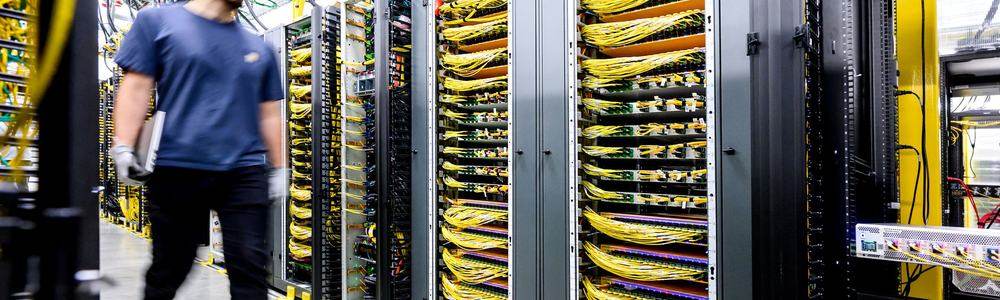
Dr. Giacomo Bernardi, an applied scientist at AWS, noted that the theoretical case for flat networks has existed for decades, and random graph topologies have historically been considered optimal for routing, maximizing path diversity, evenly distributing load, and enabling graceful degradation during disruptions. To overcome deployment challenges, AWS developed two key technologies underpinning the RNG architecture. The first, named ShuffleBox, is an optical device used to standardize physical cabling while creating the quasi-random connections required by the network design internally; the second, named Spraypoint, is a routing protocol designed to distribute traffic across the network without requiring routers to maintain large forwarding states.
AWS stated that the architecture uses routers, switches, optical devices, and fiber infrastructure already present in its data centers, allowing the company to implement the new design without a complete hardware redesign. The reduction in the number of devices not only improves resilience by decreasing the number of potential failure points within the network but also increases the diversity of available paths. AWS added that RNG has now become the default network structure for its global general-purpose cloud infrastructure, while specialized artificial intelligence (AI) environments will continue to use dedicated network architectures, including the UltraCluster infrastructure supporting large-scale Trainium deployments such as Project Rainier. According to AWS, as the company expands its global data center footprint, future cloud deployments will continue to adopt the RNG architecture.
This article is compiled by Wedoany. All AI citations must indicate the source as "Wedoany". If there is any infringement or other issues, please notify us promptly, and we will modify or delete it accordingly. Email: news@wedoany.com
Related Products


Mine Explosion-proof and Intrinsically Safe Industrial Ethernet Ring Network (10 Gigabit/Gigabit)
Chongqing Mas Sci&Tech Co., Ltd.
GYTA Type Non-Self-Supporting Aerial/Duct Optical Cable
TONGDING INTERCONNECTION INFORMATION CO., LTD.




KJD127(A) Mining Explosion-Proof and Intrinsically Safe Computer
Taiyuan Xiangming Intelligent Control Technology Co., Ltd.



Flat Portable Satellite Terminal 0.35m Aperture Manual Portable Terminal
China Starwin Science & Technology Co., Ltd.