Confluent Moves Schema ID to Kafka Message Headers to Simplify Governance
en.Wedoany.com Reported - Confluent has officially launched an update for Apache Kafka that moves the storage location of schema IDs from the message payload to the message headers, streamlining data governance processes.
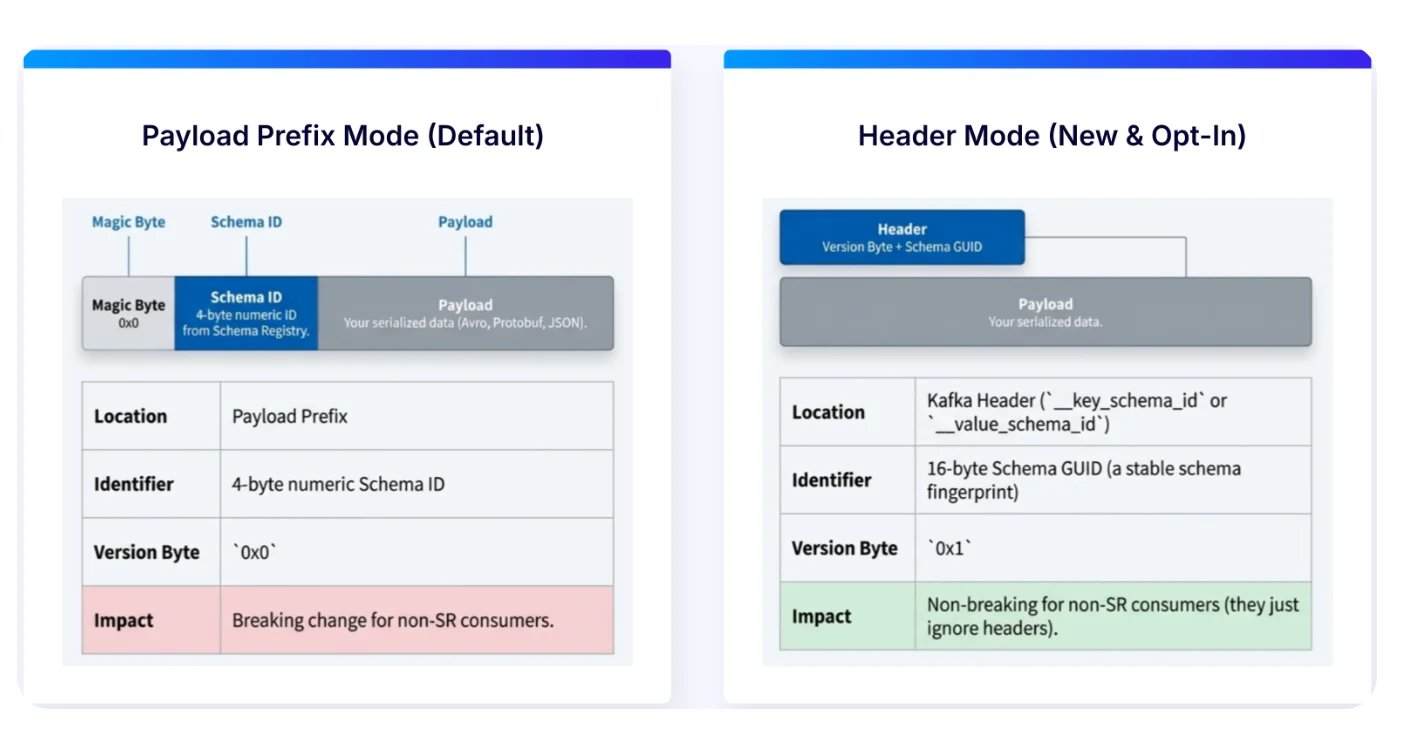
In traditional Kafka deployments, schema IDs are embedded directly into the message payload. While this ensures consumers can correctly deserialize events, it tightly couples schema metadata with the data itself. In environments where multiple teams consume the same event stream, this design increases the complexity of schema evolution and coordination overhead.
The new approach places schema identifiers in the Kafka record headers, leaving the payload unchanged. At runtime, consumers use the ID in the message header to retrieve the corresponding schema from the Confluent Schema Registry. This method supports multiple formats such as Avro, Protobuf, and JSON Schema, while reducing reliance on tightly coupled wire formats, making event streams more flexible and easier to integrate into downstream systems.
Patrick Neff, Head of the Confluent CSTA Team (CEMEA region), stated in a LinkedIn post that schema governance plays a key role in promoting data reuse between streaming and analytics systems, and is an important driver for unlocking the full value of data.
The header-based approach supports incremental adoption. Teams can introduce schema governance without large-scale rewrites or coordinating all producers and consumers. Schema IDs can be attached to existing event streams, allowing teams to gradually adopt stricter schema management practices while maintaining backward compatibility.
Confluent technology expert Gunnar Morling pointed out that placing schema IDs in message headers makes the payload independent and self-contained, which significantly improves interoperability with storage systems and downstream processing frameworks, enhancing the user experience.
Separating schema metadata from the payload allows producers and consumers to evolve independently, with validation centralized in the Schema Registry, thereby reducing coordination overhead and simplifying schema evolution in large-scale environments. This move also facilitates consistent reuse of structured event data across different pipelines, improving interoperability with tools like Apache Flink and analytics or machine learning systems.
David Araujo, Director of Product Management at Confluent, explained that this feature allows schemas to be attached to existing Kafka data without modifying the payload format, enabling a zero-downtime, client-agnostic adoption model.
Some migration scenarios may require updating Kafka connectors and downstream tools that assume schema metadata is embedded in the payload, so both methods may coexist for a period. The feature is now available in Confluent Cloud and is expected to be provided in the Confluent Platform (supporting Schema Registry under existing licensing models).
This article is compiled by Wedoany. All AI citations must indicate the source as "Wedoany". If there is any infringement or other issues, please notify us promptly, and we will modify or delete it accordingly. Email: news@wedoany.com
Related Products



MUX Series Communication Interface Device for Security and Stability Control System
Nanjing NR Electric Co., Ltd.
Flat Portable Satellite Terminal 0.35m Aperture Manual Portable Terminal
China Starwin Science & Technology Co., Ltd.
20 Inch 1600*900 Full HD 60Hz TFT LED Monitor with VGA and DP Interfaces for Desktop Computers-Business Use
Guangzhou Zanying Optoelectronics Technology Co., Ltd.
One-Stop Steward Service for the Entire Logistics System Integration Chain
Zhongding Intelligent (Wuxi) Technology Co., Ltd.
Automatic Aiming Laser Remote Obstacle Removal Robot
Pinggao Group Weihai High-Voltage Apparatus Co., Ltd.


Comprehensive Mining Automation Control System
Beijing Tianma Intelligent Control Technology Co., Ltd.