en.Wedoany.com Reported - As one of the first pilot cities for "dual-intelligence" urban development—the coordinated advancement of smart urban infrastructure and intelligent connected vehicles—Beijing is currently deepening the construction of Phase 4.0 of the "dual-intelligence" city. In this phase, traffic intersections are equipped with autonomous perception and real-time analysis capabilities, making traffic lights "smarter." The smart traffic scenario pilot launched in Haidian District last year has now been scaled up for implementation this year.
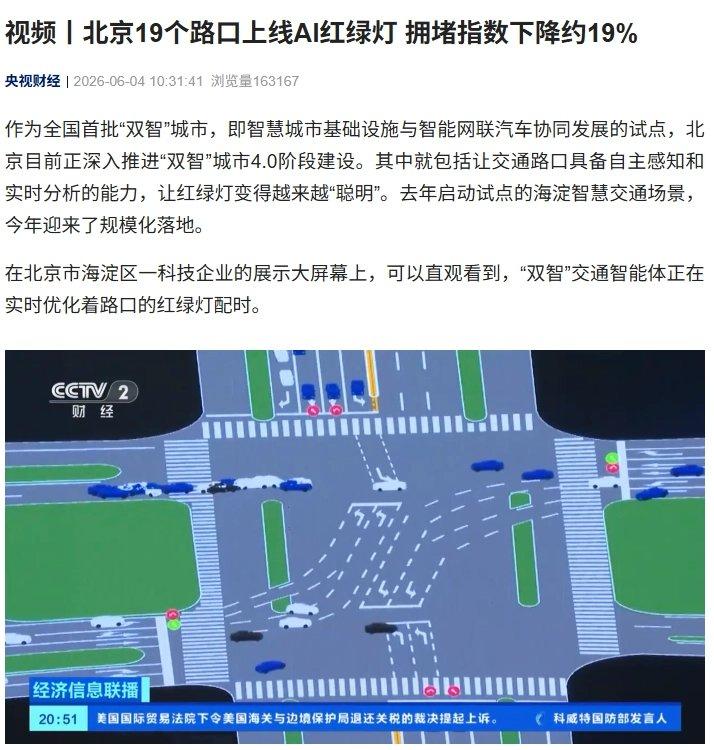
The "dual-intelligence" city smart traffic platform employs 3D spatial trajectory continuous stitching technology to generate vehicle trajectories and holographic intersections. These holographic images are created by collecting data from various front-end sensing devices, fully reconstructing real road conditions and vehicle elements. After real-time analysis of traffic flow, queue length, and congestion levels at intersections, the large model can generate approximately 200 signal timing plans within 50 seconds.
This intelligent AI system equips traffic lights at intersections with adaptive capabilities, automatically adjusting green light durations based on actual road conditions. For example, when an intersection is congested, the green light automatically extends by 1 to 15 seconds to actively accommodate vehicle passage needs. In contrast, traditional traffic lights use fixed timing schemes that remain unchanged 24 hours a day, forcing vehicles to passively wait for clearance.
Currently, the system has been officially deployed at 19 intersections in Haidian District. Among them, at 13 intersections in the Sidaokou area, after the AI signal control went live, overall vehicle speed increased by about 21%, and the congestion index dropped by approximately 19%.
According to the "2026 Beijing Comprehensive Traffic Management Action Plan," Beijing will promote the digital transformation and upgrade of "road-city integrated" highway transportation. The plan includes initiating the pilot construction of active traffic management on the mainline road network in the Beijing-Harbin Expressway test and verification zone, conducting research and validation of key technologies such as AI large models for active traffic management, and achieving real-time intelligent traffic control based on traffic flow. In conjunction with the construction of the dual-intelligence city Phase 4.0, the pilot experience from the Beijing-Harbin Expressway test zone will be systematically promoted, and the construction of a municipal-level active traffic management platform for the mainline road network will be initiated, gradually achieving coordinated management of highways, arterial roads, and urban roads.
The "Action Plan" indicates that Beijing has a total of 8,000 signalized intersections connected to the network, with 500 green wave roads across the city. Plans include dynamically adjusting lane configurations at intersections, completing adjustments to variable lanes at no fewer than 10 intersections, and adding 500 new non-site enforcement monitoring devices citywide. Additionally, 100 signalized intersections with low nighttime traffic volume will be selected to adopt flexible and diverse control methods to address issues of "waiting at red lights with no traffic and green lights with no vehicles."
This article is compiled by Wedoany. All AI citations must indicate the source as "Wedoany". If there is any infringement or other issues, please notify us promptly, and we will modify or delete it accordingly. Email: news@wedoany.com