Samsung Electronics and LG Uplus Collaborate to Verify 6G Integrated Sensing and Communication Technology
en.Wedoany.com Reported - Recently, Samsung Electronics and LG Uplus signed a memorandum of understanding to jointly research integrated sensing and communication (ISAC) technology for 6G. The collaboration is led by Samsung Research, a subsidiary of Samsung Electronics, which drives core technology development, while LG Uplus provides data, verification environments, and field test infrastructure based on its operator network experience.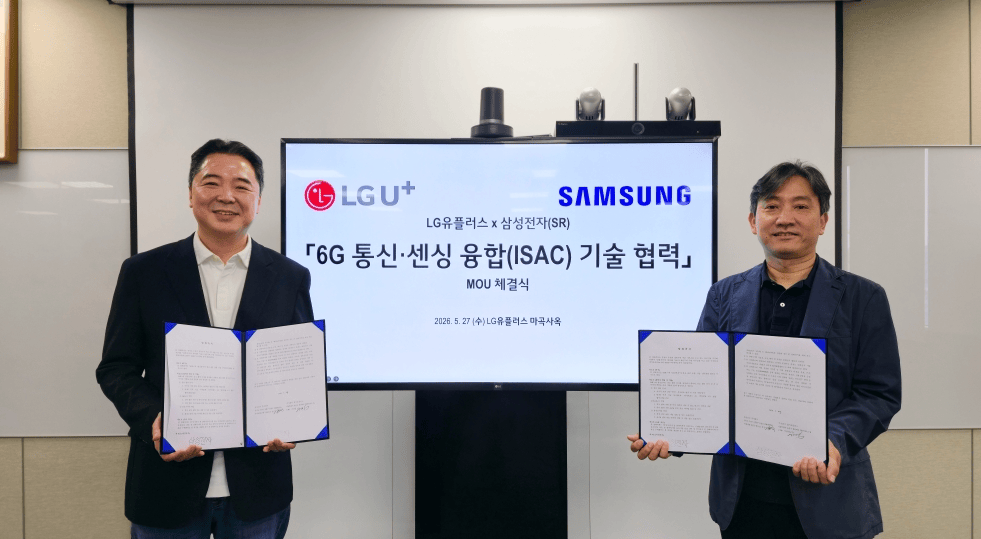
The key to ISAC technology is enabling communication networks to perceive their environment in addition to transmitting data. Existing cellular and wireless networks continuously transmit and receive wireless signals. When these signals encounter humans, vehicles, robots, drones, or other objects, they produce reflections, scattering, and changes. By analyzing these changes in wireless signals, the system can infer the distance, speed, and direction of movement of objects, thereby achieving environmental perception within a certain range without deploying dedicated radar or LiDAR equipment. The Radiocommunication Sector of the International Telecommunication Union has listed ISAC as one of the three key application scenarios for 6G, indicating that future mobile communication networks may evolve from connectivity infrastructure into sensing platforms for urban, industrial, and public safety scenarios.
The two parties plan to verify the performance of related technologies on existing 5G networks and the 7GHz frequency band. The 7GHz band is considered a candidate frequency for 6G, and related tests will help enterprises assess the deployability of ISAC technology in real network environments.
The application directions of this collaboration initially focus on daily safety and network operational efficiency. ISAC can be used to identify crowd movement, assist in detecting the operational status of drones and robots, and supplement blind spots of traditional sensing devices such as cameras and radar in traffic congestion, low-light environments, and specific industrial sites. For operators, if the network can perceive the surrounding environment and user movement status, it can form a new data foundation for base station resource scheduling, coverage optimization, capacity management, and quality of service assurance. For industrial enterprises and city managers, combining communication networks with sensing capabilities may reduce the need for independent sensor deployment in some scenarios, lower equipment maintenance complexity, and integrate safety monitoring, production scheduling, and wireless connectivity into the same infrastructure system.
Samsung Electronics and LG Uplus also plan to combine wireless data generated by ISAC—such as position, speed, and density—with camera images and other information to further develop multimodal AI technology. This direction indicates that 6G research and development is shifting from simply increasing speed and reducing latency to the integration of communication, sensing, computing, and artificial intelligence. For future 6G networks to support unmanned systems, smart factories, immersive interactions, and city-level digital twins, higher bandwidth alone is insufficient; the network itself needs to understand changes in the surrounding environment and convert sensing results into data that application systems can utilize. This verification by two South Korean companies based on real operational networks will accumulate samples for the transition of 6G ISAC technology from the research phase to engineering testing.
This article is compiled by Wedoany. All AI citations must indicate the source as "Wedoany". If there is any infringement or other issues, please notify us promptly, and we will modify or delete it accordingly. Email: news@wedoany.com
Related Products


Multi-function Marine Monitoring Low-altitude Detection Radar Sea-air Boundary Ocean Dynamic Environment Measurement
Chengdu Dixin Technology Co., Ltd.

20 Inch 1600*900 Full HD 60Hz TFT LED Monitor with VGA and DP Interfaces for Desktop Computers-Business Use
Guangzhou Zanying Optoelectronics Technology Co., Ltd.
Conveyor Belt Intelligent Monitoring System
LUO YANG WIRE ROPE INSPECTION TECHNOLOGY CO., LTD.