Japan's NTT Partners with MBRYONICS to Advance Space Optical Communication Modules
en.Wedoany.com Reported - On June 4, Japan's NTT announced a collaboration with Irish photonic communications company MBRYONICS to advance technical cooperation on next-generation space optical communication modules. This project has been incorporated into NTT's "IOWN Goes to Space" initiative, aiming to extend IOWN's optical network capabilities from terrestrial communication infrastructure to satellite networks, space data transmission, and multi-orbit communication systems.
The core of such collaboration lies in replacing high-capacity transmission tasks in traditional space communications that rely more on radio frequency links with optical communication.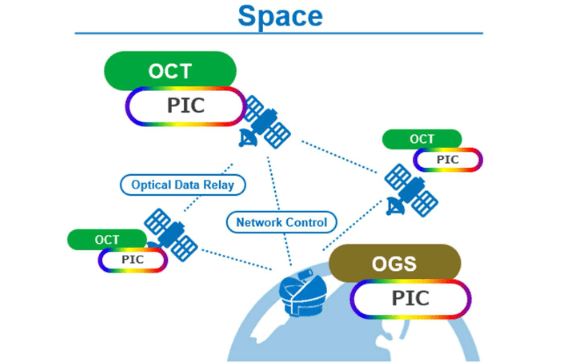
Space internet, Earth observation, satellite remote sensing, meteorological monitoring, and commercial space services beyond defense are rapidly increasing, putting growing pressure on data transmission between satellites and between satellites and ground stations. Traditional radio frequency communication has a mature ecosystem but faces increasing limitations in terms of high throughput, low latency, spectrum congestion, and secure transmission. Optical communication, which transmits data via laser beams, offers higher bandwidth, narrower beams, and stronger anti-interference characteristics, making it suitable for high-speed connections such as inter-satellite links, satellite-to-ground optical links, optical relays, and future space data centers. By choosing to collaborate with MBRYONICS, NTT is effectively combining its own technical expertise in IOWN, all-optical networks, and optoelectronic integration with MBRYONICS' engineering experience in satellite optical communication terminals, photonic integration, free-space optical links, and space-grade optical systems, to drive the development of next-generation communication modules for multi-orbit constellations including LEO, MEO, and GEO. According to MBRYONICS' official website, the company's products and services cover inter-satellite optical links, ground optical links, data relay systems, satellite optical mesh networks, optical feeder links, and deep-space missions, with design and manufacturing capabilities ranging from optical systems, optomechanical structures, and photonic integrated circuits to terminal products.
IOWN is a next-generation communication and computing infrastructure concept proposed by NTT, centered on using optical technology to reduce network latency and energy consumption while improving large-scale data processing efficiency. Previously, this framework was more focused on terrestrial networks, data center interconnection, remote collaboration, and low-latency services. This "move to space" signifies NTT's ambition to extend the boundaries of all-optical networks to space infrastructure.
From an industry chain perspective, space optical communication modules are not a single communication component but a system engineering effort involving light sources, modulation, detection, acquisition, tracking and pointing, temperature control, radiation resistance, packaging, on-board power constraints, and ground gateway coordination. Establishing stable optical links during high-speed satellite movement requires terminals capable of precise pointing with minimal angular errors, while also addressing challenges such as space temperature variations, vibration, radiation, size and weight constraints, and consistency in mass production. For NTT to bring IOWN capabilities into space networks, it must solve the engineering conversion challenge of "how to adapt terrestrial optical network technologies to satellite platforms." MBRYONICS' value lies in its long-term focus on industrializing satellite optical communication hardware, StarCom optical terminals, and photonic manufacturing capabilities, providing a foundation closer to mass production and engineering deployment for space optical modules. As satellite constellations evolve from simple communication coverage to Earth observation, edge computing, data relay, and global low-latency connectivity, space networks require higher capacity, lower power consumption, and more scalable link systems, with optical communication becoming a key enabler in this transformation.
Subsequent project progress will focus on module prototypes, on-board adaptation, interoperability with multi-orbit networks, and mass production pathways. If NTT and MBRYONICS can develop optical communication modules into scalable space network components, IOWN will no longer serve only terrestrial all-optical networks but could also become a new type of information infrastructure connecting satellites, ground stations, and future space computing nodes.
This article is compiled by Wedoany. All AI citations must indicate the source as "Wedoany". If there is any infringement or other issues, please notify us promptly, and we will modify or delete it accordingly. Email: news@wedoany.com
Related Products


MUX Series Communication Interface Device for Security and Stability Control System
Nanjing NR Electric Co., Ltd.
GYTA Type Non-Self-Supporting Aerial/Duct Optical Cable
TONGDING INTERCONNECTION INFORMATION CO., LTD.

One-Stop Steward Service for the Entire Logistics System Integration Chain
Zhongding Intelligent (Wuxi) Technology Co., Ltd.

Hot Selling 10 Inch Intel N5100 I5 I7 FHD 8 +128GB 16+256GB Win10 Pro Win11 Pro 4G 5G Rugged Tablet PC Pad with NFC Barcode
Highton Electronics Co., Ltd.


TWP16 P-Band Tropospheric Wind Profile Radar
China Huayun Meteorological Technology Group Co., Ltd.

Conveyor Belt Intelligent Monitoring System
LUO YANG WIRE ROPE INSPECTION TECHNOLOGY CO., LTD.