en.Wedoany.com Reported - As U.S. energy demand and prices continue to climb, there are growing calls to improve the consistency and predictability of offshore energy permitting processes. The House of Representatives passed the Standardized Permitting and Expediting Economic Development Act (SPEED Act) in December, but it failed to gain Senate support in the winter. By spring, bipartisan backing had increased.
At a Senate appropriations hearing in late April, Interior Secretary Doug Burgum called the reform legislation "absolutely necessary," stating, "Now is the time." Negotiations on permitting reform stalled due to the Trump administration's opposition to offshore wind projects, but resumed in March after the Interior Department initiated a review of solar projects.
On March 5, Senators Martin Heinrich (D-NM) and Sheldon Whitehouse (D-RI) issued a joint statement calling for bipartisan action, expressing hope that there would be no further disruptions to already-permitted wind projects and that momentum for solar project permitting would accelerate. The bipartisan Create Expedited Reviews to Transform American Infrastructure Now Act (CERTAIN Act), introduced on April 15, would strengthen county-level consultations and set enforceable deadlines for federal environmental permitting processes.
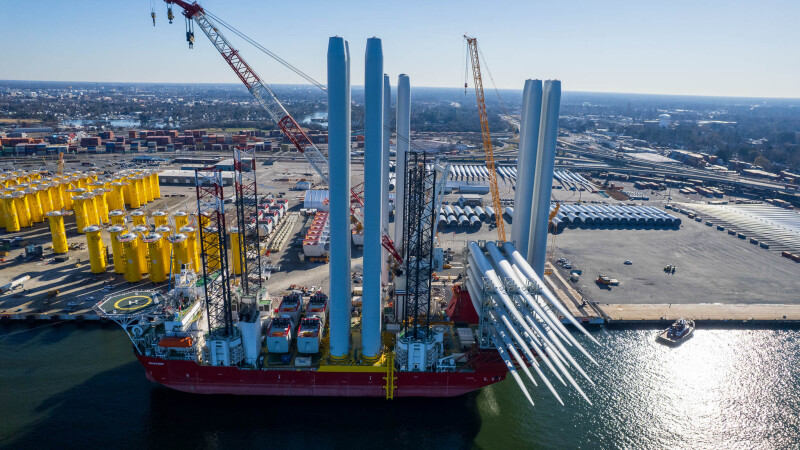
The ongoing struggles of the wind industry continue to have economic impacts. In early April, a U.S. subsidiary of German steel manufacturer EEW filed for federal Chapter 11 bankruptcy in New Jersey, a casualty of the collapse of the state's $250 million offshore wind hub and port plan in Paulsboro on the Delaware River. EEW had been set to manufacture steel monopile foundations for New Jersey's now-canceled flagship wind project. On April 21, New Jersey's utility regulators stated they were seeking to terminate a 2021 offshore wind transmission project agreement with PJM Interconnection. This agreement was part of former Governor Phil Murphy's administration's push to accelerate offshore wind development. New Jersey was once hailed as the first state to align offshore wind targets with regional grid planning. Following the cancellation of Orsted's Ocean Wind New Jersey project, the Atlantic Shores Offshore Wind Project, a joint venture between EDF Renewables and Shell, also collapsed due to inflation, rising costs, and supply chain shortages. The second Trump administration launched a comprehensive attack on remaining offshore wind projects, leaving only five projects on the East Coast surviving.
As remaining developers fight the government in federal court, TotalEnergies accepted a legally novel proposal from the Trump administration—relinquishing its existing federal offshore lease in exchange for a $928 million refund. Government and company officials stated that the refund would be reinvested in oil and liquefied natural gas projects. On April 27, supporters of the Bluepoint Wind project near New York and New Jersey and the Golden State Wind project in California followed suit, announcing "voluntary termination of their offshore wind leases" according to an Interior Department statement, with affiliated companies agreeing to invest in reliable conventional energy projects. The administration of New Jersey Governor Mikie Sherrill continues to promote renewable energy development such as solar, but the state's offshore wind prospects have suffered a severe setback.
The non-profit Regional Plan Association stated that given the Trump administration's aggressive and illegal actions to block offshore wind projects in the region, including agreements to use taxpayer funds to buy back leases, the Sherrill administration had no choice but to cancel the agreements, as there are no viable offshore wind projects to connect to and utilize this infrastructure. Even so, advocates insist that the long-term outlook remains valid as electricity demand steadily rises, particularly driven by electrification trends and data center construction.
International energy analysis firm Wood Mackenzie predicted in an April 28 report that North American energy supply will face enormous demand. The firm stated that U.S. data center capacity is expected to grow from approximately 24 gigawatts in 2026 to 110 gigawatts by 2030, accounting for 68% of total load growth during that period; data center electricity consumption will exceed 400,000 gigawatt-hours, eight times the electricity consumption of electric vehicles over the same period. The wind industry organization Oceantic Network noted in an April 14 briefing that amid heightened reliability and affordability concerns, the retirement of conventional generation has slowed, and new capacity additions (especially natural gas) are constrained by long lead times and equipment shortages; offshore wind provides large-scale, immediately deployable electricity that can be located near coastal load centers where demand is concentrated.
Permitting reform pressure comes from both the offshore wind and oil and gas sectors. The possibility of change has unsettled some critics, who see risks of bypassing the National Environmental Policy Act (NEPA). Bob Stern of the New Jersey activist group "Save Long Beach Island," commenting on the SPEED Act in March, warned that the bill creates confusion, does not aid informed decision-making, would weaken NEPA and directly conflict with other laws and even the Constitution itself, and fails to address the root causes of delays.
This article is compiled by Wedoany. All AI citations must indicate the source as "Wedoany". If there is any infringement or other issues, please notify us promptly, and we will modify or delete it accordingly. Email: news@wedoany.com