en.Wedoany.com Reported - Driven by the mining industry's transition toward low-carbon operations and cost stability, electric transport technologies are attracting widespread attention. However, the choice between battery electric vehicles (BEVs) and other electric transport systems remains highly dependent on the specific economic conditions of each mine.
According to Tim Wiitanen, Vice President of Product Engineering at Railveyor, mine depth, productivity, and mine life are determining factors. "These factors ultimately decide which transport system is the most cost-effective and economically sustainable over decades of operation," Wiitanen stated. Global mining companies face increasing pressure to reduce emissions, with many setting targets to achieve net-zero operations by 2050, accelerating the exploration of electric transport technology applications.
A recent study by GlobalData, titled "Development of Electric Vehicles in Surface & Underground Mining," shows that as of March 2025, there were 387 battery-powered mining trucks in operation globally, along with 271 trolley-assist trucks used in open-pit mining operations. The report notes that battery-powered mining trucks remain primarily in the prototype stage for large-scale mining applications, but adoption rates are steadily rising. Wiitanen believes that the industry's decarbonization drive is the main force behind the growing interest in electric transport technologies, with mining companies also seeking to improve economic stability through more predictable energy and maintenance models. "Mine electrification is the clear direction," he said. "Transitioning from diesel trucks to electric transport systems is a natural process for reducing carbon footprints and creating long-term economic stability."
In this context, mines typically conduct trade-off analyses between different transport systems. A study by Australian technical consulting firm Mining Plus compared five transport methods—diesel trucks, BEVs, conveyors, shafts, and the Railveyor system—covering mine depths from 500 meters to 1,250 meters and productivity rates from 1 million tons per year to 20 million tons per year. The study concluded that the optimal transport system is highly dependent on depth, tonnage throughput, and mine life.
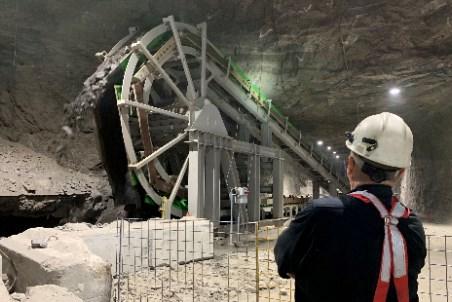
Regarding the differences between BEV trucks and the Railveyor system, Wiitanen noted that the study examined the economics of their respective infrastructure specifications, bottlenecks, and operational flexibility. BEV truck fleets require charging infrastructure and an operational layout that supports fleet movement, including passing bays and appropriate drift dimensions; while hybrid light-rail systems like Railveyor rely on electrified rail infrastructure, drive stations, and automated controls. As mines deepen, longer transport distances may increase BEV truck cycle times, affecting traffic management and operational planning, whereas hybrid light-rail systems can be expanded by extending tracks and adding cars.
"Energy infrastructure also becomes a significant consideration," Wiitanen explained. "BEVs require charging systems integrated into the mine's power grid, while hybrid light-rail systems draw continuous power directly from the mine's electrical infrastructure and recover energy through regenerative braking." For operators evaluating BEVs in deeper mines with steeper gradients, charging strategies and power demands remain important factors.
Operational bottlenecks are another key factor. BEV truck fleets operate on a cycle-based system, where loading, hauling, dumping, and charging intervals affect productivity and may lead to underground congestion and queuing, especially as fleet size increases. In contrast, hybrid light-rail systems operate continuously, reducing underground traffic interactions through automated loading and unloading sequences. The trade-off model also shows that BEV operations require operator and maintenance teams that scale proportionally with fleet size, while maintenance for hybrid light-rail systems is concentrated on fixed infrastructure. In terms of underground ventilation, both BEVs and hybrid light-rail systems reduce ventilation infrastructure needs by eliminating diesel exhaust emissions, but the study notes that heat and particulate matter still require some ventilation management.
Wiitanen acknowledged that BEVs offer significant operational flexibility, particularly suitable for mines with shorter lifespans or changing ore bodies. The comparative study found that BEV truck fleets typically have lower upfront capital costs and can adapt more flexibly to changing mine plans. "Hybrid light-rail systems are usually more infrastructure-intensive initially, but their economics improve over longer mine lives because infrastructure costs can be amortized over ten or twenty years of operation."
Wiitanen concluded that the mining industry is likely pursuing multiple electrification pathways simultaneously. The GlobalData report states that companies such as BHP, Rio Tinto, Newmont, and Teck are actively testing large-scale battery-powered mining trucks, while some operations are also expanding trolley-assist systems. "Battery technology will continue to advance, creating low-carbon opportunities especially for shorter-life mining operations," he said. "At the same time, hybrid light-rail systems like Railveyor have demonstrated compelling results in longer-life operations planned for deeper extraction and expanded production." He also noted that the long-term economics of transport decisions will remain site-specific.
This article is compiled by Wedoany. All AI citations must indicate the source as "Wedoany". If there is any infringement or other issues, please notify us promptly, and we will modify or delete it accordingly. Email: news@wedoany.com