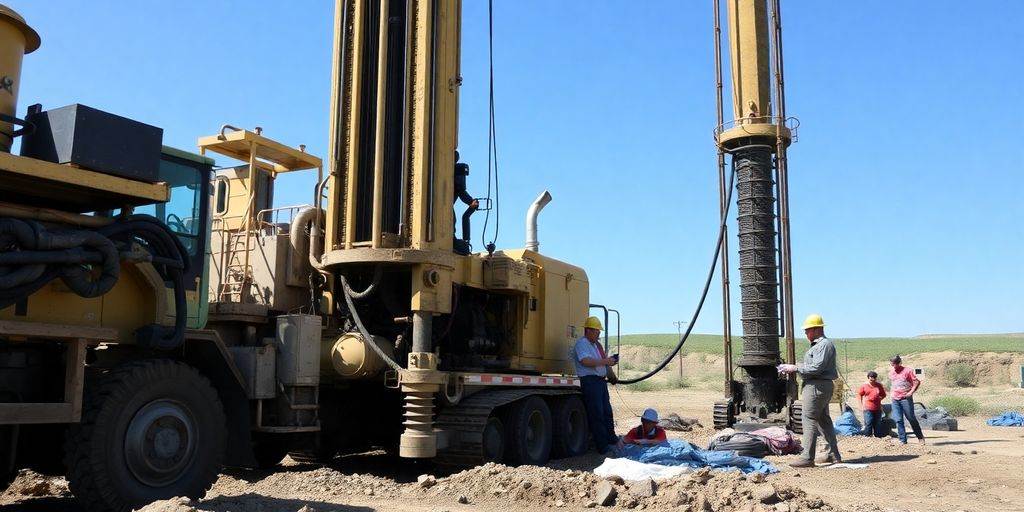
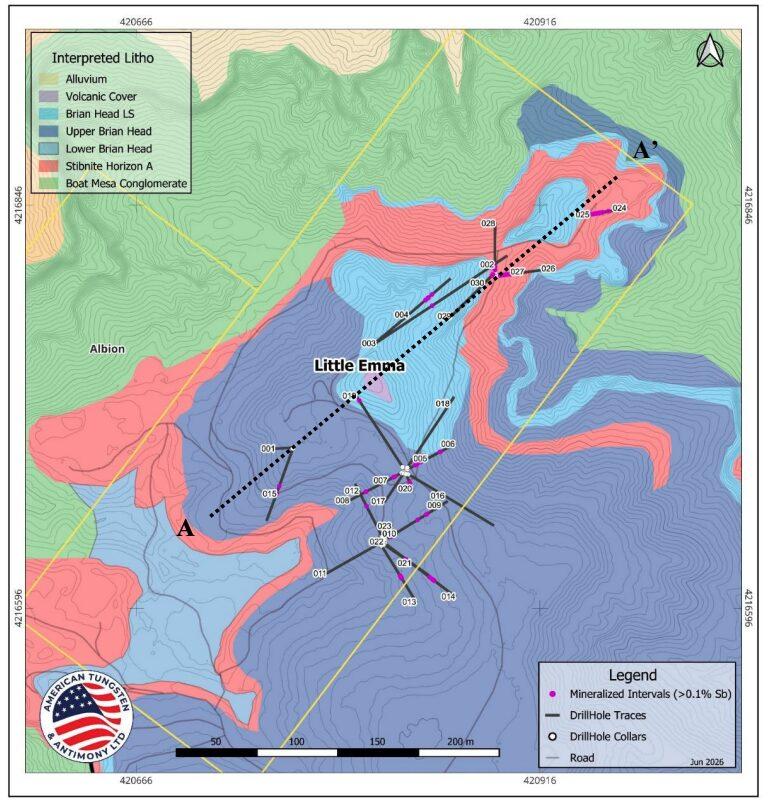
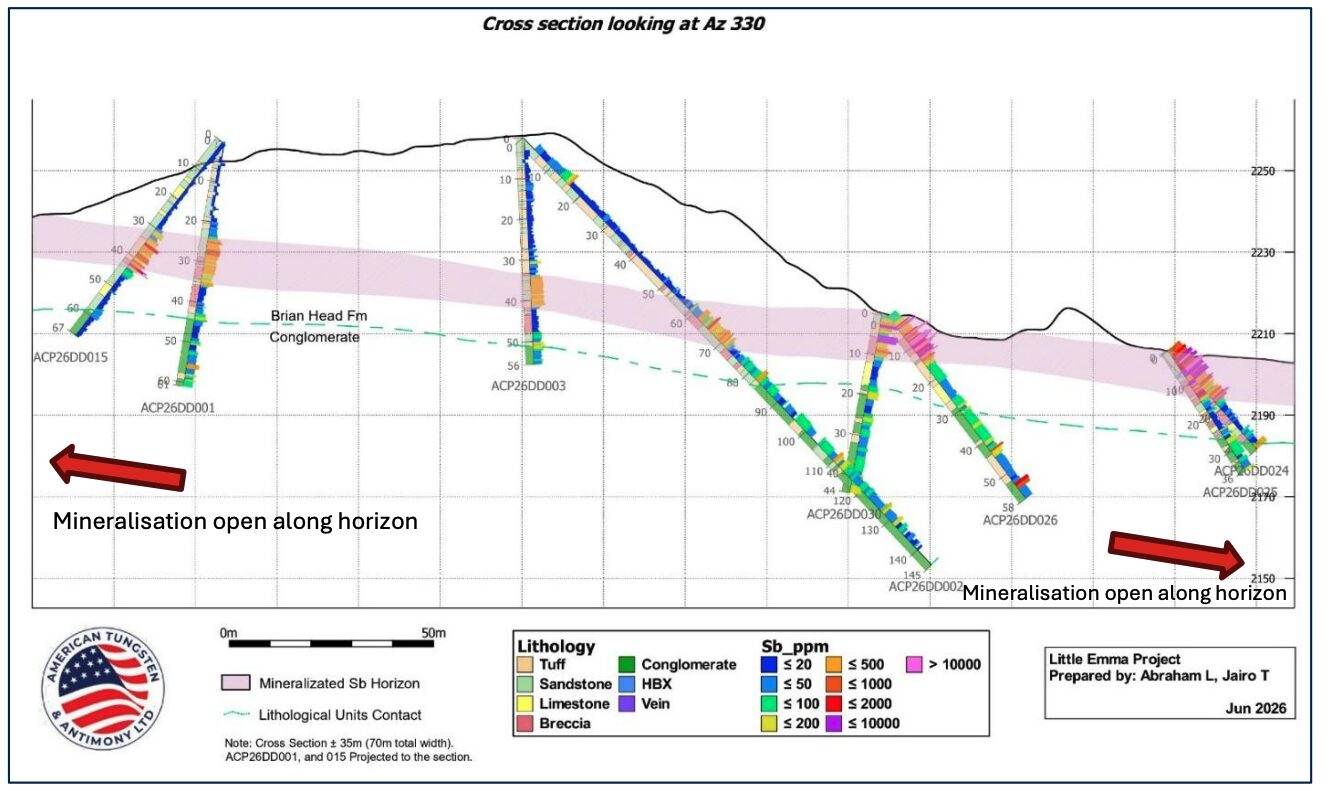
en.Wedoany.com Reported - American Tungsten & Antimony (ASX:AT4) has significantly extended the known high-grade mineralization zone at the Little Emma prospect with results from 17 additional holes from the first phase diamond drilling program at the Antimony Canyon project in Utah. The company stated that the strongest results to date confirm the scale and continuity of the stibnite system within its wholly owned claim block. Key results include: hole ACP26DD026 returned 10.37 meters at 3.98% antimony from 3.35 meters, including 4.57 meters at 8.56% antimony from 6.71 meters; another standout result, hole ACP26DD014, returned 5.7 meters at 2.80% antimony from 48.68 meters, including 1.95 meters at 8.09% antimony from 51.21 meters.
AT4 Managing Director Andre Booyzen stated that ACP26DD026 is the strongest result from the project to date, but more importantly, it is what it represents. He noted that most of the 17 holes released this time intersected mineralized horizons, deepening the understanding of the system with each drill hole advanced, and that Little Emma is just one of over 20 historical mineral occurrences within its patented claim block, covering less than 1% of the total project area.
Approximately 30 holes totaling 1,970 meters have now been completed at Little Emma. The standout high-grade intervals in ACP26DD026 and ACP26DD014 exceed the grade assumptions underlying the exploration target for the patented claim block (6.1 to 6.9 million tonnes at 1.4% to 2.3% antimony). Based on previously released analysis results from March, these intervals extend the mineralization zone along strike, and the stibnite system remains open in multiple directions.
Antimony was one of the first critical minerals affected by China's export controls, with prices surging from $12,000 per tonne to $60,000 per tonne in 2024. Prices have since retreated but remain above historical averages, ranging between $19,500 per tonne and $35,000 per tonne. This strategic metal is essential for semiconductors, munitions, night vision goggles, and industries related to the defense supply chain, and also serves as a stabilizer in solar panel glass. China continues to dominate the global antimony market, controlling nearly half of global production and nearly three-quarters of smelting capacity.
The geological setting and mineralization processes of the Antimony Canyon project share fundamental similarities with the Xikuangshan Antimony District in Hunan, China, a deposit that has historically produced over 2 million tonnes of antimony metal. In both systems, mineralization occurs in stratabound calcareous sedimentary sequences, with carbonate dissolution and pore space filling as the primary mineralization mechanisms. AT4 stated that the latest results confirm a stratabound stibnite system characterized by high-grade stibnite pods. Through detailed "fingerprinting" of the high-grade stibnite pods at Little Emma, the geochemical, mineralogical, and petrological characteristics have been understood, which will guide future drilling efforts.
Mineralization occurs within the "salt and pepper" strata. Higher-grade antimony appears within the S&P formation, typically slightly below the contact rather than directly along it.
Follow-up plans include additional drilling at multiple stibnite outcrops containing surface high-grade antimony. With soil sampling on the patented claim block completed, assay results are expected within the next six weeks. Drilling activities will now expand onto U.S. Forest Service land, advancing toward the Dry Wash target area, located 10 kilometers north of the Little Emma prospect. Meanwhile, geological mapping across the entire project area is ongoing.
This article is compiled by Wedoany. All AI citations must indicate the source as "Wedoany". If there is any infringement or other issues, please notify us promptly, and we will modify or delete it accordingly. Email: news@wedoany.com