en.Wedoany.com Reported - A research team from Zhejiang University has physically implemented a circuit-based bucket-brigade quantum random access memory (QRAM) architecture on a programmable superconducting quantum processor. This online preprint study explores a hardware interface aimed at addressing the data loading bottleneck that arises when preparing classical binary datasets for quantum processing. Although many quantum algorithms assume fast, coherent access to arrays of classical information, the physical data input layer often introduces severe latency and decoherence. The research team provides a practical circuit framework that leverages active routing mechanisms on a superconducting substrate to load traditional binary structures into quantum superposition states.
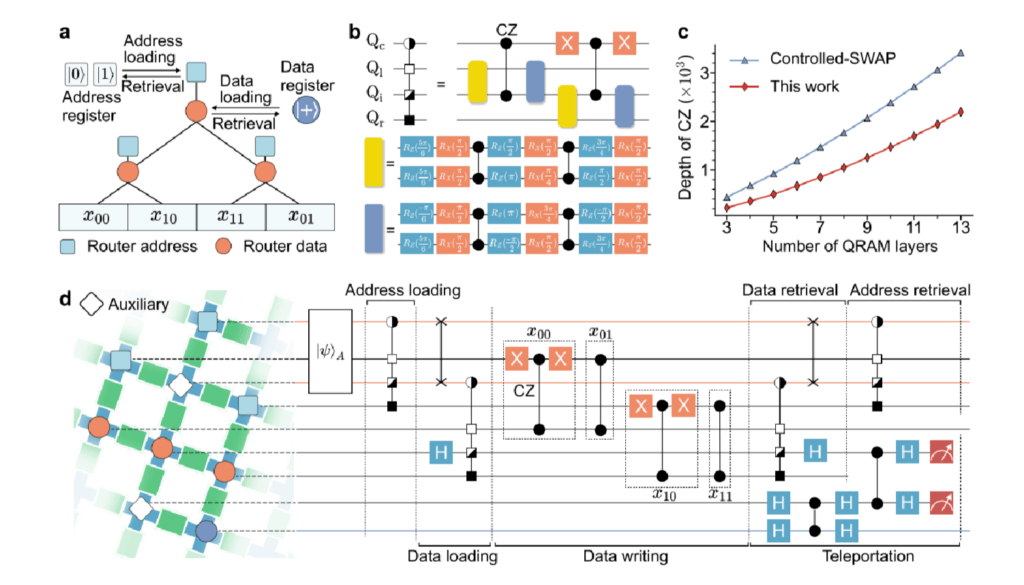
The experimental setup maps the binary tree of quantum routers onto a two-dimensional square lattice array of superconducting qubits, aiming to achieve the O(log N) active switching scaling proposed in the bucket-brigade foundational model. To address the current hardware limitations of short coherence lifetimes and circuit depth, the researchers introduced a hardware-efficient gate decomposition scheme for individual quantum routing nodes. Compared to standard controlled-swap (CSWAP) implementations, this technique compresses the necessary quantum circuit depth by over 30%. Operating on a chip with single-qubit and two-qubit gate fidelities of 99.96% and 99.7%, respectively, the team evaluated two-layer and three-layer routing trees. Assistant Professor Lu Liqiang noted that the prototype processed 4-bit and 8-bit classical data formats, with measured query fidelities of 0.800±0.026 and 0.604±0.005, respectively, while employing active error mitigation protocols to stabilize routing paths.
The ability to simultaneously route multi-input data structures is a prerequisite for executing large-data quantum algorithms, including molecular property extraction from chemical databases, transaction pattern tracking in fraud detection, and multi-parameter quantum machine learning models. However, the data reveals clear engineering limitations for current scalability. The sharp decline in query fidelity from the 4-bit to the 8-bit configuration highlights the severe noise accumulation inherent in multi-layer quantum trees. Scaling this architecture from small-scale proof-of-concept to the multi-megabit arrays required for commercial data mining will necessitate improving physical qubit gate fidelities, reducing crosstalk during parallel routing operations, and integrating robust quantum error correction on the memory bus.
The full technical manuscript is accessible via the open-access arXiv repository. For geopolitical context and institutional coverage of global deep-tech manufacturing initiatives, see the analysis summary published by the Seoul Economic Daily, as well as major technology tracking indexed by the South China Morning Post.
This article is compiled by Wedoany. All AI citations must indicate the source as "Wedoany". If there is any infringement or other issues, please notify us promptly, and we will modify or delete it accordingly. Email: news@wedoany.com