en.Wedoany.com Reported - Malawi, leveraging its potential in rare earths and other critical minerals, is attracting an increasing number of Australian-listed exploration companies, with the government positioning mining as a key pillar for economic development.
As a landlocked country in Southeast Africa, Malawi's mining sector currently contributes less than 1% to its GDP. Under the "Malawi Vision 2063" blueprint, the government is actively seeking investment in exploration, extraction, processing, and value addition to enhance the sector's economic contribution. The country's mineral resources include rare earths, uranium, titanium, gold, lithium, and coal.
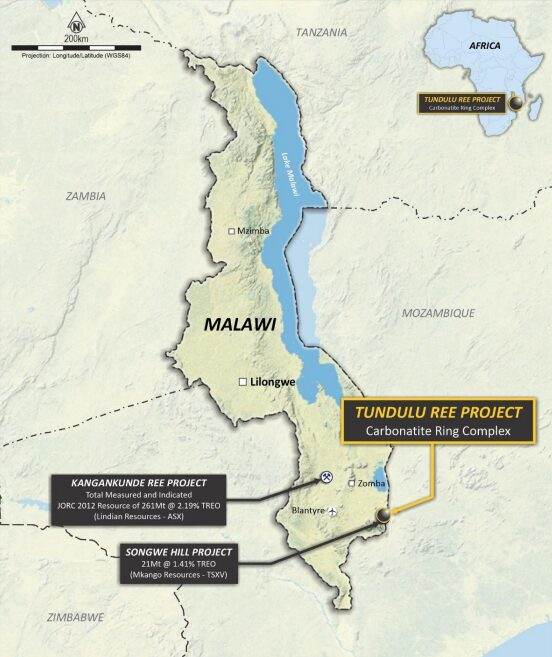
The rare earth sector is currently in focus. Since acquiring the Kangankunde rare earth project in mid-2022, Lindian Resources (ASX:LIN) has delineated 23.7 million tonnes of ore reserves with a total rare earth oxide (TREO) grade of approximately 3.0%, supporting a mine life of around 45 years. The deposit is rich in neodymium and praseodymium, totaling about 133,000 tonnes, which are used in permanent magnets. The company has secured approximately A$100 million through a placement and has entered into an offtake agreement with Iluka Resources (ASX:ILU), targeting first production in the fourth quarter of this year. AuKing Mining (ASX:AKN) entered Malawi by acquiring the Tundulu project. Historical drilling at the project returned high-grade intercepts, including 41m @ 3.7% TREO from 8m, 30m @ 4.03% TREO from surface, 35m @ 2.7% TREO from 15m, and 15m @ 3.46% TREO from 73m. A total of 24 historical drill holes ended in mineralization. AuKing is preparing to implement its first drilling program, with a total meterage of at least 5,500 meters.
The Kasiya project, advanced by Sovereign Metals (ASX:SVM), is considered the world's largest natural rutile deposit. The latest resource update shows the deposit holds 2.1 billion tonnes of resources at a rutile grade of 0.96%, containing 20.3 million tonnes of rutile and approximately 20 million tonnes of graphite. A definitive feasibility study (DFS) released in April forecasts project revenue of US$16.2 billion over an initial 25-year mine life, with annual EBITDA of US$476 million and pre-tax free cash flow of US$452 million. The study was based on data from a pilot mining program and completed under the supervision of a technical committee, including representatives from Rio Tinto. Sovereign is also evaluating monazite concentrate recovered from planned mining areas, which contains elements such as dysprosium, terbium, and yttrium, potentially adding an additional revenue stream.
In the uranium sector, Lotus Resources (ASX:LOT) resumed production at the Kayelekera uranium mine in August last year, targeting a steady-state annual output of 2.4 million pounds of U3O8. The project has a 10-year mine life with total resources of 51.1 million pounds of U3O8 equivalent. The company has secured contract commitments for approximately 1 million pounds, with deliveries planned for the second half of this year. In April, uranium concentrate from the mine received product acceptance from French nuclear energy expert Orano.
Globe Metals & Mining (ASX:GBE) released the results of a bankable feasibility study (BFS) for the Kanyika niobium asset, estimating a 24-year mine life with EBITDA of US$4.9 billion, free cash flow of US$2.9 billion, a net present value (NPV) of approximately US$1 billion, an internal rate of return (IRR) of 48%, and a payback period of three years. Early construction has begun, with first production targeted for early 2028. Approximately 90% of niobium supply comes from Brazil, and management noted that the metal ranks second among the 35 metals on the U.S. critical metals list, with demand for niobium pentoxide expected to quadruple by 2035. Chilwa Minerals (ASX:CHW) has delineated 113 million tonnes of heavy mineral sand resources at the Lake Chilwa project, with a total heavy mineral (THM) grade of 4.04%, containing 4.4 million tonnes of ilmenite. The company is evaluating approximately 200 historical drill holes to study ion-adsorption clay rare earth opportunities in the project area. Recent drilling at the Nakombe target confirmed niobium, rare earth, tantalum, and gallium mineralization, with intercepts including 126.1m @ 0.31% Nb2O5 from 125m.
This article is compiled by Wedoany. All AI citations must indicate the source as "Wedoany". If there is any infringement or other issues, please notify us promptly, and we will modify or delete it accordingly. Email: news@wedoany.com