en.Wedoany.com Reported - On June 8, South Korea's LG Group and NVIDIA announced the construction of AI factories to provide accelerated computing infrastructure for LG's core businesses, including robotics, autonomous driving, data center technology, and GPU cloud services. The two parties will connect AI model development, physical AI data generation, robot simulation training, edge deployment, and factory-level digital twins into a unified workflow, serving the AI-driven upgrade of multiple LG business sectors.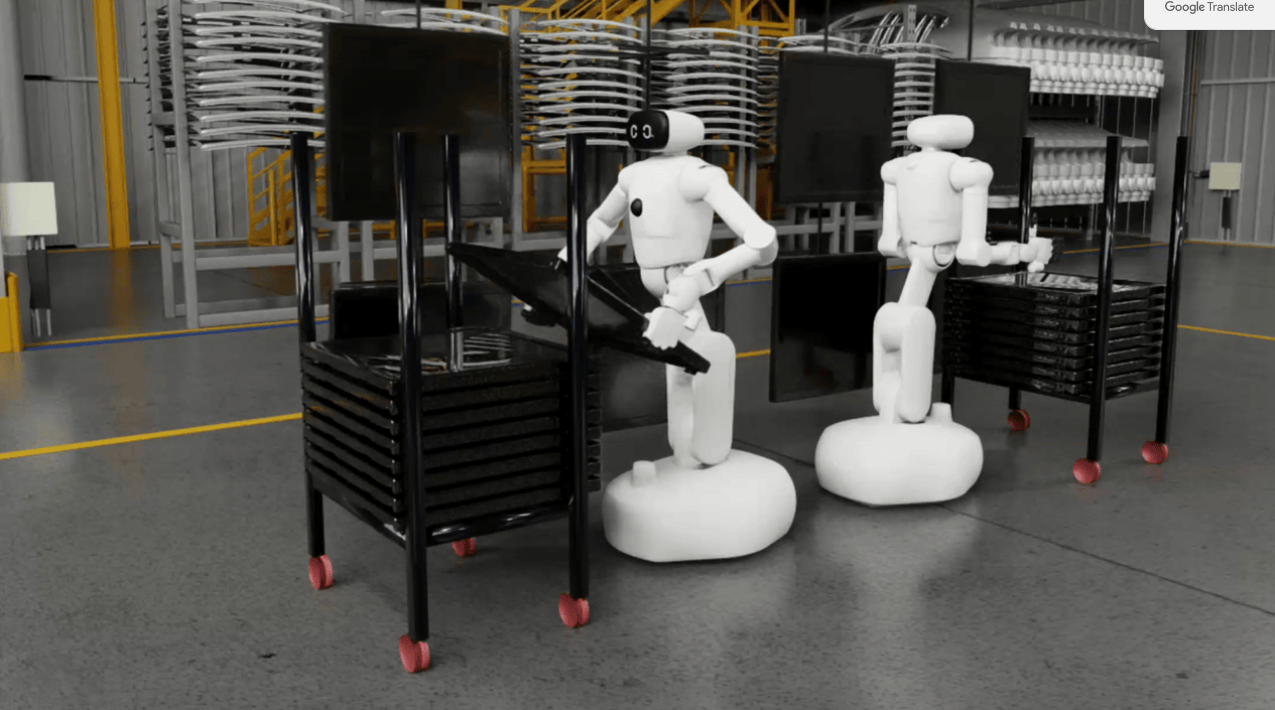
This collaboration first focuses on physical AI and robotics. LG Electronics is developing the CLoiD robot for indoor home tasks and plans to integrate NVIDIA's open robot frameworks, such as Isaac Sim and Isaac Lab, into its R&D process. This will enable simulation, training, and validation in physically accurate virtual environments before deployment on real devices. LG is also exploring the use of NVIDIA's Isaac GR00T open-source reasoning vision-action language model to enhance task understanding and action execution capabilities for home and modular robots. Additionally, LG plans to jointly develop reference robots with NVIDIA, incorporating LG robots into the Isaac GR00T ecosystem. To address the industry bottleneck of insufficient robot training data, LG Electronics will build a physical AI data factory. Leveraging NVIDIA's Cosmos world foundation model, it will generate and enhance synthetic data, providing high-quality training data for robotics and industrial AI projects to companies in South Korea and globally. LG Innotek plans to leverage its optical and sensing capabilities to provide perception components compatible with NVIDIA's development environment and GPU architecture for robots. LG CNS will introduce NVIDIA's robotics technology, Isaac framework, Cosmos world model, and GR00T robot foundation model into its PhysicalWorks industrial robot platform, promoting AI robot deployment in manufacturing and logistics sites.
AI factory infrastructure is another key focus. LG Electronics will advance technical collaboration on cooling distribution units, cold plates, and prefabricated modular designs for AI factory liquid cooling thermal management.
LG Uplus, in collaboration with LG Electronics and LG Energy Solution, will build scalable, energy-efficient AI factories based on NVIDIA's DSX platform. This will combine NVIDIA's accelerated computing and AI factory reference architecture with LG's capabilities in infrastructure, energy, and communications to support future AI cloud and GPU services. LG CNS also plans to build high-performance AI factories equipped with NVIDIA GPUs based on DSX, while LG Uplus plans to construct large-scale AI data centers capable of housing the latest NVIDIA GPUs. As AI factories evolve from simple server stacking to high-density liquid cooling, modular delivery, power coordination, and cloud service operations, LG Group's capabilities in communications, data centers, energy storage, and engineering implementation will be integrated into a unified infrastructure system. LG Energy Solution will also explore 800-volt DC data center energy storage solutions with NVIDIA to meet the higher demands of next-generation GPUs for power supply stability, energy storage regulation, and energy efficiency management. For AI cloud service providers and large enterprise customers, such infrastructure collaborations focus on shortening the deployment cycle of high-performance computing power, improving the adaptability of liquid cooling and power supply systems, and providing continuous scalability for large-scale training, inference, and agent-based operations.
Autonomous driving and autonomous AI are also included in the collaboration. LG Electronics will align its advanced driver-assistance systems and in-vehicle AI systems with NVIDIA's DRIVE platform, focusing on matching the DRIVE Hyperion roadmap in sensors, computing, and software architecture. It will use the DRIVE AGX accelerated computing platform to advance AI cockpits, edge AI processing, and software-defined vehicle product lines. LG Innotek will explore component collaboration for next-generation autonomous driving architectures with NVIDIA, focusing on core components such as sensors, connectivity, and lighting. At the model level, LG AI Research will continue advancing the EXAONE sovereign AI model, leveraging NVIDIA's Blackwell GPU, NeMo framework, Nemotron open datasets, and TensorRT-LLM inference software to strengthen model development and deployment. It will also promote agent-based AI applications within LG Group through enterprise platforms like ChatEXAONE. By integrating robotics, automotive, data centers, energy, and enterprise AI into a single collaboration framework, LG Group's AI transformation will more closely resemble an "industrial system upgrade" rather than just point-solution deployments.
This collaboration shows that large South Korean industrial conglomerates are reorganizing consumer electronics, automotive electronics, industrial platforms, cloud services, energy storage, and large model capabilities into an AI factory ecosystem. For NVIDIA, LG provides manufacturing data, robot hardware, automotive components, communication networks, and data center construction scenarios needed for physical AI deployment. For LG, NVIDIA offers a foundational platform spanning accelerated computing, simulation training, robot foundation models, and AI factory architecture. Future progress will primarily depend on the real-world deployment of robot products like CLoiD, the expansion speed of the PhysicalWorks platform in manufacturing and logistics sites, the construction pace of DSX AI factories, and the depth of EXAONE and ChatEXAONE usage in the group's business processes.
This article is compiled by Wedoany. All AI citations must indicate the source as "Wedoany". If there is any infringement or other issues, please notify us promptly, and we will modify or delete it accordingly. Email: news@wedoany.com