en.Wedoany.com Reported - NTT docomo recently demonstrated communication network countermeasures based on lessons learned from the 2024 Noto Peninsula earthquake and other disasters, as well as specific plans for AI-era network operation monitoring, during a tour at its Shinagawa Building.
docomo has summarized its basic disaster countermeasure policy into three directions: individual preparedness, the power of collaboration, and continuous improvement for the future. The main causes of communication base station service outages during disasters are power outages and transmission line failures. To ensure power supply, the company has constructed medium-area base stations at approximately 2,000 locations nationwide.
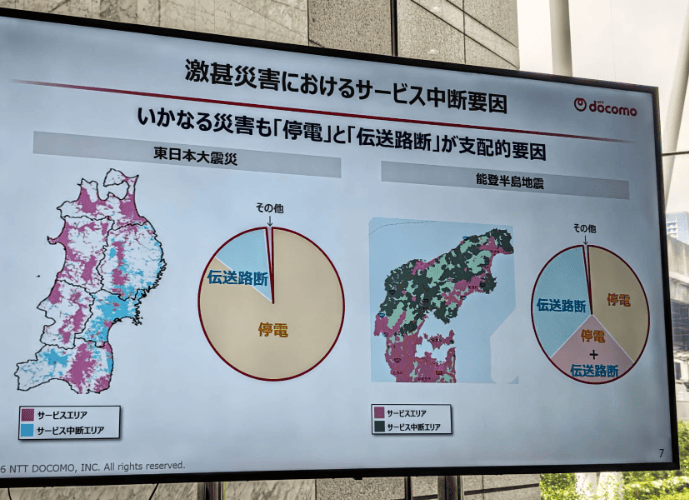
In the event of a power outage, the system activates a sleep control mechanism, limiting multiple frequency bands to one to extend the battery life of the base station.
For transmission line failures, docomo utilizes the low Earth orbit satellite communication system "Starlink" as a solution. The antenna is small and lightweight, making it easy to transport to disaster areas, and can be combined with portable base stations to quickly restore communication services.
A "wide-area base station" has been deployed on the roof of the Shinagawa Building to ensure wide-area communication. When a large-scale disaster causes ordinary ground-based base stations to fail simultaneously due to collapse or power outage, this system operates as a final line of defense, covering a broad area.
A total of 105 wide-area base stations have been installed nationwide, with the Shinagawa Building having antennas configured at four locations. Normally, they do not operate to avoid radio wave interference, but in an emergency, the system operates at maximum output power, covering an area with a radius of approximately 7 kilometers.
Previously, wide-area base stations have only been commercially activated once, during the Hokkaido Eastern Iburi Earthquake. The power required for their operation and communication maintenance is directly supplied by large generators within the building, and the transmission lines are also duplicated, ensuring high security through a thoroughly redundant system.
In large-scale disasters, traditional large base station vehicles often cannot enter affected areas due to road blockages caused by landslides and other factors. Based on this lesson, docomo is advancing the deployment of smaller vehicles with better mobility.
The light vehicle-type mobile base station vehicle integrates Starlink and an antenna with a maximum height of 6 meters on its roof. This vehicle has flexible steering, allowing it to enter narrow roads with poor conditions and establish communication areas.
In addition to Starlink, traditional standard vehicle-type mobile base station vehicles are equipped with a dedicated line (JCSAT) antenna for more stable communication quality. The vehicle has a built-in engine for power generation and can deploy an antenna up to 11 meters high to cover a wide area. Depending on on-site needs, Starlink is used when communication speed is required, and the dedicated line is used when quality is needed, enabling flexible operation.
Regarding power supply countermeasures, the core is the deployment of generators capable of ultra-long-term operation. These generators are equipped with two fuel tanks; when one tank runs out, it automatically switches to the other. Operators can refuel the empty tank while the generator is running, enabling continuous operation for approximately 100 to 150 hours, equivalent to maintaining power supply for one week.
In addition to its own initiatives, docomo has strengthened collaboration with other operators and related organizations during disasters. Previously, each company independently provided shelter support, but this has been unified into the "Connect × Change Project (つなぐ×かえるプロジェクト)", which jointly provides Wi-Fi and multi-chargers capable of simultaneously charging 10 to 20 smartphones, accelerating support for disaster victims.
Looking toward the AI era, docomo is advancing the "AI for Network" initiative to build next-generation infrastructure. Keisuke Suzuki, Director of the Service Management Department's Operations System Division, defined the application of AI in three stages: AI conversing with humans, AI agents conversing with humans, and autonomous operation by AI agents. Suzuki stated that the company is currently promoting the introduction of the first two stages.
In the first stage, specialized AIs in various fields converse with humans to accelerate initial response during failures. Among them, the "Traffic Analysis AI" can analyze the entirety of large volumes of data that humans cannot quickly review and determine the scope of impact; the "Automated Call AI" identifies suspected points through automatic testing; and the "Engineering Impact Confirmation AI" correlates engineering work with failures.
Additionally, the "Past Experience Search AI" suggests optimal response plans based on past cases, and the "Information Dissemination AI" is responsible for rapidly notifying internal and external parties. By combining these AI tools, the time required for initial response has been reduced by approximately 60%.
In the second stage, docomo has built data from over 1 million network devices into a "digital twin," considered one of the largest in the world. From anomaly detection and suspect point estimation to recovery measure suggestions, multiple AI agents execute these tasks automatically, reducing recovery time for complex failures by more than 50%.
At the Network Operations Center (NOC), responsible for actual operational monitoring and maintenance, information such as traffic status of base stations and switches distributed nationwide, as well as Starlink operational status, is displayed in real-time on large screens, enabling 24/7 monitoring and control of the communication network.
The AI agent screen displays nationwide anomaly analysis, making it clear what alerts are occurring where. The system provides conclusions such as "localized phenomenon on a specific device, expected automatic recovery, no action required," significantly reducing the burden on operators.
To detect "silent failures" that do not trigger alarms, the NOC also monitors posts on X (formerly Twitter) and the user feedback platform DownDetector.
On the 19th of last month, docomo confirmed many reports on social media that services were "difficult to use," but subsequently issued a notice stating that no impact from its own equipment failures had been confirmed. Several hours later, the issue was identified as being caused by MVNO equipment. This was a case handled by the NOC through the process of SNS monitoring, equipment status confirmation, and notification issuance. At the time, the NOC manager noticed a sharp spike in anomaly reports regarding docomo on DownDetector, while posts on X also reflected a certain number of "no signal" issues. The NOC immediately confirmed the overall network traffic and found no abnormalities in docomo equipment. Although system alarms did not sound, there was a clear actual impact based on SNS feedback. docomo first suspected a "silent failure" in its own equipment and prioritized disclosing information to users before identifying the cause, issuing the first notification. Subsequent investigation revealed a failure on the MVNO side, and the matter was ultimately handled by canceling the failure information. Not all problems can be detected by system alarms; the NOC has established a monitoring system that can detect service impacts early by combining external services and user feedback.
As a next-generation disaster countermeasure, docomo has formulated a roadmap to promote DX (Digital Transformation) and upgrade AI applications. Yasuyuki Ozaki, General Manager of the Disaster Countermeasures Office in the Service Operations Department, stated that the company will predict events before disasters occur and support actions, strengthening the pre-disaster prediction system. Going forward, the company will promote the introduction of AI agents for domestic monitoring and other areas, aiming to build a more resilient communication network operation system.
docomo is also advancing the upgrade of international roaming service monitoring. In March 2026, it successfully conducted a proof-of-concept test of the "International Zero-Touch Operations System" with Singapore's StarHub. Previously manual responses to failures of overseas operators will shift to automatic determination and automatic collaboration, aiming to achieve global-scale communication quality improvement and rapid response.
This article is compiled by Wedoany. All AI citations must indicate the source as "Wedoany". If there is any infringement or other issues, please notify us promptly, and we will modify or delete it accordingly. Email: news@wedoany.com