en.Wedoany.com Reported - On June 9, China's AI ultrasound brain-computer interface company Huachao Shenkong (BCI-Sonics) announced the completion of a hundred-million-yuan angel round series financing. The angel round was led by Matrix Partners China, while the angel+ round was co-led by Delian Capital and Daoyuan Capital, with Xunguang Capital serving as the exclusive financial advisor. The funds raised will be used for technology validation and industrial implementation.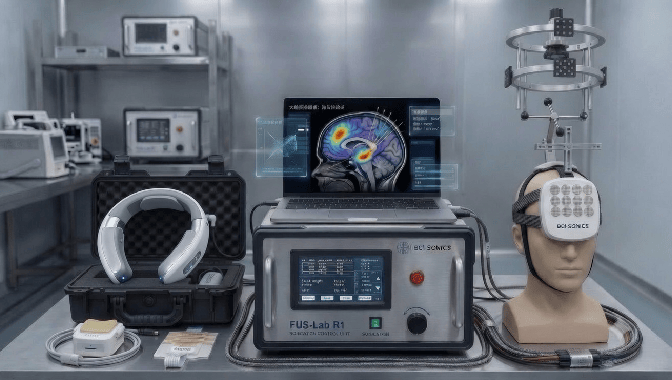
Founded in Shanghai, Huachao Shenkong is positioned as a next-generation AI ultrasound brain-computer interface company, focusing on "deep, non-invasive, and personalized" brain-computer interface technology. The company's technical approach revolves around AI algorithms, transcranial focused ultrasound, and multimodal neural reading and decoding, aiming to accurately identify, regulate, and provide feedback on deeper brain regions without opening the skull. In traditional brain-computer interface approaches, invasive solutions can obtain more direct neural signals but require surgical implantation; non-invasive solutions have a higher safety margin but face constraints in spatial resolution, deep brain region access, and personalized regulation. Low-intensity focused ultrasound technology was chosen by Huachao Shenkong as the core physical pathway due to its potential to penetrate the skull, focus on deep regions, and achieve high-precision regulation, making it suitable for integration with AI algorithms, medical imaging, acoustic modeling, and neural signal decoding to form a more complete closed-loop system.
Huachao Shenkong's team covers neuroscience, acoustics, medical imaging, artificial intelligence, and other fields, and possesses experience in medical devices from principle prototypes, engineering prototypes, clinical validation, to registration and transformation.
Technical challenges focus on transcranial propagation accuracy and closed-loop regulation capability. Human skull thickness, density, and curvature vary significantly. When ultrasound passes through the skull, phase distortion, energy attenuation, and focal point shift can occur. Without effective correction, deviations may arise between the theoretical target and the actual acoustic field focus. Huachao Shenkong disclosed that its self-developed transcranial phase correction algorithm can rapidly compensate for acoustic field distortions caused by the skull, converging transcranial focusing accuracy to a minimum of 1.5 millimeters. The company is also building an AI closed-loop neural regulation platform, which collects multimodal neural signals, provides high-precision acoustic feedback, and uses AI algorithms to identify brain states, generating personalized stimulation plans and dynamically adjusting regulation strategies. This system aims to complete the "read—understand—regulate—feedback—re-optimize" chain, transforming the ultrasound brain-computer interface from a single stimulation device into a verifiable, replicable, and iterable platform-based technology system.
This financing also reflects that the brain-computer interface industry is moving from single-route competition to a phase of parallel exploration of multiple technology routes. Invasive brain-computer interfaces have advantages in high-quality neural signal reading, while non-invasive directions such as EEG, near-infrared, and transcranial magnetic stimulation emphasize safety and accessibility. Ultrasound brain-computer interfaces attempt to establish a new technological balance between "non-invasive" and "deep precision." Huachao Shenkong has established collaborations with multiple universities, top-tier hospitals, and clinical expert teams to advance underlying acoustic technology, neural regulation mechanisms, multimodal data collection, clinical protocol design, and real-world validation. Research directions include pain, addiction, and neural remodeling. For investors, the value of AI ultrasound brain-computer interfaces lies not only in individual device products but also in their potential future extension to neural regulation, rehabilitation assistance, brain science research, and pan-medical AI platforms, among other scenarios.
Subsequent priorities will focus on engineering prototype validation, stability of personalized phase correction, effectiveness of multimodal data closed-loop systems, progress in clinical collaborations, and product registration pathways. For brain-computer interfaces to truly enter industrialization, conditions such as verifiable underlying mechanisms, replicable device engineering, and clear clinical and application scenario pathways must be met simultaneously. With the billion-yuan early-stage financing, Huachao Shenkong will have more resources to advance technology validation and productization milestones, also providing a new early-stage financing sample for China's ultrasound brain-computer interface track.
This article is compiled by Wedoany. All AI citations must indicate the source as "Wedoany". If there is any infringement or other issues, please notify us promptly, and we will modify or delete it accordingly. Email: news@wedoany.com