en.Wedoany.com Reported - Arista Networks has launched the new 7060XE7 series of 1.6 Terabit Ethernet platforms, designed to serve as the network foundation for next-generation AI clusters. This product portfolio is an extension of the Arista Etherlink architecture, supporting both scale-out and scale-up AI deployments with environmental adaptability ranging from air-cooled systems to fully liquid-cooled racks. Arista positions these new platforms as a transition from standalone switching infrastructure to integrated rack-scale AI systems capable of supporting hundreds of thousands of AI accelerators.
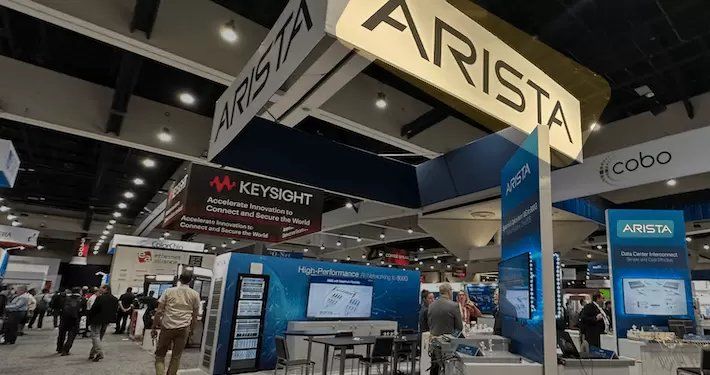
The 7060XE7 series includes multiple configurations, based on 100 Tbps switching capacity and supporting 224G SerDes technology. Arista states that these systems meet the increasing density, power, and thermal requirements of AI infrastructure while enabling deployment flexibility across various accelerator architectures. The product portfolio includes air-cooled 64-port and 128-port systems, as well as a liquid-cooled 2RU platform designed for integration into Open Rack v3 environments. The use of Linear Pluggable Optics (LPO) reduces interconnect power consumption by approximately 60%, helping operators maximize compute density within limited power budgets.
Arista highlighted collaborations with major cloud operators such as Meta, Microsoft, and Oracle, as well as ecosystem partners including AMD and Broadcom. These systems integrate AI-oriented software features within Arista EOS, including congestion management, dynamic load balancing, Multi-Path Reliable Connection (MRC) support, and advanced telemetry. The platforms will ship in phases, with the 64-port air-cooled system planned for availability in the fourth quarter of 2026, followed by additional liquid-cooled and 128-port configurations in early 2027.
"The AI era demands a rethinking of the network—it is no longer a standalone infrastructure layer but a tightly integrated component of the AI hypersystem," said Tyson Lamoreaux, Senior Vice President of Cloud and AI Networking at Arista Networks.
The new 7060XE7 product portfolio provides 1.6T Ethernet connectivity for AI architectures, with switching capacity of up to 100 Tbps per platform. It supports both scale-out and scale-up AI architectures and offers air-cooled and liquid-cooled configurations. LPO technology reduces interconnect power consumption by approximately 60%. The products are based on the Broadcom Tomahawk 6 switching chip and support Arista EOS and open network operating systems. The systems feature MRC resilience, advanced congestion management, and AI-oriented load balancing. Initial systems will ship in the fourth quarter of 2026.
Analysis: Arista's announcement reflects the industry's shift toward rack-scale AI architectures based on 224G SerDes and 1.6T Ethernet connectivity. As hyperscale cloud providers deploy increasingly dense AI clusters, the network has become a primary determinant of overall system performance, particularly for large-scale training workloads requiring low-latency collective communication across tens of thousands of GPUs and XPUs.
This launch also strengthens Ethernet's momentum in AI infrastructure. Arista, together with Broadcom, AMD, Meta, Microsoft, Oracle, and other ecosystem partners, is advancing Ethernet-based AI architectures as an alternative to proprietary interconnect solutions. The inclusion of liquid-cooled switching platforms aligns with the broader industry trend of supporting AI racks approaching and exceeding 100 kW per rack, where cooling and power efficiency become critical deployment constraints.
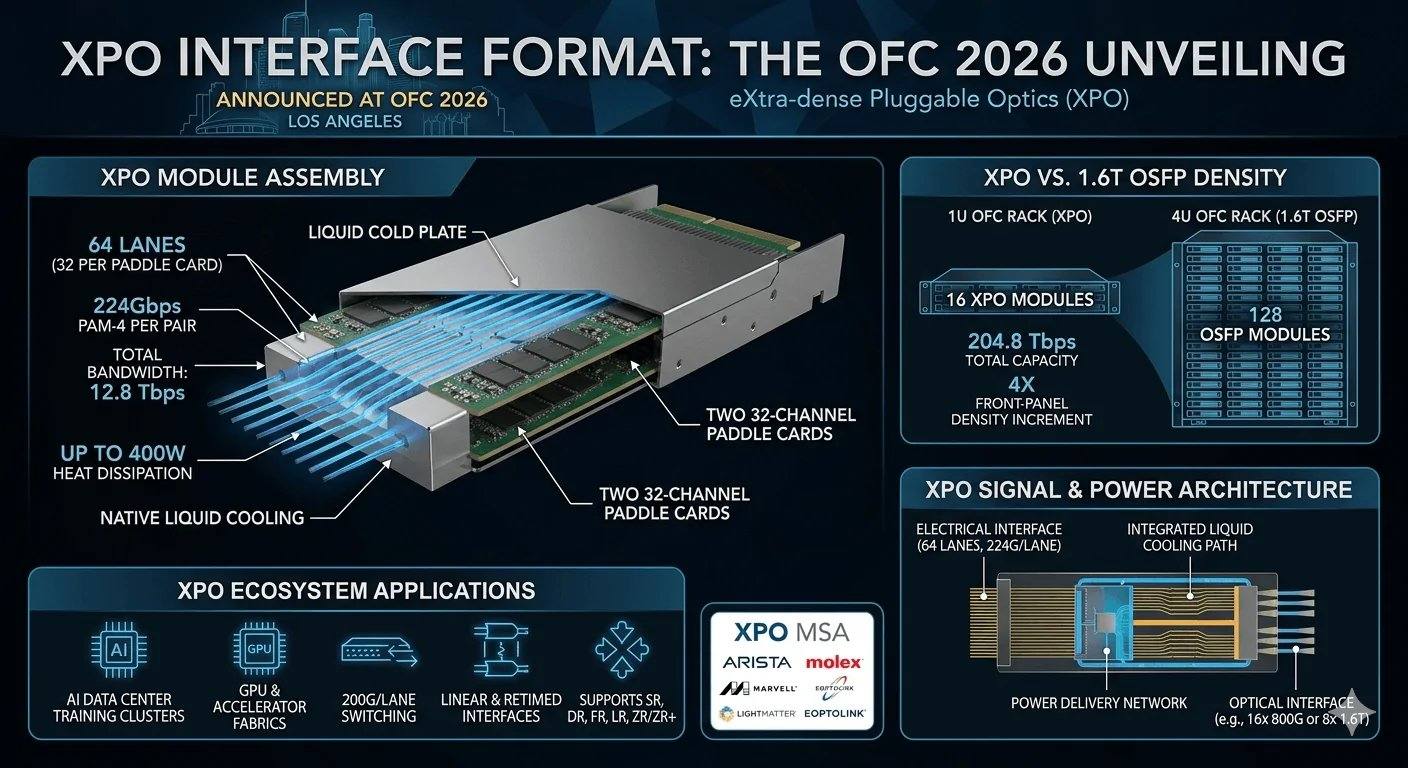
XPO (eXtended Performance Overlay) is an initiative announced in March 2026 aimed at improving Ethernet performance, resilience, and scalability for AI training and inference clusters. Its architecture is an overlay software layer running on top of Ethernet and RDMA architectures, with key functions including Multi-Path Reliable Connection (MRC), congestion management, adaptive load balancing, telemetry, fault recovery, and job completion optimization. XPO targets AI clusters composed of tens of thousands to hundreds of thousands of GPUs, XPUs, and accelerators, and is designed to complement the Ultra Ethernet Consortium (UEC) AI network specification. Founding supporters include Arista, AMD, Broadcom, Cisco, Juniper Networks, Meta, Microsoft, NVIDIA, Oracle, and other ecosystem partners. The new Arista 7060XE7 platform integrates features aligned with XPO, including MRC resilience, dynamic load balancing, congestion signaling, and AI architecture telemetry. XPO represents a significant industry effort to establish Ethernet as the preferred interconnect architecture for hyperscale AI infrastructure.
This article is compiled by Wedoany. All AI citations must indicate the source as "Wedoany". If there is any infringement or other issues, please notify us promptly, and we will modify or delete it accordingly. Email: news@wedoany.com