en.Wedoany.com Reported - On June 9, the iron ore pellet (Fe 63%) price index (PELLEX) in Raipur, India, rose by INR 200/tonne compared to June 5, reaching INR 9,600/tonne ($101/tonne) DAP (Delivered at Place). This index is derived from BigMint's bi-weekly domestic pellet price assessment.
The increase in Raipur pellet prices this week was primarily driven by local pellet producers raising their offers following the price hike by the National Mineral Development Corporation (NMDC) for iron ore.
The PELLEX index is calculated based on data points (i.e., transactions, offers, and bids). Four transactions were recorded within this publication window, two of which were used for calculation, with the T1 transaction category carrying a 50% weight. A total of sixteen firm offers, bids, and indicative prices were collected, fourteen of which were used for price calculation, accounting for the remaining 50% weight.
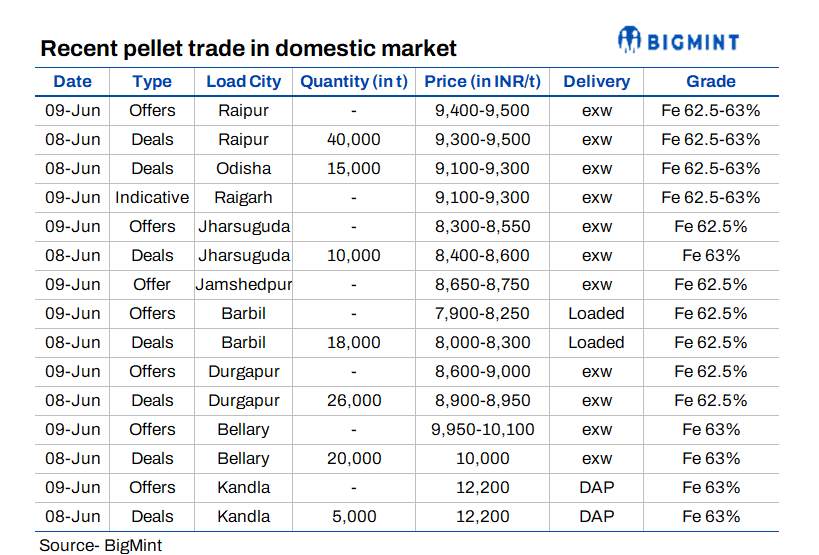
Raipur pellet producers raised offers for Fe 62.5/63% (+/-0.5%) grade pellets by INR 200/tonne ($2/tonne) to INR 9,400-9,500/tonne ($98-99/tonne) ex-works. Earlier, NMDC had increased iron ore fines and lump prices by INR 150-200/tonne. In the Raipur and Odisha regions, pellet producers concluded transactions totaling approximately 55,000 tonnes, with prices ranging from INR 9,100-9,650/tonne DAP.
Market sources stated that multiple transactions were concluded at the adjusted offer levels, particularly by some large pellet producers whose sales had largely stalled in the previous week. The price increase was mainly attributed to rising raw material costs. However, overall market sentiment remained cautious, as the downstream steel market continues to face pressure. Sponge iron and billet prices are on a downward trend, limiting buyers' willingness to accept higher pellet prices.
A steel manufacturer in the Raipur region indicated that buyers are currently in a wait-and-watch mode due to uncertainty in finished steel demand and price direction. Another steel producer noted that the accumulation of finished steel inventories has weakened market liquidity, which is further reflected in subdued raw material procurement activities.
Despite cautious sentiment, some pellet sellers reported that inquiries have emerged and some deals were concluded after the price adjustment. However, market participants observed a slowdown in buyer response after the initial round of bookings at the new price levels. One buyer commented that if the semi-finished market continues its downward trend, current prices may limit further pellet procurement this week.
Meanwhile, competitive supplies from Odisha continue to exert pressure on the Raipur market. Multiple transactions involving Odisha pellets were reported at around INR 9,000-9,300/tonne DAP Raipur, offering buyers a more cost-effective alternative compared to local material. The availability of lower-priced Odisha pellets has limited the extent to which local price increases are accepted. Market participants stated that the market is awaiting clearer signals on steel prices and demand conditions before adopting an aggressive procurement stance.
In terms of key market drivers, sponge iron (PDRI) prices fell by INR 250/tonne ($2.5/tonne) week-on-week to INR 24,200/tonne ($255/tonne) ex-works Raipur. On the day, sponge iron prices in the Raipur cluster declined by INR 100/tonne, as suppliers adjusted offers to boost market participation. The softer prices facilitated improved booking activity in the region, with trade volumes increasing compared to previous periods. Billet prices fell by INR 200/tonne ($2/tonne) week-on-week to INR 38,650/tonne ($405/tonne) ex-works, with a marginal daily decline of INR 50/tonne. The market overall remained range-bound, supported by slightly improved buying activity in the semi-finished steel segment, but sentiment in the finished steel market remained cautious.
According to BigMint's analysis, while the recent offer hikes reflect rising production costs, pellet prices may continue to face pressure in the short term amid weak steel market fundamentals, poor liquidity, and the ongoing downward trend in sponge iron and billet prices.
This article is compiled by Wedoany. All AI citations must indicate the source as "Wedoany". If there is any infringement or other issues, please notify us promptly, and we will modify or delete it accordingly. Email: news@wedoany.com