en.Wedoany.com Reported - Shanghai is advancing two major directions in the field of computing-electricity synergy: cross-province computing power migration and undersea data center deployment, exploring a new model that transforms computing power into a regulator of the power grid rather than a load bottleneck.
In terms of cross-province computing power migration, Shanghai completed an engineering validation of a "one-to-many" green electricity scheduling project for heterogeneous inference computing power in May 2025. A 160,000-Token inference task running at the Shanghai China Telecom Intelligent Computing Center was fully packaged, encrypted, and migrated to the green electricity node in Karamay, Xinjiang within four minutes, achieving zero business interruption, no user-perceptible impact, and a 95% reduction in carbon emissions per Token. The test was jointly completed by the State Grid Shanghai Electric Power Marketing Service Center, Shanghai Telecom, and other institutions. Through the municipal-level virtual power plant operation management platform built by State Grid Shanghai Electric Power, the Shanghai Telecom virtual power plant operator platform, and China Telecom's "Xirang-Yunting" computing power scheduling platform, a three-tier platform architecture of "municipal management-operator-computing power scheduling" was established, enabling real-time data exchange between power and computing resources. Technically, a stepwise switching mode (with every ten routes as one step) was adopted, combined with checkpoint-resume computing technology, second-level transmission supported by 800G optical networks, and pre-warming of the remote node environment, keeping the end-to-end latency within minutes. This test is regarded as the first engineering validation of the "one-to-many green electricity scheduling for heterogeneous inference computing power" pathway. Zhao Jianli, Deputy Director of the State Grid Shanghai Electric Power Demand-Side Management Center, stated that this scheduling has integrated heterogeneous inference nodes, equivalent Token production capacity, and green electricity absorption windows into a unified logic.
As of the end of 2025, Shanghai has over 160 data centers in operation, 23 of which are connected to the virtual power plant management platform, with a total declared adjustable load of 182,300 kilowatts. Throughout the year, the virtual power plant was dispatched 81 times, with a total response electricity volume exceeding 6 million kilowatt-hours, and data center users have accumulated over 500,000 yuan in revenue. Shanghai is currently advancing the construction of the third-generation virtual power plant intelligent operation management platform, VPPMaster, aiming to establish it as a benchmark application for municipal-level vertical large models and build a "1+N" ecosystem. The original plan to achieve 150,000 kilowatts of adjustable capacity from data centers by 2027 is expected to be revised upward.
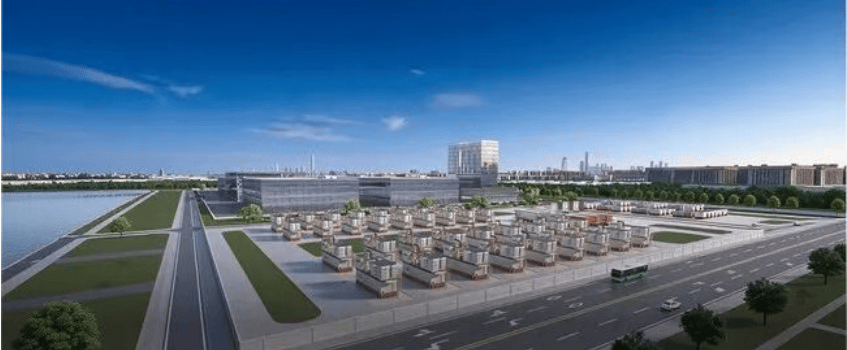
In the direction of undersea data centers, the world's first commercial undersea data center with direct offshore wind power connection and natural seawater cooling—the Shanghai Lingang Undersea Data Center—commenced full commercial operation on April 2. The project, built by Shanghai Hailanyun Technology Co., Ltd., has a total investment of 1.6 billion yuan and an overall planned scale of 24 megawatts. The first phase, with a capacity of 2.3 megawatts, is deployed at a depth of 8 to 10 meters underwater, directly powered by an offshore wind farm, with green electricity accounting for over 95%. Utilizing a passive circulation system for natural seawater cooling, its Power Usage Effectiveness (PUE) is 1.15, outperforming the national mandatory standard of 1.3. Pan Yahong, General Manager of the Project Development Center at Shanghai Hailanyun Technology Co., Ltd., estimates that at full 24-megawatt load operation, the annual electricity savings would be equivalent to over 10,000 tons of standard coal. Hailanyun is advancing joint ventures and collaborations with energy companies such as Shenergy, exploring an "asset integration" model that incorporates both wind power and computing facilities under a single investment entity. The company also plans to participate in Shanghai's intelligent computing power load planning during the "15th Five-Year Plan" period, deploying part of the computing power offshore while following Chinese wind power enterprises going global.
This article is compiled by Wedoany. All AI citations must indicate the source as "Wedoany". If there is any infringement or other issues, please notify us promptly, and we will modify or delete it accordingly. Email: news@wedoany.com