en.Wedoany.com Reported - Greek bulk carrier owner DryDel Shipping continues to advance its ship ordering program at Japanese shipyards, with the latest orders involving three shipbuilders for a total of three bulk carriers.
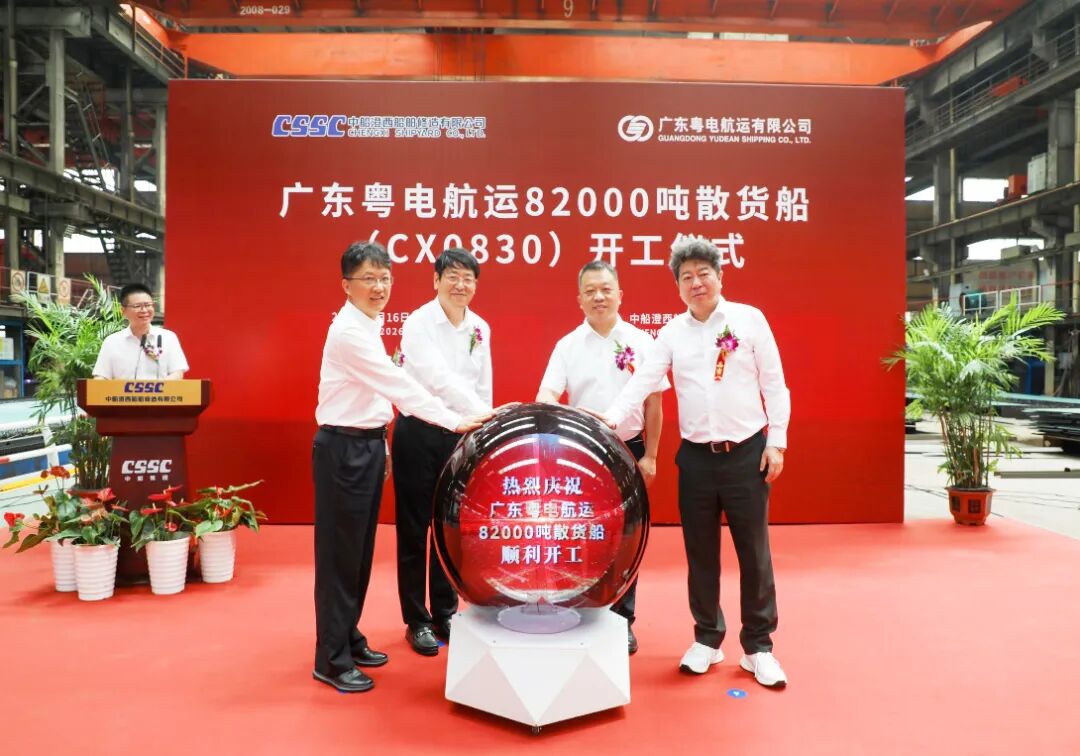
The orders include two Ultramax and one Kamsarmax bulk carrier. Specifically, Imabari Shipbuilding and Oshima Shipbuilding will each build one 64,000 dwt Ultramax bulk carrier, scheduled for delivery in 2029 and 2030 respectively; Shin Kurushima Dockyard will build one 82,000 dwt Kamsarmax bulk carrier, expected to be completed in 2028. The newbuilding prices have not been disclosed. Based on reference data from Clarksons, the current newbuilding price for an 82,000 to 84,000 dwt Kamsarmax bulk carrier is approximately $37.5 million (about RMB 254 million), a slight increase from $36.5 million in the same period last year; while the newbuilding price for a 61,000 to 64,500 dwt Ultramax bulk carrier is about $33.5 million (about RMB 227 million), a slight decrease from $34 million in the same period last year.
DryDel stated that all new vessels will be built in compliance with the International Maritime Organization's Tier III emission standards and the Energy Efficiency Design Index (EEDI) Phase III requirements, adopting a new-generation "Super Eco" design concept aimed at reducing fuel consumption and greenhouse gas emissions.
This order further extends DryDel's long-term strategic focus on Japanese shipbuilding. Since 2021, the company has placed orders for over 20 bulk carriers at Japanese shipyards, covering Handysize, Ultramax, Kamsarmax, and Capesize types. DryDel currently has 11 newbuildings under construction, all scheduled for delivery by 2030. The distribution of vessels under construction includes: one 42,300 dwt and one 64,000 dwt bulk carrier at Oshima Shipbuilding, one 63,370 dwt bulk carrier at Shin Kasado Dockyard, one 66,000 dwt bulk carrier at Tsuneishi Shipbuilding's Cebu shipyard in the Philippines, one 82,500 dwt bulk carrier at Tsuneishi Shipbuilding, one 82,000 dwt bulk carrier at Shin Kurushima Dockyard, one 64,000 dwt bulk carrier at Imabari Shipbuilding, and four 182,000 dwt bulk carriers at Namura Shipbuilding.
DryDel CEO Costas Delaportas stated that the company will continue to focus on investments in Japanese shipbuilding, adhere to a long-term development approach, and maintain confidence in the construction quality consistently demonstrated by Japanese shipyards. He noted that this move is not only about investment strategy but is also built on long-term mutual trust and shared values. Delaportas emphasized that the company's goal is not simply to pursue scale growth, but to build a modern, efficient, and commercially competitive fleet that provides long-term value to global charterers and partners.
DryDel Shipping, formerly known as Meadway Shipping, was established in 2021 and was renamed and rebranded in February 2024. The company stated at the time that the name change marked the beginning of a new phase, reflecting its commitment to service excellence and a bold, innovative approach to work. According to its official website, DryDel currently operates a fleet of 14 bulk carriers with deadweight tonnage ranging from 40,000 to 82,000 tons and an average age of 4 years; in addition, the company has 23 bulk carriers on long-term charter to further expand market capacity.
According to Clarksons data, as of now, Imabari Shipbuilding has an orderbook of 214 vessels totaling 22.37 million dwt, including 141 bulk carriers, 38 container ships, 17 tankers, 9 car carriers, 5 chemical tankers, 2 ro-ro ships, 1 research vessel, and 1 LPG carrier, with delivery schedules extending to 2030; Oshima Shipbuilding has an orderbook of 98 vessels totaling 6.17 million dwt, all bulk carriers, with delivery schedules also extending to 2030; Shin Kurushima Dockyard has an orderbook of 75 vessels totaling 2.92 million dwt, covering 36 bulk carriers, 24 chemical tankers, 7 car carriers, 4 product tankers, and 4 general cargo ships, with delivery schedules extending to 2029.
This article is compiled by Wedoany. All AI citations must indicate the source as "Wedoany". If there is any infringement or other issues, please notify us promptly, and we will modify or delete it accordingly. Email: news@wedoany.com