en.Wedoany.com Reported - The global Robotaxi industry is transitioning from the prototype validation phase to commercial operations, with multiple projects accelerating worldwide. At the NVIDIA GTC Taipei conference, several new collaborations were announced, indicating a faster pace of deployment in this field.

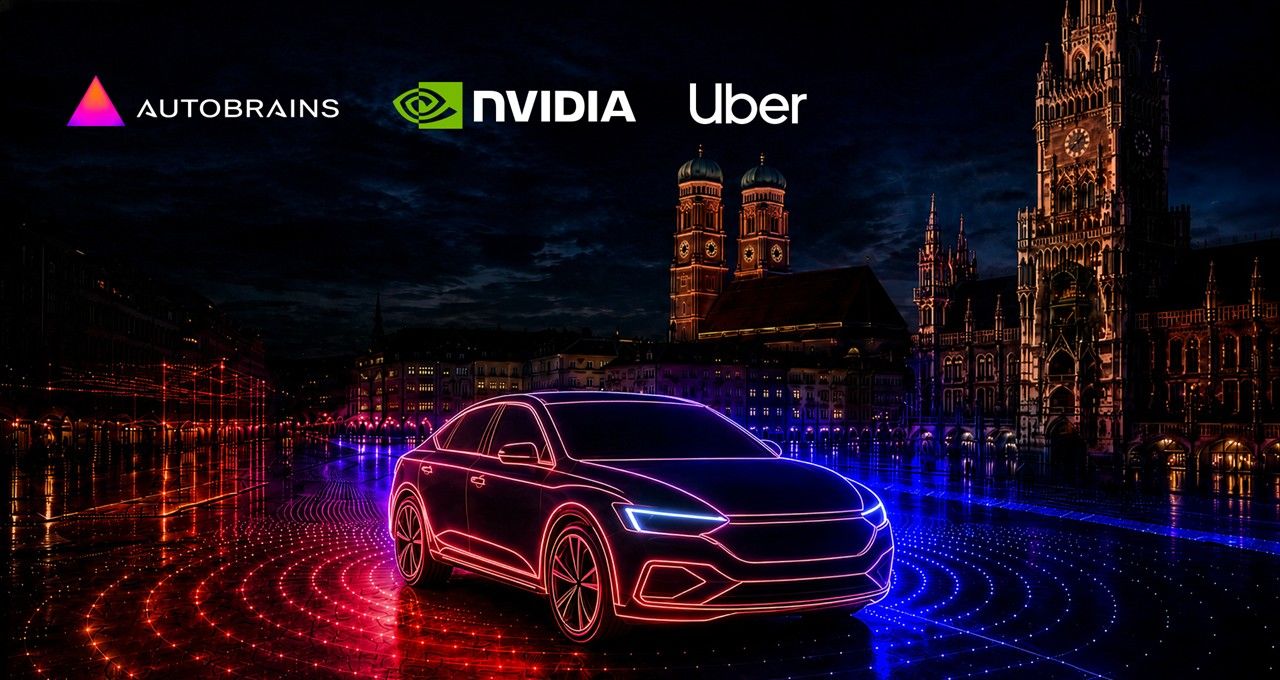
Uber and Autobrains have launched a Robotaxi project in Munich based on the NVIDIA DRIVE Hyperion platform, leveraging Autobrains' autonomous intelligent AI to support large-scale operations. Foxconn has expanded its collaboration with NVIDIA to deploy a Robotaxi fleet, integrating NVIDIA DRIVE Hyperion for rapid integration and scaling in Taiwan. VinFast, in partnership with Autobrains, is bringing L4-level vehicles built on DRIVE Hyperion to the Southeast Asian market. HUMAIN is committed to introducing Robotaxis equipped with DRIVE Hyperion to Saudi Arabia, thereby extending the platform's global footprint to the Middle East.
As the Robotaxi industry scales, safety has become a focal point. Regulators, certification bodies, and developers are closely examining the requirements for large-scale safe deployment. Industry discussions on L4 autonomous driving typically focus on the vehicle's perception and decision-making capabilities, but this alone is insufficient to meet regulatory demands. Regulators require proof that the entire system behaves reliably, can isolate faults before escalation, and operates within its design domain.
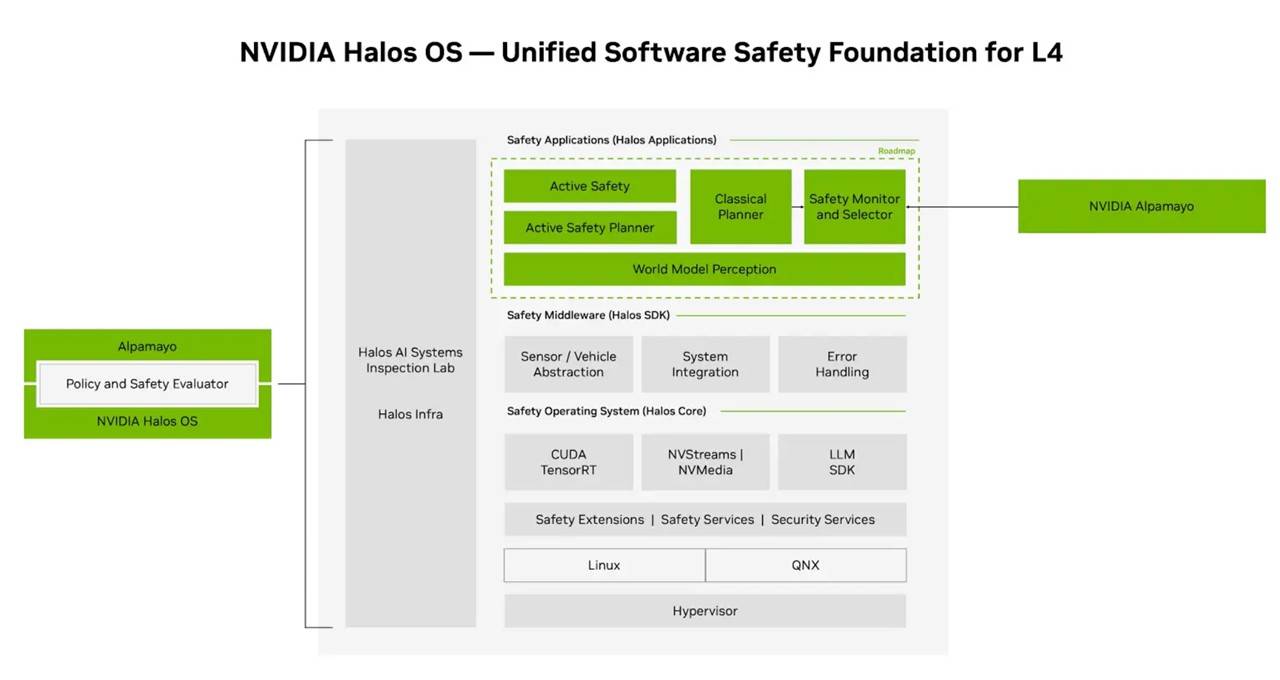
Robotaxi safety must address four challenges simultaneously: a safety-certifiable operating system, standardized hardware and software interfaces for safety, AI operating within verifiable guardrails, and large-scale validation before vehicles hit the road. To tackle these challenges, NVIDIA has introduced the Halos operating system, a component of the NVIDIA Halos full-stack comprehensive safety system, providing a unified, production-ready safety foundation for AI-driven vehicles built on NVIDIA DRIVE Hyperion.
The foundation of NVIDIA Halos OS is Halos Core, the next-generation NVIDIA DriveOS, certified to automotive safety standards. Halos Core has been audited and documented to demonstrate predictable behavior under fault conditions, with its Hypervisor isolating safety-critical functions. Halos Core complies with ISO 26262 ASIL D, includes safety-certified support for NVIDIA CUDA and TensorRT, and offers the TensorRT Edge-LLM open-source framework for high-performance large language model inference.
Halos SDK decouples the autonomous driving software stack from individual sensor drivers through a sensor abstraction layer, allowing sensors to be added or replaced without affecting application code. The vehicle abstraction layer connects the autonomous driving stack to the rest of the vehicle through a single, consistent interface. Halos SDK also provides runtime building blocks required for safety-critical software, including a deterministic application-level scheduler, zero-copy inter-process communication, a system error handling framework, and a data logger.
The Halos Applications layer provides safety guardrails for AI through deterministic, rule-based functions. It includes world model perception and the NVIDIA DRIVE Active Safety stack, featuring automatic emergency braking, lane departure warning, blind spot monitoring, collision warning, and more. Halos OS can be combined with end-to-end AI models, including the NVIDIA Alpamayo open-source model series, which supports chain-of-thought reasoning to continuously assess the road and plan actions.
Halos Infra is a cloud-based development infrastructure supporting training, simulation, and large-scale validation. It serves as the foundation for the NVIDIA Halos Safety Evaluation Framework. The SEF provides tools and guidelines for building safety cases from L2 to L4 levels, drawing on over 330 research papers and more than 1,000 patents developed within NVIDIA Halos OS.
Halos Infra runs on NVIDIA's three-computer autonomous driving solution: the NVIDIA DGX system for data center AI training, NVIDIA Omniverse based on NVIDIA OVX systems for simulation and synthetic data generation, and the NVIDIA AGX in-vehicle computer for real-time sensor processing and safety. Halos OS covers the complete development lifecycle, from training and simulation in Halos Infra to inference on the vehicle itself.
This article is compiled by Wedoany. All AI citations must indicate the source as "Wedoany". If there is any infringement or other issues, please notify us promptly, and we will modify or delete it accordingly. Email: news@wedoany.com