en.Wedoany.com Reported - The Stanford Digital Economy Lab at Stanford University has announced the launch of the AI Economic Indicators, a free and open platform for tracking how artificial intelligence is reshaping work, productivity, and value creation in the economy. "We are flying blind into one of the most important periods in world history," said Erik Brynjolfsson, a Stanford professor and director of the Stanford Digital Economy Lab. "We cannot rely on anecdotes or lagging indicators to understand AI's impact." He added, "We need timely, credible evidence to understand where AI is creating value and where it is disrupting work."
Traditional economic statistics were not designed for a technology that fundamentally changes work at the task level or creates value for consumers in ways that cannot be captured by conventional price measures. This can lead to actual changes—whether positive or negative—being overlooked or identified long after they occur. The indicators aim to bridge this gap by serving as an accessible, curated source of information to help policymakers, business executives, and individual workers make more informed decisions.
The AI Economic Indicators provide regularly updated data, interactive dashboards, and research-based methodologies on a single platform, equipping policymakers, researchers, employers, and workers with tools and information. The platform launches with three dashboards, each updated regularly at its own frequency.
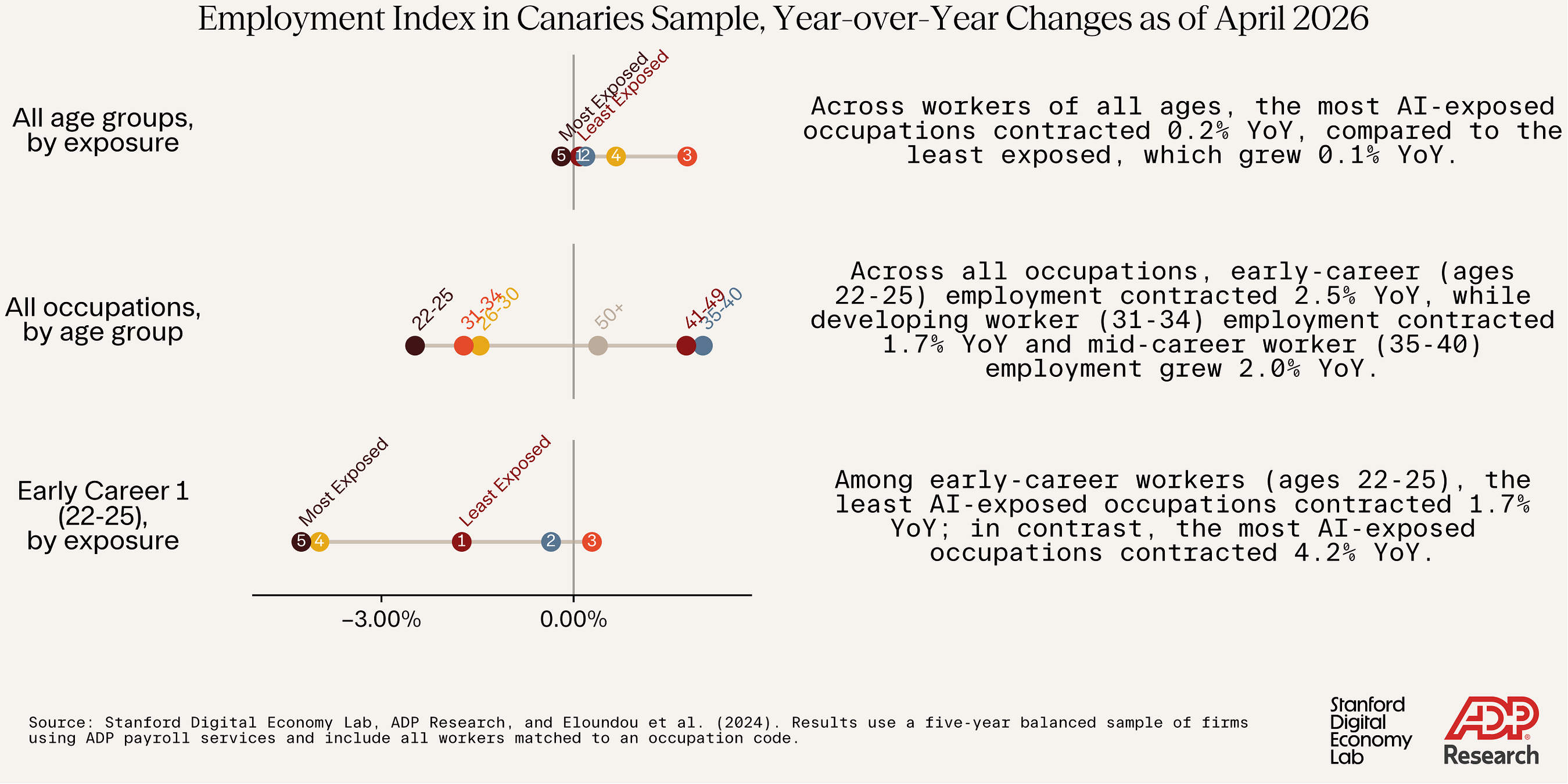
The Canaries Dashboard is a collaboration between ADP Research and the Stanford Digital Economy Lab. Leveraging DEL's access to anonymized ADP payroll data, this dashboard tracks labor market outcomes on a monthly basis, drawing on the research "Canaries in the Coal Mine: Six Facts about the Recent Employment Effects of Artificial Intelligence" (Brynjolfsson, Chandar, and Chen, 2025). It focuses on occupations and industries exposed to AI as potential early signals of employment and wage trends. Dr. Nela Richardson, chief economist at ADP, noted that this dataset allows economists, business leaders, and policymakers to see in near real-time how AI is reshaping work, tracking wages, hiring patterns, occupational mobility, and more by analyzing millions of jobs represented in ADP payroll data.
The Takeoff Tracker monitors a set of "AI takeoff" indicators, inspired by Nobel laureate William D. Nordhaus's research on economic singularities, transforming productivity, capital stock, infrastructure, and other inputs into signals, categorized by the strength of evidence supporting their role in an AI-driven economic takeoff. The Adoption Monitor uses surveys and international data sources to track AI adoption by workers and companies, monitoring the spread of AI and its potential economic effects.
More dashboards, datasets, and measurement efforts are planned for the coming months. Christie Ko, executive director of DEL, stated that this is not a one-time, static website; it will continuously grow and evolve to address current challenges, with the current launch representing only the tip of the iceberg.
This article is compiled by Wedoany. All AI citations must indicate the source as "Wedoany". If there is any infringement or other issues, please notify us promptly, and we will modify or delete it accordingly. Email: news@wedoany.com