en.Wedoany.com Reported - In 2026, Thailand's fixed broadband market has reached approximately 15.4 million connections, with a household broadband penetration rate of about 55%. Fiber-to-the-Home (FTTH) now accounts for nearly 90% of broadband connections, with a national median download speed of 272.65 Mbps and upload speed of approximately 255 Mbps. The market is dominated by several operators, and users' choice of ISP increasingly depends on reliability, customer experience, AI features, gaming performance, and value-added services.
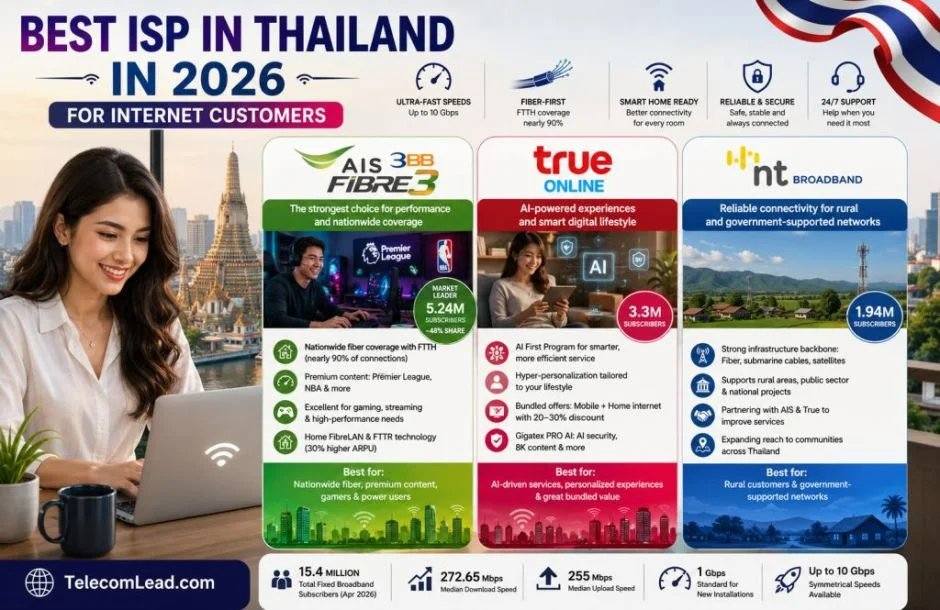
Thailand's broadband market is dominated by two private operators and one state-owned enterprise. AIS 3BB Fibre3, a subsidiary of Advanced Info Service, has become the largest broadband provider in Thailand after merging with 3BB, serving 5.24 million internet users and controlling approximately 48% of the market share. This operator adopts a quality-centric growth strategy, with broadband revenue growing by 9.6% in the most recent fiscal year. AIS offers innovative Home FiberLAN technology, premium sports content such as the English Premier League and NBA, and invests in Fiber-to-the-Room (FTTR) technology, which has increased Average Revenue Per User (ARPU) by 30%. AIS plans to invest 30 billion to 35 billion Thai Baht in network and IT modernization in 2026, with annual investments expected to reach 35 billion to 40 billion Thai Baht in 2026 and 2027, an increase of 50% to 60% compared to previous years, to support the AI ecosystem and next-generation broadband infrastructure.
TrueOnline, as part of the True-DTAC group, has approximately 3.3 million broadband users. Its core strategy is the "AI First Program," leveraging artificial intelligence to improve network performance, customer support, and personalized digital services. True customizes broadband experiences for users in major metropolitan areas through a "Hyper-Personalization" strategy, offering the Gigatex PRO AI package, which bundles broadband with AI-driven home security, smart home services, and 8K content streaming support. The company also offers converged packages, providing 20% to 30% discounts when households combine mobile and fixed broadband services.
State-owned National Telecom (NT Broadband) has approximately 1.94 million retail broadband users and holds digital infrastructure assets valued at over 200 billion Thai Baht, including submarine cables, satellite systems, and fiber optic networks. NT Broadband plays a role in rural connectivity and government projects but is expected to face an operating loss of approximately 6 billion Thai Baht in 2026 and is exploring cooperation opportunities with AIS and True to improve profitability.
Thailand's broadband market is characterized by hybrid connectivity. In addition to fiber, AIS and True are actively deploying 5G Fixed Wireless Access (FWA) to cover rural communities and temporary commercial locations where fiber installation is difficult. New installations typically start at 1 Gbps, thanks to the widespread deployment of XGS-PON technology. High-end users can enjoy symmetrical 2 Gbps or even 10 Gbps services. International connection latency has improved, with latency to regional hubs such as Singapore and Hong Kong ranging between 18 milliseconds and 25 milliseconds, driven by expanded submarine cable investments.
Broadband pricing remains competitive. Standard 1 Gbps fiber packages typically cost between 500 Thai Baht and 600 Thai Baht per month. Operators encourage users to adopt high-end packages, such as AIS's SuperFast Plus plan, which includes a free public IPv4 address. In terms of customer experience, AIS users occasionally report IPv4 routing challenges and online gaming performance packet loss during peak evening hours. Some former 3BB users have encountered billing inconsistencies and loyalty reward conversion issues when migrating to AIS systems. TrueOnline users have raised concerns about automatic activation of paid value-added services after free trial periods end. NT Broadband users face reliability challenges with rural infrastructure during adverse weather conditions and issues with weekend technical support availability.
The industry faces a digital skills gap of approximately 70,000 people. Operators are deploying AI-driven autonomous operations and maintenance platforms to automate network management, data center operations, liquid cooling systems, and infrastructure optimization. True has committed to providing AI foundational skills training to 100% of its employees by the end of 2026. Meanwhile, the broader digital ecosystem benefits from substantial international investments. Amazon Web Services has committed to investing $15 billion in infrastructure in Thailand, and ByteDance has announced a $4 billion investment in data centers. These projects are expected to support enterprise ICT growth of 10% to 12%, increasing demand for managed connectivity and private 5G services.
For users seeking the best ISP in Thailand in 2026, the choice depends on usage patterns. AIS 3BB Fibre3 offers advantages in nationwide fiber coverage, premium content, gaming, and high-performance broadband. TrueOnline excels in AI-driven services, personalized digital experiences, and bundled products. NT Broadband remains a practical choice for rural users and government-supported networks. With 15.4 million users, nearly 90% FTTH penetration, standard 1 Gbps packages, high-end 10 Gbps services, a median speed of 272.65 Mbps, and billions of dollars in AI and data center investments, Thailand's broadband market is evolving into a sophisticated digital connectivity ecosystem.
This article is compiled by Wedoany. All AI citations must indicate the source as "Wedoany". If there is any infringement or other issues, please notify us promptly, and we will modify or delete it accordingly. Email: news@wedoany.com