en.Wedoany.com Reported - GigaDevice has launched two new microcontroller series for optical communication modules, expanding its product line for high-speed and low-speed optical interconnect applications. The newly released GD32E512 and GD32E252 MCU series target the growing demand in AI data centers, cloud infrastructure, telecom networks, and access network deployments, where optical connectivity is becoming increasingly critical to system performance.
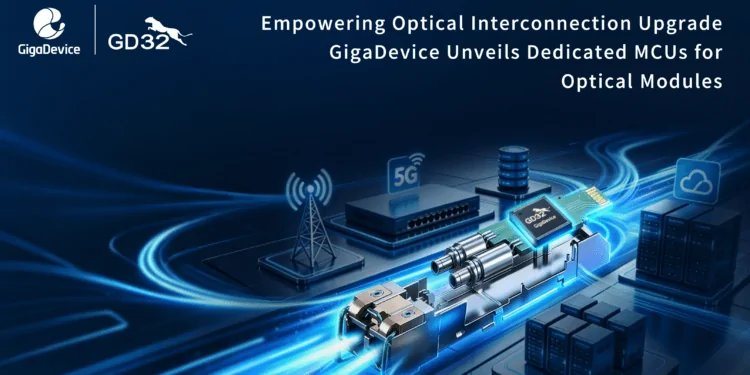
The GD32E512 series targets high-speed optical modules, featuring an Arm Cortex-M33 processor with a main frequency of up to 120 MHz. The device integrates I3C connectivity and combines multiple monitoring and control interfaces, including I²C, MDIO, ADC, DAC, comparators, and operational amplifiers. GigaDevice stated that the MCU adopts a compact 3 mm × 3 mm package to accommodate increasingly dense optical module designs. The GD32E252 series, targeting low-speed optical modules and access network applications, adopts the Arm Cortex-M23 architecture and is optimized for low power consumption, analog performance, and cost-sensitive deployments.
GigaDevice has been investing in optical module MCUs since 2018 and has shipped tens of millions of optical communication processors to the market. The company claims its optical communication products are now deployed in telecom, data center, and access network applications. Looking ahead, GigaDevice said it is focusing R&D on three major optical network trends: high-speed pluggable optics, silicon photonics, and co-packaged optics (CPO), which are increasingly tied to AI infrastructure and next-generation network platforms.
Microcontrollers are often overlooked components in optical transceivers, but they play a critical role in monitoring, management, diagnostics, power control, thermal management, and communication between the optical module and the host system. As optical modules become more complex, especially in 800G, 1.6T, and future AI network deployments, the demand for higher-performance embedded controllers continues to grow. The addition of I3C support in the GD32E512 is particularly noteworthy. As module complexity increases and management traffic expands, the optical networking industry is gradually moving beyond the traditional I²C interface. I3C offers higher bandwidth, lower latency, and better scalability, making it increasingly attractive for future high-density optical modules used in AI clusters and hyperscale networks.
This article is compiled by Wedoany. All AI citations must indicate the source as "Wedoany". If there is any infringement or other issues, please notify us promptly, and we will modify or delete it accordingly. Email: news@wedoany.com