en.Wedoany.com Reported - Sharp announced at a business briefing on June 9 that it will restructure its smartphone product lineup, shifting its sales focus from entry-level to mid-to-high-end price segments. The company plans to increase the shipment ratio of AQUOS sense and higher models from 40% in fiscal 2025 to 70% in fiscal 2026. Currently, Sharp's smartphone product line is divided into three tiers: the entry-level AQUOS wish, the mid-range AQUOS sense, and the high-end AQUOS R series.
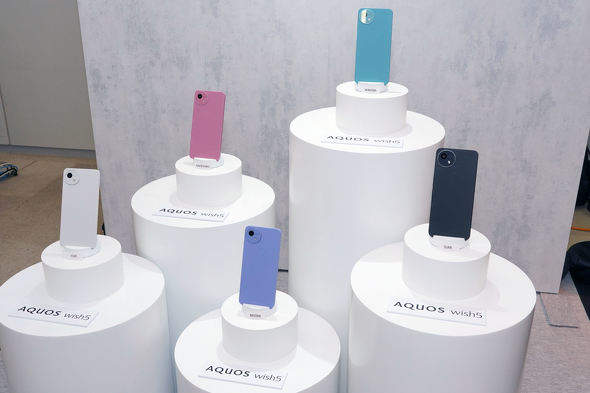
Shigeru Kobayashi, Executive Officer, Co-COO overseeing Sharp's smartphone and PC businesses, and Head of the Smart Workplace Business Group, stated that this move aims to improve profitability. He emphasized that the company hopes to raise the sales ratio of high-end and mid-range models from 40% to 70%. Previously, the entry-level AQUOS wish series accounted for 60% of shipments. The latest model, "AQUOS wish5," launched in June 2025 at a price of approximately 35,000 yen, is Sharp's main product for maintaining market share. The mid-range AQUOS sense series originally occupied this price point, but its price gradually increased with generational upgrades, prompting Sharp to introduce the cheaper AQUOS wish series below it.
The background to Sharp's shift toward mid-to-high-end price segments is the sustained rise in memory and storage chip prices. Although the company procures components through its parent company Hon Hai, leveraging global economies of scale, it still faces cost pressures. Kobayashi noted that the depreciation of the yen, combined with rising memory and SSD prices, has created a challenging market environment. This impact is most pronounced on low-cost entry-level terminals. He also pointed out that AQUOS's domestic market share in Japan has slightly declined recently, with changes in the sales structure of overseas manufacturers being a significant factor. According to the "Fiscal 2025 Full-Year Domestic Mobile Phone Shipment Survey" by market research firm MM Research Institute, Sharp's smartphone shipments fell 32.4% year-on-year, dropping to fourth place, behind Google and Samsung Electronics. In fiscal 2024, Sharp ranked second with the highest share among Android smartphones, but it has been significantly squeezed due to Samsung Electronics expanding its sales channels to SoftBank and Rakuten Mobile, as well as the strong performance of Google's Pixel a series.
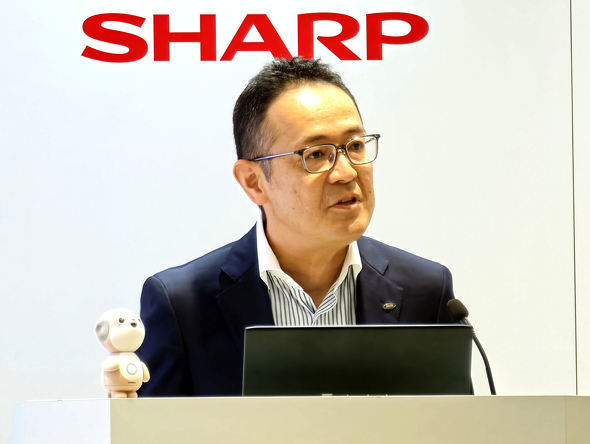
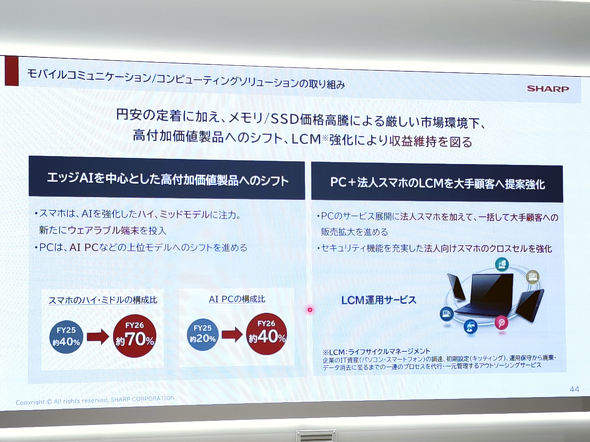
Kobayashi admitted that Google and Samsung Electronics are strong in the mid-to-high-end segment, and Sharp needs to respond by strengthening its high-end and mid-range products. Among these, the mid-range AQUOS sense series enjoys high customer satisfaction, and the company hopes to maintain this advantageous position. Another reason Sharp is focusing on mid-range and above is the rising cost of memory and storage. Due to surging demand from AI servers and other factors, memory chips are in short supply, leading to a sharp increase in procurement prices. There is a time lag from procurement and development to market launch, but this impact is now becoming apparent.
Entry-level models are more significantly affected by the surge in memory and storage prices. The main hardware distinguishing high-end, mid-range, and entry-level categories is the chipset and camera. For example, using a Snapdragon 8 series indicates high-end, while a 6 series indicates entry-level, with performance directly determining cost. In contrast, configuration differences in memory and storage are smaller and not directly linked to the terminal tier. An entry-level phone priced at around 30,000 yen and a high-end phone priced at over 200,000 yen may both be equipped with 256GB of storage. Since the price of an entry-level phone is only about one-seventh that of a high-end model, the proportion of memory and storage costs in its total cost is higher. Once component prices rise, the profit margins of entry-level models, which rely on high volume and low margins, are squeezed to the point where higher sales volumes could lead to greater losses.
The impact of rising memory prices is not unique to Sharp; many manufacturers are adopting similar strategies of shifting toward mid-to-high-end price segments. When Xiaomi launched the "Xiaomi 17T" and "Xiaomi 17T Pro" in June, it also cited rising memory prices as a reason for price increases, with the more mid-range Xiaomi 17T seeing a larger price hike. The "arrows We3," launched by FCNT on June 25, also saw a price increase compared to the "arrows We2" released two years ago. Comparing open market prices, the arrows We2 was approximately 37,000 yen, while the arrows We3 is about 42,000 yen, an increase of roughly 5,000 yen. The company initially planned to increase memory from 4GB to 6GB but abandoned this plan due to market conditions. Although costs for custom components like displays are also rising, even with the procurement capabilities of the Lenovo Group, price stability cannot be maintained.
This article is compiled by Wedoany. All AI citations must indicate the source as "Wedoany". If there is any infringement or other issues, please notify us promptly, and we will modify or delete it accordingly. Email: news@wedoany.com