en.Wedoany.com Reported - Container spot freight rates on the transpacific and Asia-Europe routes have risen for the sixth consecutive week, although the strong gains of last week have moderated. Since the Red Sea crisis effectively closed the Suez Canal to most Asia-Europe routes and some Asia-North America East Coast services, the early arrival of the summer peak season by a full month has become the norm.
A major European freight forwarder told The Loadstar that shippers and importers have booked large volumes of containers due to the Cape of Good Hope diversion, increasing transit times, while the Suez Canal remains effectively impassable. Against this global backdrop, a demand spike has emerged, altering shipper strategies, and key routes have been adjusted to accommodate longer transit times. The forwarder added that the peak season has shifted, with the "just in case" concept regaining precedence over the "just in time" philosophy, as retailers seek to stock up early for sales while avoiding air freight modes and their higher costs.
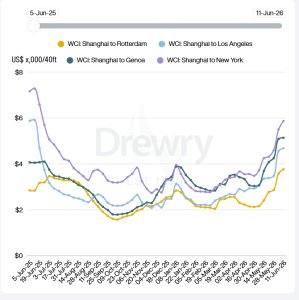
This week, Drewry Freight's World Container Index (WCI) showed rates on the Shanghai to Rotterdam leg rising 5% to $3,768 per 40-foot container, while the Shanghai to Genoa leg increased only 1% to $5,139 per 40-foot container.
With significant bookings already in place for the remaining Asia-Europe capacity in June, carriers will continue to push spot rates higher next week. MSC's new FAK (Freight All Kinds) rates will take effect on June 15, at $6,000 per 40-foot container to North Europe and $6,500 per 40-foot container to West Mediterranean ports.
Today's Shanghai Containerized Freight Index (SCFI) showed a 15.5% increase on the Shanghai to North Europe leg and an 11.5% increase on the Shanghai to Mediterranean leg. The rise in spot freight rates coincides with various peak season surcharges (PSS) on cargo under long-term contracts. CMA CGM and Ocean Network Express (ONE) have announced peak season surcharges of $1,000 to $1,200 per 40-foot container, also effective June 15.
Another European freight forwarder told The Loadstar that the current rise in demand and increase in bookings are somewhat expected, as shippers had delayed for some time to observe the evolution of the Middle East situation. She was uncertain whether demand was sufficient to justify the introduction of high peak season surcharges in contracts. She added that carriers are canceling voyages and skipping ports in Asia, tightening control over allocation agreements, and experiencing some rollovers. Forwarders also reported that some carriers have resumed the strategy of reducing allocations and then notifying that FAK or higher rates would apply if overbooked.
With June capacity largely booked, carriers and customers are turning their attention to the supply-demand ratio for July. MSC this week announced new FAK rates effective July 1, at $7,500 per 40-foot container to North Europe and the Mediterranean. A forwarder said carriers indicate that June is fully booked, and some even say July is also fully booked, applying to all key routes: transpacific, westbound Asia, and everything in between.
Pricing on transpacific routes mirrors that of Asia-Europe. WCI's Shanghai to New York rate rose 7% week-on-week to $5,870 per 40-foot container, while the Shanghai to Los Angeles leg increased 3% to close at $4,683 per 40-foot container. The new carrier rate increases announced this week for July look substantial. Most notably, CMA CGM announced a "shock" peak season surcharge (PSS) of $4,000 per 40-foot container on all Asia-to-US cargo effective July 10, suggesting transpacific freight rates could surge next month.
US West Coast forwarder Freight Right noted that US shippers are facing significant confusion and market anxiety due to upcoming tariff adjustments in July. The current market pressure represents an early and highly compressed peak season, rather than the traditional timeline typically seen in the second half of the year. The company stated that this high-rate environment is expected to persist through the remainder of June and throughout July, as ocean carriers are highly unlikely to voluntarily relinquish their pricing leverage.
This article is compiled by Wedoany. All AI citations must indicate the source as "Wedoany". If there is any infringement or other issues, please notify us promptly, and we will modify or delete it accordingly. Email: news@wedoany.com