en.Wedoany.com Reported - On June 15, Zhiyuan announced that its full-size bipedal humanoid robot, Expedition A3, achieved fully autonomous table tennis play. Without remote control, pre-scripted commands, or human intervention, the robot completed a closed-loop control process encompassing visual perception, trajectory prediction, whole-body motion planning, and precise ball striking. Zhiyuan stated that Expedition A3 has become the first full-size bipedal humanoid robot to autonomously make decisions and complete a table tennis match, advancing the demonstration of humanoid robot motion capabilities from pre-programmed performances to real-time perception, instant judgment, and dynamic execution.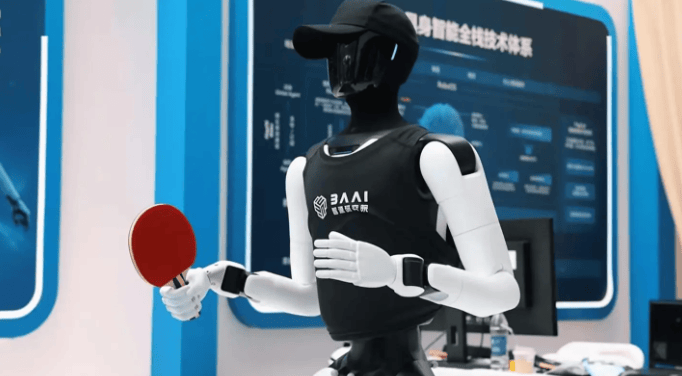
The difficulty of table tennis for humanoid robots lies in extremely short reaction times, rapidly changing trajectories, and a narrow window for striking the ball. The robot must not only clearly see the incoming ball but also predict its landing point, speed, and spin trend within milliseconds, while simultaneously coordinating its legs to maintain balance, its upper limbs to complete the swing, and its torso for posture adjustment. Unlike fixed robotic arms, a full-size bipedal humanoid robot must manage the relationship between its center of gravity, foot support, joint response, and the precision of its upper limb endpoint when striking. If the judgment of the racket contact point deviates significantly, the robot, even after completing the swing motion, will struggle to execute an effective return.
One of the key breakthroughs in this achievement is the humanoid robot table tennis motion control algorithm, SpikePingpong, jointly developed by Zhiyuan and the team of Professor Zhang Shanghang from Peking University. Designed for high-speed ball game scenarios, this algorithm integrates visual perception, ball trajectory prediction, strategic planning, and whole-body motion control, enabling the robot to generate real-time actions based on the state of the incoming ball, rather than executing a pre-written fixed script. For embodied intelligence, the value of such algorithms lies not in enabling the robot to "play a single shot," but in verifying whether the robot can continuously perceive, judge, correct, and act in a dynamic environment. The table tennis scenario provides a high-frequency, repeatable, and strongly feedback-driven testing environment, allowing for a concentrated evaluation of the robot's body control, perception system, and motion decision-making capabilities.
The vision system also determines the response ceiling of the Expedition A3. This time, Zhiyuan introduced the 20kHz high-frequency pulse camera developed by the team of Professor Huang Tiejun from Peking University, increasing the visual response speed by 10 times compared to traditional solutions and enabling millimeter-level pre-judgment of the racket contact point. Traditional vision solutions are often limited by frame rate, exposure, and motion blur in high-speed motion scenarios. When a table tennis ball is flying at high speed, ordinary cameras struggle to provide sufficiently timely trajectory information for the robot's control system. The high-frequency pulse camera captures motion changes with higher temporal resolution, providing the algorithm with more continuous and faster perceptual input, allowing the robot to prepare for the strike before the ball arrives.
This progress also indicates that humanoid robot research and development is shifting from single-action demonstrations to complex task validation. In the past, common demonstrations for humanoid robots included walking, jumping, carrying objects, shaking hands, and simple tool operations. While these actions showcase the robot's basic motion capabilities, their requirements for real-time response to environmental changes are relatively limited. Table tennis competition requires the robot to operate in a high-speed, non-deterministic, and continuously changing environment, which is closer to the dynamic interactions found in real-world tasks. In the future, for applications such as industrial inspection, warehouse logistics, home services, elderly care, and public service scenarios, robots will also need to handle moving targets, temporary obstacles, sudden changes, and human-environment interactions. Motion control and perception-decision capabilities will directly impact the effectiveness of deployment.
From a technological innovation perspective, the Expedition A3's autonomous table tennis play is not merely an entertainment showcase but a comprehensive test of the "eye, brain, body, and hand" coordination capabilities of a full-size bipedal robot. The SpikePingpong algorithm is responsible for converting perceptual results into strategies and actions, the high-frequency pulse camera improves the speed of visual input, and the robot body itself must translate control commands into coordinated joint movements and striking actions. If this set of capabilities continues to mature, related technologies could be transferred from ball game scenarios to tasks such as high-speed grasping, dynamic obstacle avoidance, precision assembly, and human-robot collaboration. As Chinese humanoid robot companies accelerate their shift from hardware launches to scenario validation, Zhiyuan's Expedition A3, by autonomously completing a table tennis match, provides a new engineering benchmark for the motion intelligence and real-time control capabilities of full-size humanoid robots.
This article is compiled by Wedoany. All AI citations must indicate the source as "Wedoany". If there is any infringement or other issues, please notify us promptly, and we will modify or delete it accordingly. Email: news@wedoany.com