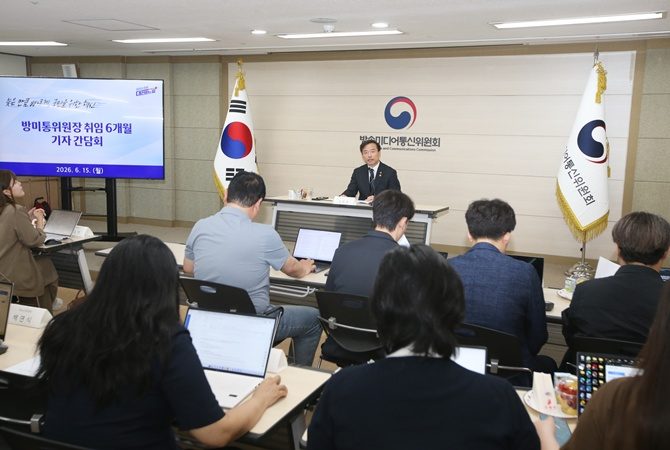
en.Wedoany.com Reported - Kim Jong-cheol, Chairman of the Korea Communications Commission (KCC), stated at a press conference marking his six months in office held on the 15th at the Government Complex in Gwacheon that he will decisively improve outdated and unreasonable systems such as broadcasting advertising and programming regulations to foster a healthy media environment.
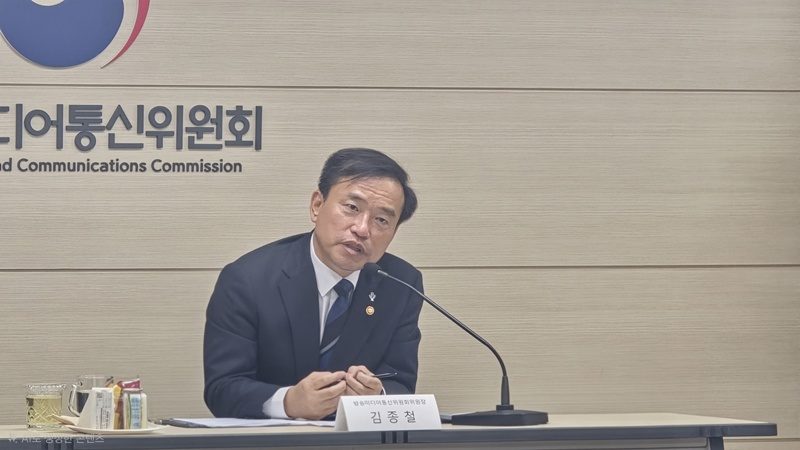
At the press conference, Chairman Kim emphasized the vision of a "Basic Media Society" and plans to establish the Media Development Committee (provisional name) under the Prime Minister in the second half of the year, repositioning the Korea Communications Commission as a policy agency encompassing both promotion and regulation. Chairman Kim stated that with an attitude of "better late than fast," the commission is focusing on resolving pending issues accumulated over the past two years, prioritizing the establishment of an operational system for stable commission functioning.
The Media Development Committee is a public-private consultative body promoted by the government as a national task. The lead agency, the Korea Communications Commission, along with the Ministry of Science and ICT and the Ministry of Culture, Sports and Tourism, will participate to integrate and manage media policy authority currently dispersed across various ministries. Chairman Kim noted that core topics for discussion at the Media Development Committee include financial resource plans in broadcasting, media, and telecommunications sectors, including the Broadcasting Development Fund. He emphasized that the Broadcasting Development Fund is rapidly depleting due to changes in the media environment, requiring comprehensive discussions on short-term, mid-term, long-term, and sector-specific customized improvement plans. Additionally, preparations for legal foundations such as the Comprehensive Media Act, innovation in advertising and programming regulations, and support plans for paid broadcasting will also be discussed.
The Basic Media Society refers to guaranteeing citizens' rights of access, use, and choice throughout the entire process of content, platforms, networks, and devices. To this end, the Korea Communications Commission is considering introducing a "voucher" system. Chairman Kim stated that this system is currently in the stage of review and research as a way to expand access to content and platforms. Regarding concerns that vouchers might flow to overseas platforms like Netflix, he added that even for overseas OTT services, if they are arbitrarily discriminated against, public policy itself could become a pretext for international trade disputes, and there is also a view that citizens can choose to watch both domestic and international high-quality content through vouchers.
The Korea Communications Commission also stated it will continue to push for the establishment of the Korea Broadcasting and Media Promotion Agency and the Transparency Center. The Korea Broadcasting and Media Promotion Agency is an institution that unifies promotion tasks in the broadcasting and media sectors. The partial amendment to the Framework Act on Broadcasting and Communications Development, which includes its establishment, passed the National Assembly's Science, Technology, Information, Broadcasting and Communications Committee on the 7th of last month. The Transparency Center is an institution established to quickly block illegal information that clearly harms society, such as drugs, gambling, and sexually exploitative materials. Its legal foundation has been established with the implementation of the amendment to the Information and Communications Network Act (Act on Eliminating False Manipulated Information). Additionally, the commission will promote the expansion of media and AI competency education by life cycle, planning to expand education including AI usage methods and prevention of side effects to all age groups.
At the press conference, Chairman Kim also mentioned the issue of fines related to Google's in-app payment. He stated that the part concerning in-app payments has entered the deliberation process and will be formalized soon. The predecessor of the Korea Communications Commission, the Korea Communications Commission, ruled in 2023 that Google and Apple violated the mandatory in-app payment prohibition law, announcing fines of 47.5 billion won and 20.5 billion won, respectively. In March 2025, the commission recalculated sales and formulated an adjustment plan: 42 billion won for Google and 21 billion won for Apple. Chairman Kim emphasized that pending issues are being handled based on three criteria—urgency, significance, and maturity of deliberation—and that the results of the Google in-app payment fine will soon be confirmed.
Regarding the issue of Coupang's hijacking advertisements, Chairman Kim stated that the problem involves not only hijacking advertisements but also restrictions on the right to cancel contracts. The Korea Communications Commission has completed fact-finding on the relevant parts and is preparing follow-up procedures. The commission is investigating whether this advertising execution method infringes on users' right to choose and whether, under Coupang's unified account system, the separate withdrawal of sub-services is restricted. However, Chairman Kim remained silent on the specific level of sanctions or the timing of votes for the two cases.
Chairman Kim also expressed his position on governance issues of public broadcasters resulting from the revision of the Broadcasting Act, such as the delay in forming the KBS Programming Committee. Currently, KBS has suspended the process of forming the Programming Committee due to a temporary injunction filed by the labor union. Chairman Kim emphasized that the delay in forming the Programming Committee is very regrettable and that it should be initiated as soon as possible in accordance with broadcasting laws and regulations. Regarding JTBC's liquidity crisis, Chairman Kim pointed out that it is currently assessed as a liquidity crisis level and has not immediately affected the broadcasting business itself. However, in the re-approval review delayed during the vacancy period of the Korea Communications Commission, financial and technical evaluations, as major items, could directly impact the assessment.
Chairman Kim briefly summarized the achievements of the Korea Communications Commission in the two months since the formation of its plenary session at the press conference that day. The commission handled a total of 98 agenda items, including 17 plenary sessions, and listed the selection of organizations recommending public broadcaster directors, the announcement of TV home shopping coexistence cooperation plans, and the completion of the revision of the enforcement decree of the Telecommunications Business Act as achievements.
This article is compiled by Wedoany. All AI citations must indicate the source as "Wedoany". If there is any infringement or other issues, please notify us promptly, and we will modify or delete it accordingly. Email: news@wedoany.com