en.Wedoany.com Reported - On June 15, 2026, local time in the United States, the 43rd International Bridge Conference (IBC) Awards Ceremony was held in Maryland, USA. The Nanjing Xinshengwei Yangtze River Bridge, designed by China Railway Major Bridge Reconnaissance & Design Institute, constructed by China Railway Major Bridge Engineering Group, and participated in by China Railway Industry, stood out from numerous global projects to win the 2026 Gustav Lindenthal Medal. Recognized as the "Nobel Prize" of the international bridge community, this award is granted to only one bridge worldwide each year. This honor signifies that the world-class ultra-long-span suspension bridge has received full-dimensional recognition from global authoritative judges in four aspects: engineering innovation, material breakthroughs, architectural aesthetics, and social benefits.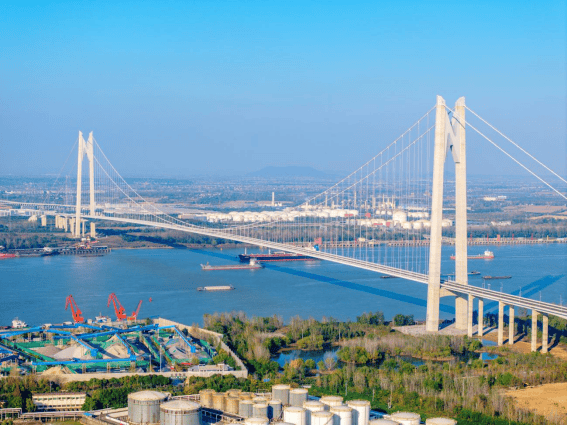
The Gustav Lindenthal Medal was established by the International Bridge Conference in 1999, with selection criteria centered on five core standards: cutting-edge technological innovation, new material development, landscape aesthetics, ecological adaptability, and public value. World-renowned landmark bridges such as the Golden Gate Bridge have previously received this honor. Review experts from this year's IBC organizing committee stated that the Xinshengwei Yangtze River Bridge has set new global standards for long-span suspension bridge construction through multiple original technological breakthroughs, achieving a deep integration of engineering strength and urban cultural aesthetics, making it a benchmark for contemporary ultra-long-span urban river-crossing bridges.
The Xinshengwei Yangtze River Bridge is a major landmark river-crossing project under Nanjing's "14th Five-Year Plan." Construction began in March 2020 and, after five years of intensive efforts, officially opened to traffic on November 26, 2025. The bridge has a total length of 13.17 kilometers, with the main bridge adopting a single-span integral steel box girder suspension bridge scheme with a main span of 1,760 meters. It features a two-way six-lane urban expressway standard with a design speed of 80 km/h. The bridge is the largest-span suspension bridge built in China and the third largest in the world. Its main tower stands 263.8 meters tall, the highest among existing bridges in Nanjing. After opening, the commuting time from Qixia Avenue to Jiangbei Avenue in Nanjing was reduced from one hour to 10 minutes, greatly improving Nanjing's expressway network and significantly promoting the integration of Nanjing, Zhenjiang, and Yangzhou, as well as the connectivity of the Yangtze River Delta.
The bridge achieved multiple original technological breakthroughs in design and construction. In the globally pioneering humanized wind resistance design system, the team first proposed design concepts for flow-around wind attack angles and damping reserves, effectively suppressing vortex-induced vibration under an ultra-low damping ratio of only 0.1% (national standard is 0.3%). They also pioneered a wind-vehicle-bridge coupling and human comfort vortex-induced vibration evaluation standard, achieving a dual-control model from "ensuring structural safety" to "safety plus driving comfort." In the field of suspension bridge fire resistance technology, the team built China's first multi-physics coupled fire quantitative analysis model, identified the high-temperature mechanical evolution law of 2,100 MPa ultra-high-strength steel wires, independently developed a composite fire-resistant material for main cables and an integrated fire-resistant and anti-corrosion protection system for steel components, and compiled the "Design Guidelines for Fire Resistance of Highway Bridge Cable Systems," filling an industry gap. Additionally, the team developed a three-in-one longitudinal restraint system comprising a 0.1-exponent viscous damper, a limiting device, and a central buckle, and successfully developed 2,100 MPa ultra-high-strength zinc-aluminum coated main cable steel wires, setting a new domestic record for main cable wire strength. In foundation design, the team innovatively introduced soil resistance indicators and proposed a new anchor foundation design method, achieving lightweight foundations with cost reduction and efficiency improvement. The main tower's upper crossbeam features a unique "N" shape, inspired by the first letter of "Nanjing" in Chinese pinyin, and is equipped with an intelligent RGBW dynamic lighting system at night, achieving a three-in-one integration of engineering function, regional culture, and urban landscape.
From the Yachi River Bridge to the Xinshengwei Yangtze River Bridge, Chinese bridges have successively won the Gustav Lindenthal Medal, vividly reflecting China's transition from "following and running alongside" to "leading globally" in bridge construction. This award further solidifies China's global leadership in the field of ultra-long-span suspension bridges, marking a milestone in China's modern transportation infrastructure and the localization of bridge technology.
This article is compiled by Wedoany. All AI citations must indicate the source as "Wedoany". If there is any infringement or other issues, please notify us promptly, and we will modify or delete it accordingly. Email: news@wedoany.com