en.Wedoany.com Reported - On June 17, China's artificial intelligence infrastructure and intelligent computing cloud company Jiuzhang Yunji unveiled its "AI Factory" core strategy in Beijing, proposing an intelligent scalable delivery system that uses DCU as the input metric and professional tokens as the output unit. This strategy aims to advance AI capabilities from single-point model development to an infrastructure operation model that is measurable, schedulable, and deliverable in batches.
Jiuzhang Yunji founder and chairman Fang Lei stated at the launch that competition in the AI industry is shifting from a single large model performance contest to a modern factory-style system building. What enterprises need is not just stronger models, but a system capable of low-cost, high-stability, scalable production and delivery of intelligent capabilities. Following this approach, the "AI Factory" quantitatively links computing power input and intelligent output, enabling enterprises to more clearly measure the input, output, and delivery efficiency of AI applications.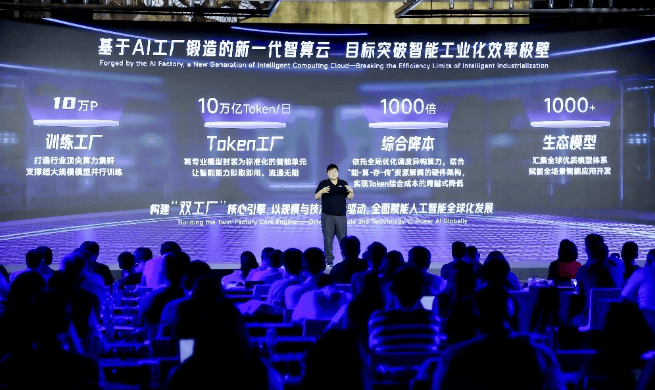
The "AI Factory" consists of two engines: the Training Factory and the Token Factory. The Training Factory uses reinforcement learning as its core technical path, transforming general intelligence into professional models adapted to multiple scenarios, solving the "from 0 to 1" R&D and manufacturing problem of intelligent capabilities. The Token Factory is responsible for packaging professional models into standardized, precisely measurable professional tokens, enabling the "from 1 to N" scalable delivery of intelligent capabilities across different business scenarios.
On the technology foundation side, Jiuzhang Yunji simultaneously launched the next-generation intelligent computing cloud Alaya NeW Cloud 3.0 based on this strategy. This platform is centered on the Training Factory and Token Factory, and supports model training, inference optimization, context management, resource scheduling, and energy consumption control through a full-stack intelligent computing foundation. Targeting the Agent-native era, the platform focuses on addressing issues such as low heterogeneous hardware collaboration efficiency, static scheduling resource waste, and passive energy efficiency management.
The launch also disclosed three strategic goals for Jiuzhang Yunji. The company plans to build a 100,000 P-scale intelligent computing cluster, aiming to achieve a daily token throughput capacity of 10 trillion, and relying on full-stack self-developed technology to achieve a thousand-fold comprehensive cost reduction. These goals target not just the expansion of computing power scale, but also the transformation of computing resources into sustainably deliverable intelligent capacity through engineering system optimization.
Jiuzhang Yunji emphasized that its core business is not simply selling intelligent computing hardware, but operating an industrial delivery system that converts computing power input into professional token output. The platform's value is primarily reflected in dimensions such as cluster comprehensive utilization rate, unit completion cost of customer tasks, and full-process measurability of DCU. For enterprise customers, this model can transform high fixed-asset computing power investments into more flexible and controllable operational intelligent service expenditures.
This launch also included the Intelligent Computing Open Plan. This plan revolves around a three-layer architecture of capability openness, resource openness, and ecosystem openness, linking chip, large model, server hardware, comprehensive energy, and industry application enterprises to jointly build an inclusive computing power industry ecosystem. Jiuzhang Yunji also showcased progress in its domestic and international computing power network layout. Domestically, it has completed intelligent computing center deployments in several core provinces and cities. Overseas, it has achieved node operations in Indonesia and continues to advance the construction of more regional nodes globally.
For Jiuzhang Yunji, the subsequent focus of the "AI Factory" strategy will be on computing cluster construction, Token Factory operational efficiency, customer scenario delivery, and ecosystem partner collaboration. Only when professional tokens can be stably generated, cost-effectively invoked, and continuously optimized in real business operations will this intelligent scalable delivery system truly transition from a strategic concept to a verifiable commercial operation phase.
This article is compiled by Wedoany. All AI citations must indicate the source as "Wedoany". If there is any infringement or other issues, please notify us promptly, and we will modify or delete it accordingly. Email: news@wedoany.com