en.Wedoany.com Reported - Cognex has launched the In-Sight 6900 vision controller, which leverages Nvidia Jetson technology to transform traditional image processors into AI engines capable of running complex neural networks directly at the edge without requiring an external PC. According to Brian Benoit, Director of Advanced Vision Products at Cognex, this integration enables multiple high-resolution AI models to run simultaneously without increasing cycle time, and the optimized Nvidia TensorRT integration synchronizes AI decisions with microsecond-level timing of high-speed production lines.
Cognex will demonstrate the product at Booth 3101 during the Automate show in Chicago from June 22 to 25.
Benoit stated that Cognex has been building AI-driven vision inspection capabilities for nearly a decade, including strategic acquisitions of ViDi Systems and Sualab. The integration of Nvidia Jetson is the next step in this process, enabling transformer-based model architectures to run within the In-Sight Vision Suite while simultaneously processing multiple complex neural networks. He emphasized that Cognex is not simply using Nvidia chips as components, but has built its own AI models, training tools, and deployment infrastructure on top of this computing platform.
The In-Sight 6900 supports Cognex's complete portfolio of industrial cameras, with resolutions ranging from 2.3 MP to 65 MP, covering both area scan and line scan configurations, and is compatible with C-mount and large-format lenses as well as specialized industrial lighting. The device uses the In-Sight Vision Suite software and enables cloud-based AI model development and deployment through OneVision. This cloud-to-edge architecture allows centralized training and management of AI models in the cloud, which are then deployed to edge devices for running inspections without requiring a cloud connection. OneVision supports advanced AI tool patterns such as Few-Sample Classification and Robust Segmentation.
![Cognex_IS_6900VC_with_Nvidia_(002)[56]_copy.jpeg](https://img.wedoany.com/2026/0618/20260618102344813.jpg)
Benoit noted that the modular, plug-and-play architecture of the In-Sight 6900, along with intelligent lighting, pre-matched optics, and native support for industrial protocols such as PROFINET, EtherNet/IP, and EtherCAT, helps reduce system deployment complexity. OneVision addresses scalability challenges through centralized model development. He cited examples where Essity compressed the inspection development process from over a year to one day using OneVision, and Schneider Electric achieved global model standardization through the solution, doubling throughput while reducing false rejects.
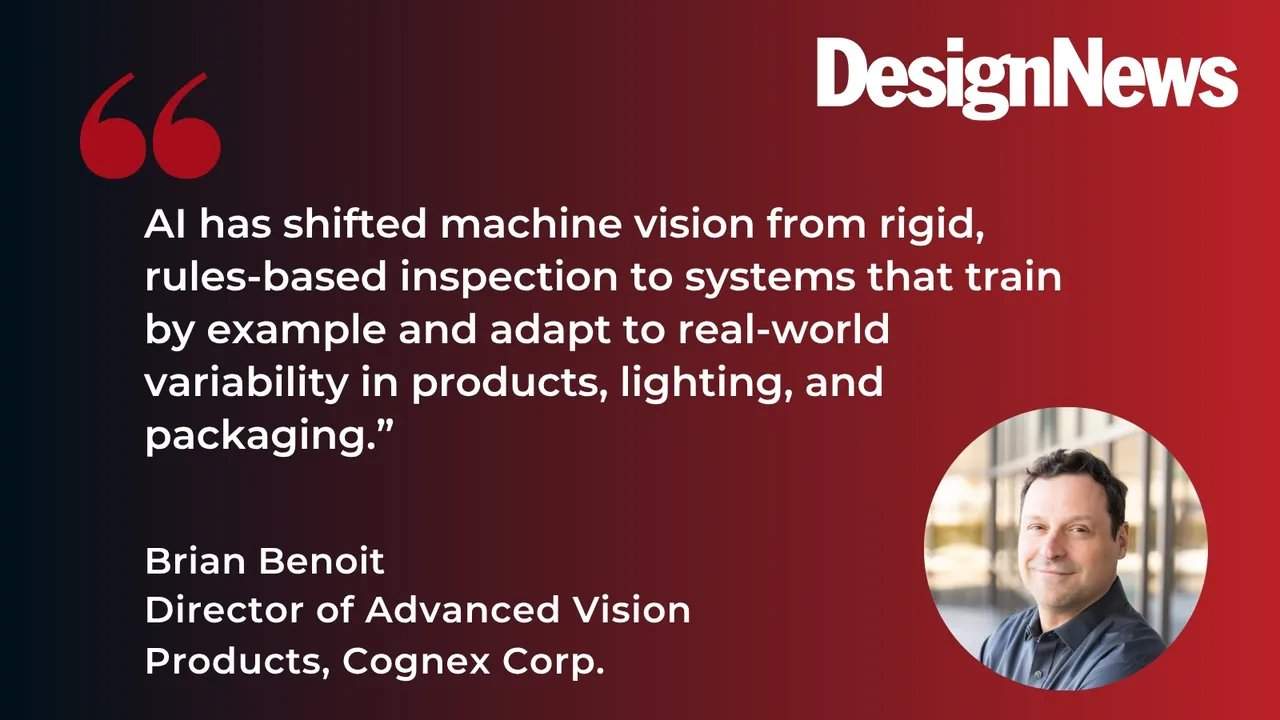
Benoit pointed out that AI has transformed machine vision from rule-based inspection into systems that learn from examples and adapt to real-world variations. Modern AI models can run on compact edge devices while maintaining accuracy exceeding 99.5%. He believes that future vision technology will go beyond defect detection toward continuous, plant-wide intelligence, where predictive quality systems can detect process drift before generating waste, and models will become more transferable. These capabilities will run directly at the edge without requiring deep expertise or significant infrastructure investment.
This article is compiled by Wedoany. All AI citations must indicate the source as "Wedoany". If there is any infringement or other issues, please notify us promptly, and we will modify or delete it accordingly. Email: news@wedoany.com