en.Wedoany.com Reported - According to Bloomberg Intelligence, to avoid EU tariffs of up to 45.3% on electric vehicles, Chinese automakers have no choice but to build factories in Europe. Setting up operations in Spain appears to be the path of least resistance. SAIC Motor announced this month that it will produce MG brand vehicles in the Galicia region of Spain. This brings the number of Chinese automakers planning or already building factories in Spain to four.

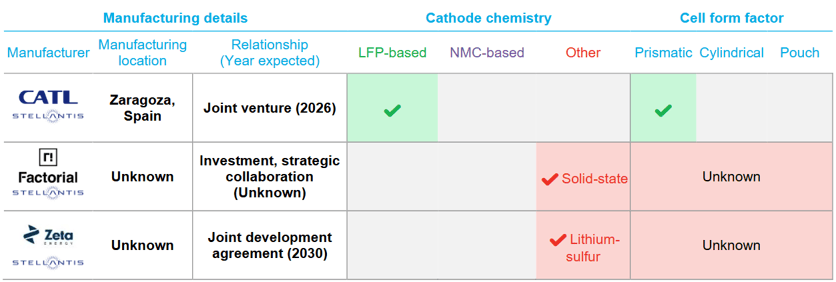
Battery giant CATL has partnered with Stellantis to build an LFP (lithium iron phosphate) battery plant in Spain. The total investment for the project is €4.1 billion, with a planned capacity of 50 GWh. The plant is located adjacent to Leapmotor's production base. Volkswagen's battery subsidiary PowerCo is also building a factory in Valencia with a planned capacity of up to 40 GWh, a similar scale.
Stellantis Battery Manufacturing Strategy Plan
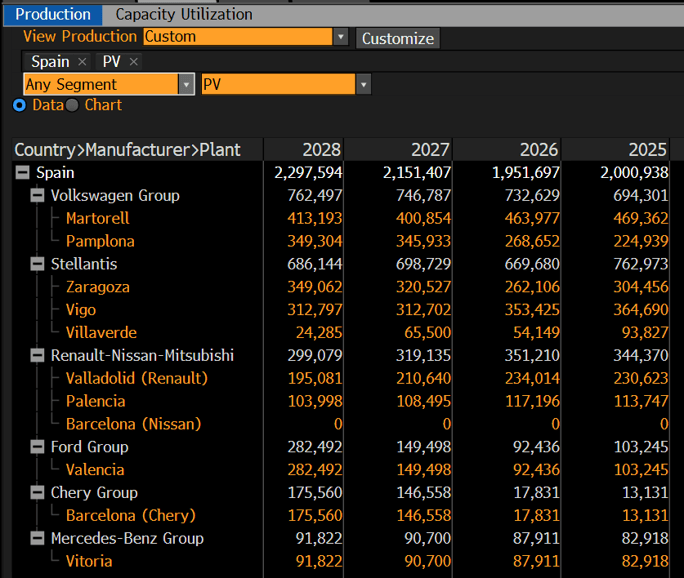
Spain's ability to attract massive automotive industry investment relies on two core policy pillars. The first is the PERTE VEC program, an EU initiative launched in 2021 to support zero-emission vehicle manufacturing. The second is the new Auto+ plan, officially implemented in early 2026, which provides instant subsidies to car buyers, with a maximum subsidy of €4,500 per vehicle. Additionally, Spain's domestic industrial scale offers significant advantages. It is the second-largest car producer in Europe, after Germany, and has long been a core manufacturing base for overseas automakers like Volkswagen and Ford. Coupled with the absence of a major domestic legacy automaker, the competitive environment is relatively relaxed, making Spain an ideal springboard for Chinese automakers entering Europe.
Bloomberg Terminal Shows Spain Passenger Vehicle Production Forecast
Global shipping giant COSCO announced this month that it will leverage its 50-year terminal concession at the Port of Tarragona in Catalonia, Spain, to handle the import and export of 300,000 vehicles annually. This move further solidifies Spain's position as a European automotive logistics hub.
Tracking Large European Car Carriers (Deadweight Tonnage > 15,000 Tons)
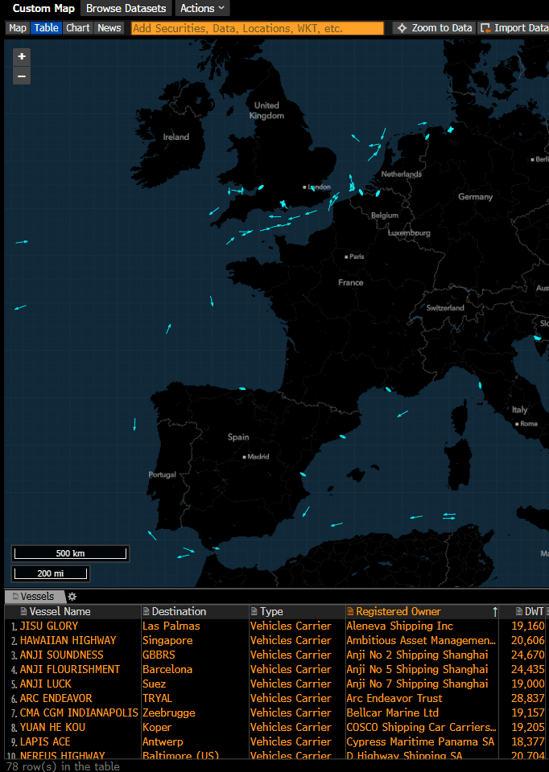
In recent years, Chinese shipping companies such as COSCO and China Merchants Group have been deepening their presence in the Southern European market, holding core terminal equity in Greece's Piraeus Port, Spain's Valencia Port and Bilbao Port, while also cooperating with major transit hubs like Slovenia's Port of Koper, which handles large volumes of cargo. Transshipping vehicles via Southern European ports can shorten shipping time by 4 to 7 days compared to traditional routes to Northern Europe, while also avoiding severe congestion at traditional European car import ports like those in Belgium and Germany.
Spain's aggressive push to attract Chinese automotive investment has drawn criticism from the European Commission and labor unions across Europe. Concerns are growing that Chinese automakers, which benefit from subsidies and state-backed systems, could gradually erode the overall competitiveness of the EU's automotive industry.
In response, the EU is rolling out a series of regulatory measures, including stringent battery localization requirements, comprehensive carbon footprint audits, mandatory data compliance rules, and the activation of the Foreign Subsidies Regulation (FSR) to conduct oversight and reviews of Chinese automaker factories within the EU.
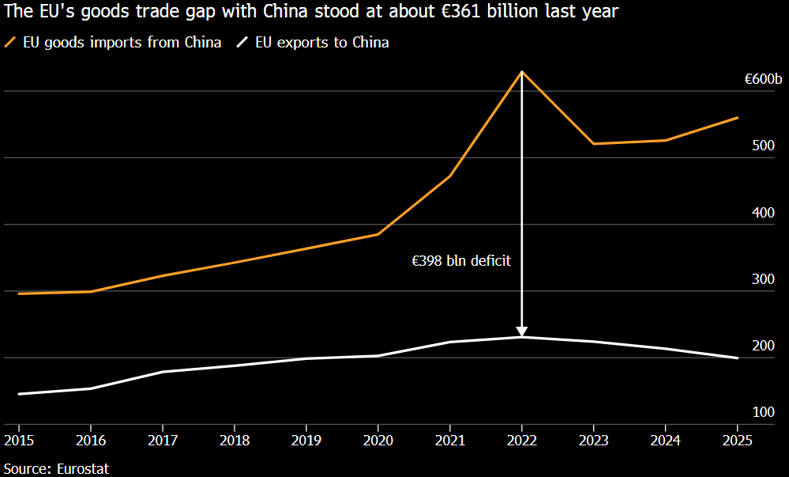
EU Trade Deficit Continues to Widen
This article is compiled by Wedoany. All AI citations must indicate the source as "Wedoany". If there is any infringement or other issues, please notify us promptly, and we will modify or delete it accordingly. Email: news@wedoany.com