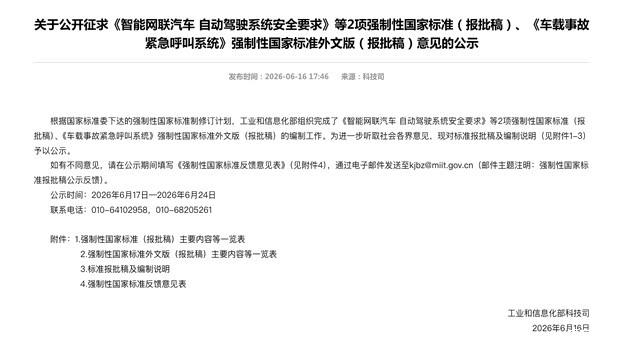
en.Wedoany.com Reported - The Ministry of Industry and Information Technology has completed the drafting of the mandatory national standard "Safety Requirements for Autonomous Driving Systems of Intelligent Connected Vehicles" (submitted for approval). The standard draft and its compilation notes were published for public comment from June 17 to 24, 2026, to further solicit opinions from all sectors of society.
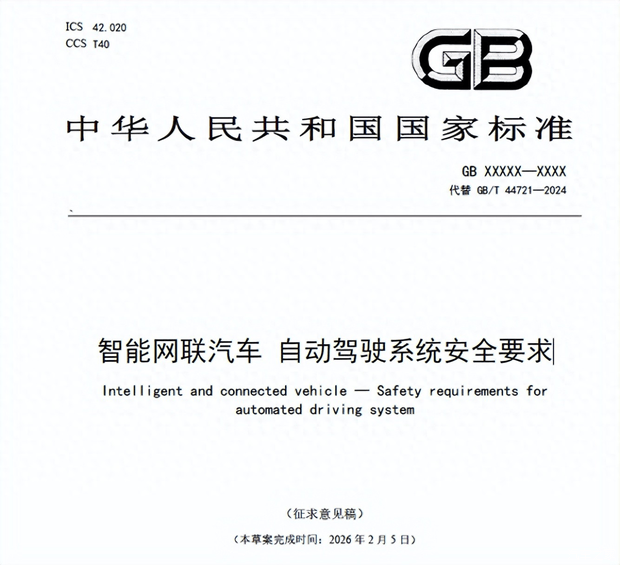
This standard revision covers the entire system, including adjusting the standard name and scope of application, adding complete safety case rules, vehicle inspection specifications, L3/L4 tier-specific technical appendices, and supporting transition period arrangements. The policy sets differentiated compliance grace periods: from July 1, 2027, newly declared vehicle models must fully comply with the new regulations; vehicles already type-approved and on sale have a 13-month transition period, after which, by 2028, L3/L4 vehicles that fail to meet the standards will be banned from market sales. The standard applies to M and N category passenger and commercial vehicles, excluding only Automated Parking Systems (APS). It primarily governs two levels: Conditional Automation (L3) and High Automation (L4), establishing a comprehensive safety constraint system covering vehicle hardware, algorithm strategies, enterprise full-process management, and experimental verification.
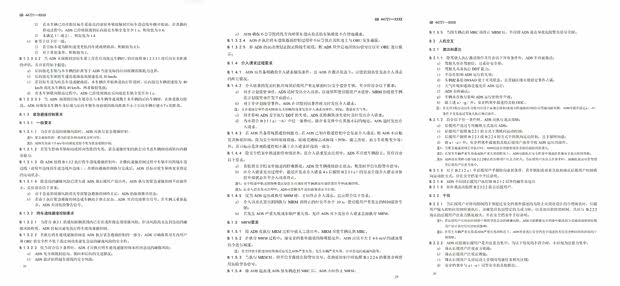
The institutional innovation of this national standard lies in introducing the internationally accepted Safety Case mechanism. The new regulations specify that all automakers launching L3/L4 models must compile a complete structured safety case, using a three-layer logic of "claim-argument-evidence" to demonstrate that the autonomous driving system poses no unreasonable safety risks. The safety case content includes vehicle-level hazard analysis, functional safety and safety of the intended functionality assessments, ODD (Operational Design Domain) boundary descriptions, fault response strategies, massive simulation, field, or road test raw data, human-machine interaction logic, and minimum risk condition solutions. Inspection agencies will verify the completeness of the case and the credibility of the tests item by item; models whose safety cases fail the review will not obtain market access qualifications.
The standard establishes a supporting Safety Management System (SMS), mandating automakers to implement risk control throughout the entire lifecycle of development, production, and post-market operation: requiring the use of professional analysis tools such as FMEA and STPA to identify vehicle hazards, conducting safety audits on supply chain sensor and controller suppliers; continuously collecting accident and failure data after vehicle launch, and re-completing safety verification before any OTA update. Additionally, all L3/L4 models are mandated to be equipped with a compliant Data Storage System for Autonomous Driving (DSSAD) to fully record the entire process of takeover, faults, and collisions, providing objective evidence for accident liability determination.
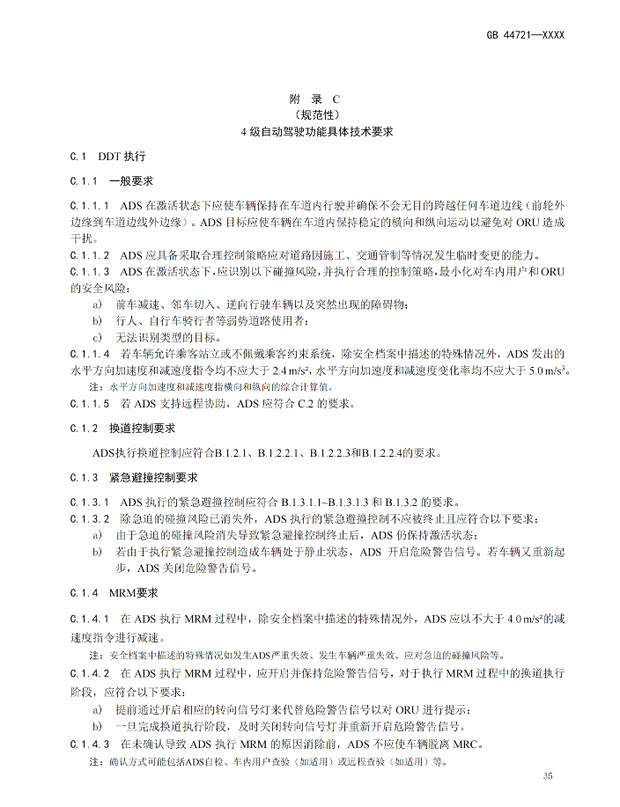
The standard establishes two different sets of technical specifications for L3 and L4 autonomous driving, clearly defining the division of responsibilities between the human driver and the vehicle system. In L3 mode, the driver is the legal fallback user; the system only takes over driving within a limited ODD. Once operating conditions are exceeded or a fault occurs, the system must immediately request human takeover. The takeover monitoring system is written into a normative appendix and is a mandatory baseline: continuously identifying the driver's seat occupancy, seatbelt status, and driving attention, using at least two independent indicators to determine if the driver is capable of taking over; if the driver is distracted, leaves the seat, or is not wearing a seatbelt, multi-level visual, audible, and tactile warnings are triggered sequentially; if focus is not regained within 15 seconds, the Minimum Risk Maneuver (MRM) is initiated; if takeover cannot be completed, the vehicle autonomously decelerates smoothly, activates hazard lights, changes lanes reasonably to stop in a safe roadside area, and the autonomous driving function is prohibited from reactivation until the vehicle's power system is restarted. In highway scenarios, L3 sets quantitative indicators for lane changes, collision avoidance, and perception distance. At a speed of 120 km/h, the minimum forward detection distance is 130 meters, and lane changes require sufficient rearward safety time gap. The core logic of L4 mode is that no human inside the vehicle is required as a fallback driver. Remote commands can only provide auxiliary information like route guidance. The vehicle must independently handle emergencies such as obstacles, system failures, or adverse weather without relying on remote control. Passengers can directly request the system to stop. For models without seatbelts or allowing passengers to stand, vehicle acceleration and deceleration are strictly limited. MRM capability requirements are more stringent; in case of failure, the vehicle should prioritize pulling into the emergency lane, and in extreme cases, come to a safe stop within its own lane.
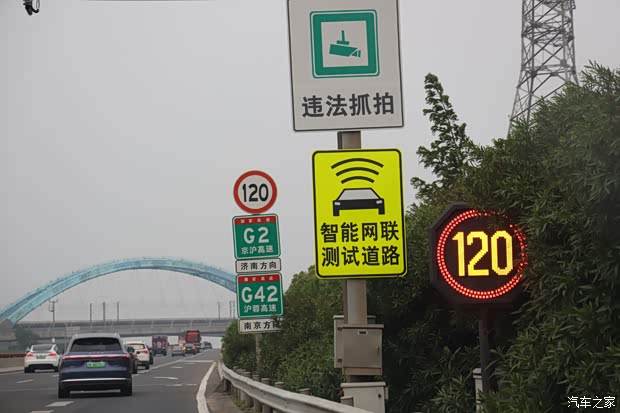
The full text of the submitted draft does not contain the term "LiDAR." The regulation does not specify specific sensor hardware types, only defining a unified mandatory perception threshold from a performance perspective. The vehicle perception system must laterally cover a range of 9 meters on each side of the vehicle body. The forward detection distance increases stepwise with vehicle speed, while fully identifying motor vehicles, pedestrians, non-motor vehicles, traffic signals, and emergency rescue vehicles, and actively yielding to police cars, ambulances, etc. The standard requires the system to have a perception degradation compensation mechanism to handle scenarios such as rain, fog, glare, and sensor soiling. A camera-only pure vision solution cannot meet the requirements for nighttime, low visibility, and long-distance obstacle recognition. Automakers need to incorporate ranging sensors like millimeter-wave radar or LiDAR to form heterogeneous redundancy. Automakers can freely choose hardware combinations such as LiDAR or 4D millimeter-wave radar, as long as the vehicle's overall perception, collision avoidance, and lane-changing performance meet the quantitative indicators of the national standard.
This article is compiled by Wedoany. All AI citations must indicate the source as "Wedoany". If there is any infringement or other issues, please notify us promptly, and we will modify or delete it accordingly. Email: news@wedoany.com
Related Products


Wheel and Track Technology Business
Beijing Research & Design Institute of Rubber Industry Co., Ltd.
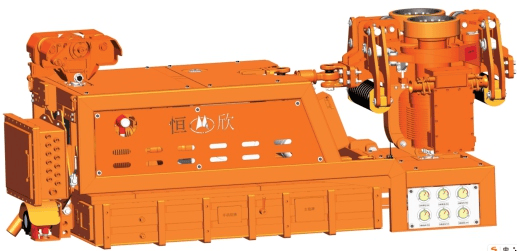
Explosion-proof lithium battery dispatching monorail crane locomotive (permanent magnet frequency conversion integrated machine)
Xiangtan Hengxin Industrial Co., Ltd.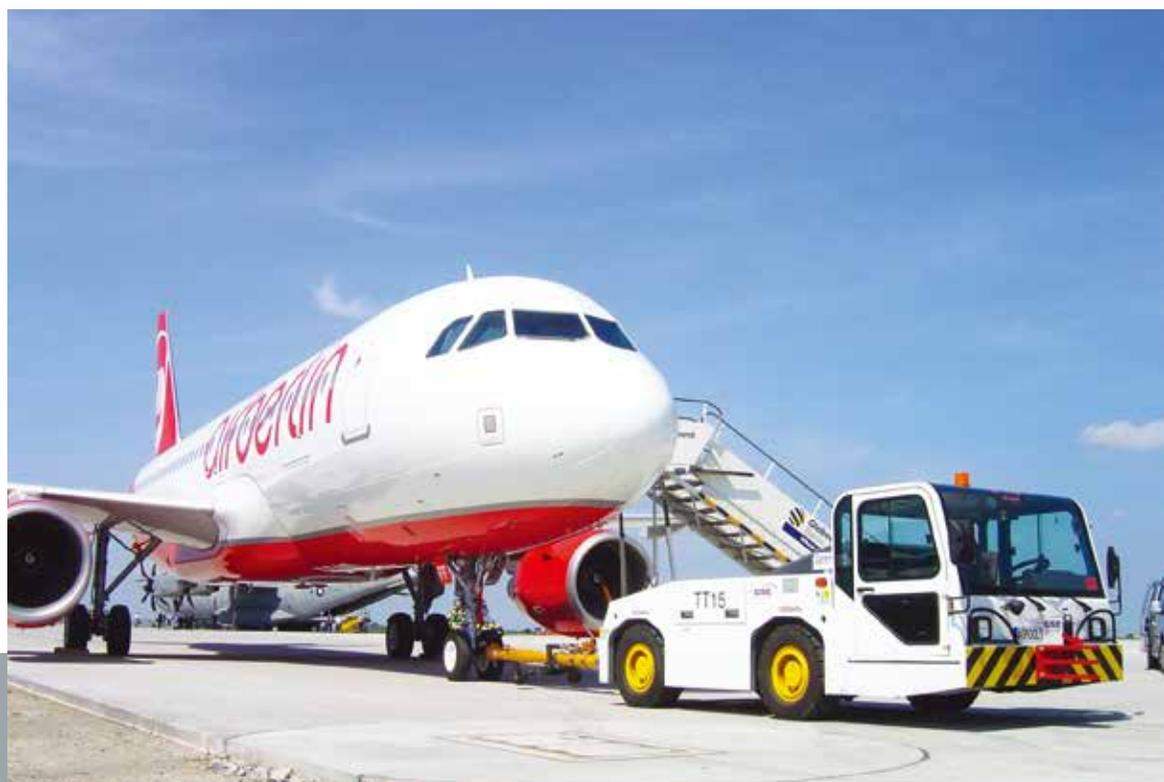
WGQY Series Aircraft Tow Tractor-WGQY15, WGQY27
Weihai Guangtai Airport Equipment Co., Ltd.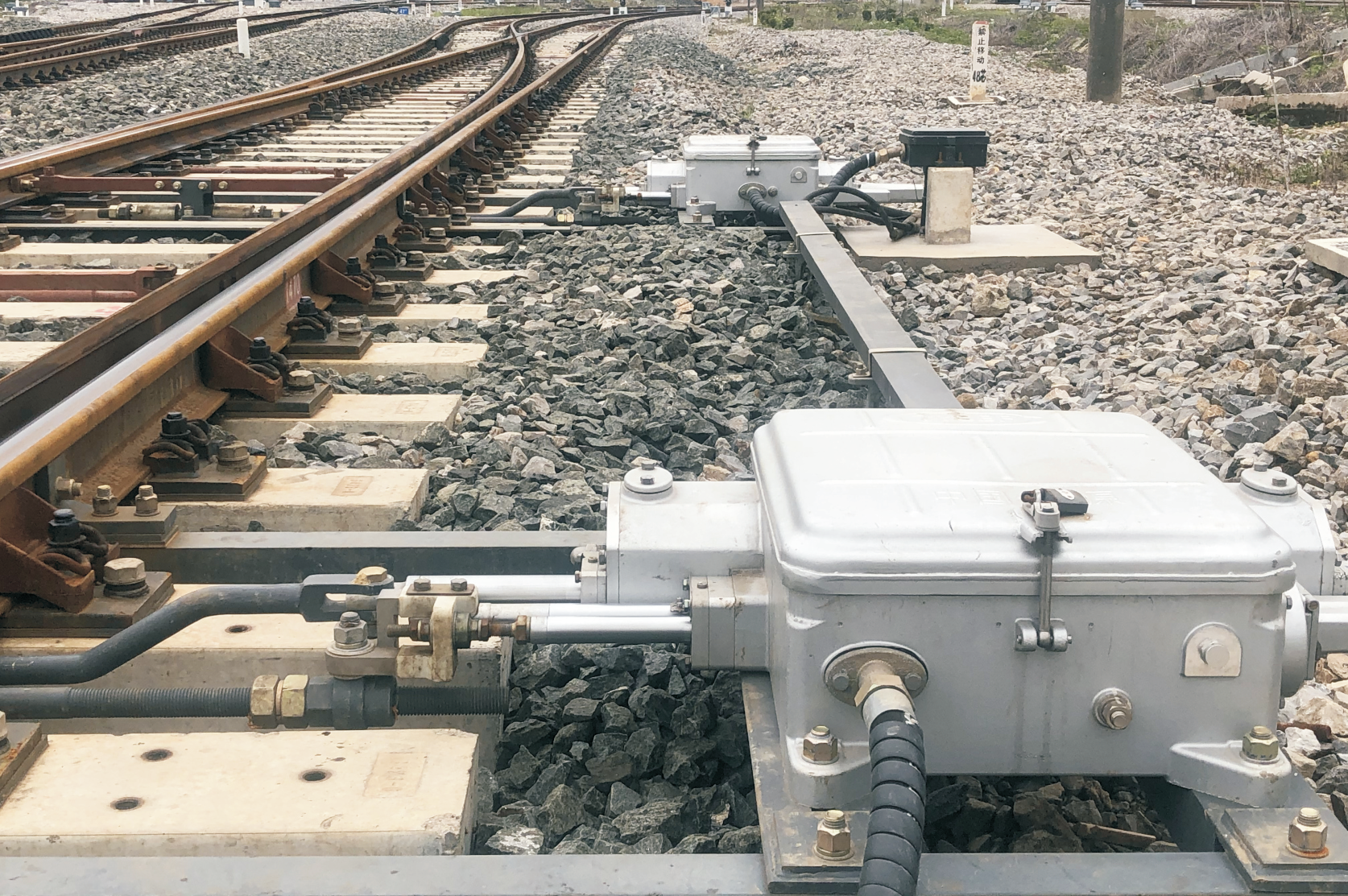
ZY(J)7(M) Sealed Type Electro-Hydraulic Turnout Machine
TAIYUAN CR JINGFENG EQUIPMENT TECHNOLOGY CO., LTD.
China - Alashankou/Khorgos - Europe Full Range Transportation (Mala/Hamburg/Duisburg/Budapest, etc.)
Shenzhen Neptune Logistics Co., Ltd.